Cost Guide · 2026
Injection Molding Cost: Price Per Part, Tooling and TCO
Injection molding cost is not one number. It is a one-time mold price plus a part price you pay on every order. As volume grows, the part price usually becomes the bigger number. This guide shows how to calculate injection molding cost per part, what moves it, the hidden costs most quotes leave out, and how to compare suppliers on total cost of ownership (TCO), not headline price.
Quick answer: molded parts usually cost from a few cents to a few dollars each, plus a one-time mold of about $1,500–80,000. Your part price is resin + press time + labor + scrap + amortized tooling. At high volume, cycle time and scrap decide who is really cheaper.
👉 Download the RFQ checklist · 👉 Upload your drawing for a cost estimate · 👉 Estimate your mold cost
How Much Does Injection Molding Cost?
Think about it in three layers:
- Tooling cost (one-time). Paid up front. It sets long-term stability: cycle time, scrap rate, maintenance and mold life.
- Part cost (recurring). Paid on every run. As volume grows, it usually becomes the biggest share of total spend.
- TCO (what really matters). TCO = tooling + part cost × volume + downtime + scrap + engineering change risk.
Four things raise total cost fastest once production starts:
- Cycle time drift. A cycle time that looks fine at trial can creep up in production through cooling imbalance, ejection issues or an unstable process window. Small increases get expensive at scale.
- Scrap and rework.Defects rarely show in the quote. They waste resin, press time, labor and inspection, and they delay deliveries.
- Oversized press tonnage. Poor gating or layout can force a bigger press, which raises the hourly rate.
- Maintenance downtime. Low-grade steel, weak heat treatment or overly complex actions mean more stoppages.
Buyer takeaway: if two suppliers quote similar part prices but one can prove stable cycle time, low scrap and predictable maintenance, that supplier usually delivers the lower TCO, even with a higher tooling price.
Get an Injection Molding Cost Estimate
Enter your part and volume below for a quick estimate. Treat it as a planning number. A firm quote needs your 3D file.
Injection Molding Cost Calculator
Estimate mold tooling cost and per-unit price for ABS, PC, PP, Nylon, POM plastic injection molded parts
INJECTION MOLDING COST CALCULATOR
Estimate mold tooling + unit price · Final quotation requires DFM review
How to Calculate Injection Molding Cost Per Part
Injection molding cost per part (also called cost per unit or piece price) is built from five pieces:
Resin + Press time + Scrap allowance + Amortized tooling + Packing / secondary ops
- Resin = (part weight + runner share) × resin price per kg.
- Press time = (cycle time ÷ cavities) × press hourly rate.
- Scrap allowance = (resin + press time) ÷ (1 − scrap rate), minus the original.
- Amortized tooling = mold price ÷ parts you expect to make on it.
- Packing and secondary ops = assembly, printing, bagging, labels.
Worked example: injection molding cost breakdown
Illustrative inputs, not our rates. Swap in your own numbers: a 40 g ABS housing, 2-cavity cold-runner tool (8 g runner per shot), ABS at $2.00/kg, 30-second cycle, press at $20/hour, 2% scrap, a $12,000 mold amortized over 100,000 parts, and $0.01 packing.
| Cost element | Calculation | Cost per part |
|---|---|---|
| Resin | (40 g + 4 g runner) × $2.00/kg | $0.088 |
| Press time | (30 s ÷ 2) × $20/h | $0.083 |
| Scrap allowance | 2% on resin + press time | $0.004 |
| Amortized tooling | $12,000 ÷ 100,000 parts | $0.120 |
| Packing | Bag and carton | $0.010 |
| Total | $0.305 |
Notice the tooling line. At 100,000 parts it is the biggest single cost. Spread the same mold over 1,000,000 parts and it drops to $0.012, taking the total to about $0.197. That is why volume decides the mold, and the mold decides the part price.
Want to run your own numbers? Use our piece-price calculator and cycle time calculator.
Plastic Injection Molding Cost Per Part: Key Drivers
Part cost is recurring. Over a program’s life it often exceeds the mold price, and small inefficiencies compound with every shot.
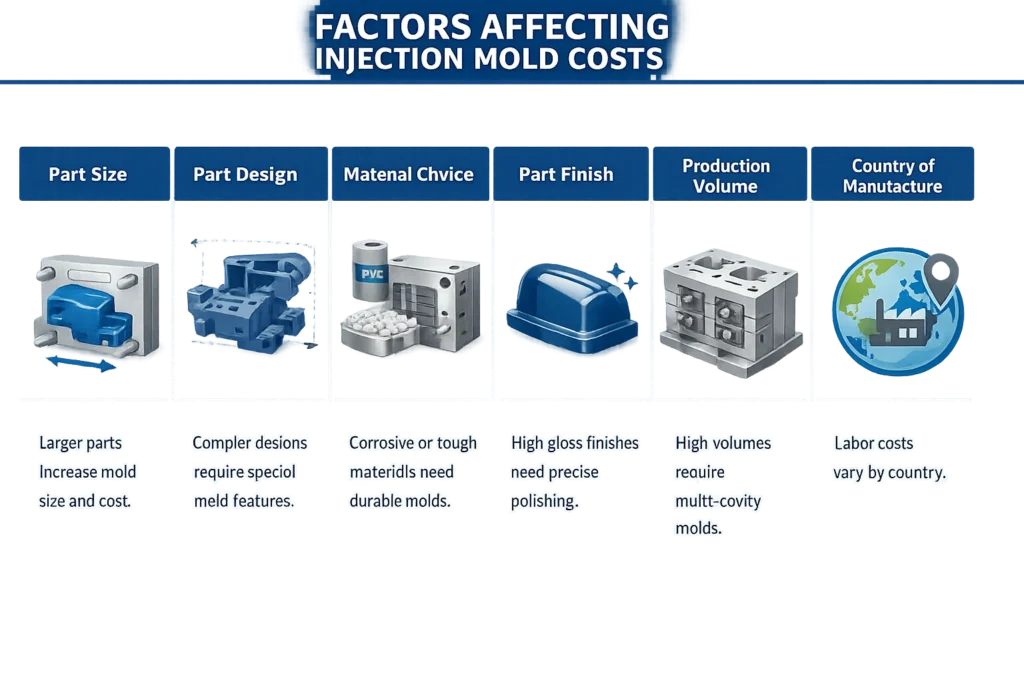
- Material type and weight. Resin price, density and part weight set the material line. Cutting wall thickness or removing excess mass lowers it for the whole program.
- Cycle time. It sets how many parts a press makes per hour. One or two extra seconds add up fast over hundreds of thousands of shots.
- Press size. Bigger presses cost more per hour. A poor layout can force an oversized press without adding any value.
- Labor and automation. Manual loading, trimming or inspection adds cost and variation. Automation lowers unit cost at scale, but needs planning up front.
- Scrap rate. Unstable processing, poor cooling or uneven ejection create rejects. Scrap is an invisible cost that compounds at volume.
- Cavity count. More cavities divide press time across more parts. The mold costs more, but each part costs less.
Critical insight: a cheaper mold can cut tooling cost, but if it brings longer cycles, more scrap or unstable runs, it makes more expensive parts for years.
Tooling Cost in Brief
Mold cost is a one-time investment, typically $1,500–80,000 depending on part size, cavity count, steel and side actions. It is paid once, but it sets your cycle time, scrap rate and maintenance for the life of the program. A lower tooling quote often hides lighter steel, weaker cooling or skipped validation. For price bands, a cost breakdown and a free estimator, read our full injection mold cost guide.
Total Cost of Ownership (TCO) in Injection Molding
Judging on tooling price or part price alone is misleading. The real number is TCO: the total cost of producing the part over its whole life.
Here is the same worked example, compared across two suppliers at 1,000,000 parts:
| Supplier A | Supplier B | |
|---|---|---|
| Mold price | $10,000 | $12,000 |
| Cycle time | 32 s | 30 s |
| Scrap rate | 3% | 2% |
| Cost per part | $0.202 | $0.197 |
| Total over 1,000,000 parts | ≈ $202,400 | ≈ $196,800 |
Supplier A looks $2,000 cheaper on day one. Two extra seconds and one extra point of scrap cost about $5,500 more over the run. Supplier B wins, and the gap grows with volume.
What TCO includes
- Tooling cost: mold design, steel, machining and validation.
- Recurring part cost: resin, cycle time, press rate, labor and scrap on every run.
- Operational losses: downtime, rework, process tweaks and frequent maintenance.
- Risk: late deliveries, quality swings and supply interruptions that never show in a quote.
Why TCO matters more than unit price
A mold that costs a little more up front often gives a shorter, steadier cycle, lower scrap, a smaller press and predictable long-term cost. A cheap mold without proper cooling, steel or validation can inflate cost year after year. The cheapest quote rarely produces the lowest total cost.
How to Compare Supplier Quotes Using TCO
Do not ask “who is cheapest?”. Ask “who is most predictable?“. Use this checklist:
- Is cycle time validated with a trial report, a stable window and balanced cooling?
- What scrap rate is expected in mass production?
- What mold life, in shots, is the tool built for?
- What validation is included: samples, dimensional reports, PPAP-style documents?
- What are the maintenance plan, spare parts, lead times and warranty scope?
Tip: if a supplier cannot explain cycle time, scrap rate and mold life clearly, the quote is incomplete.
China Injection Molding Cost: Landed, Not Ex-Works
A China quote is usually ex-works or FOB. Your real part cost is landed: part price plus freight, insurance, duty, broker and port fees. On light, high-value parts, freight is small. On bulky, low-value parts, it can rival the part price itself.
- Check the correct HS code. Molds and molded parts are classified differently; see HS 8480.71 vs 3926.90.
- Duty and extra tariffs change. Check current rates with your customs broker before you compare suppliers.
- Model it with the landed-cost tool on our interactive molding tools page.
- For the wider picture, read how to manage costs when buying from China.
For a full worked example with freight, duty and inspection added line by line, see buying injection molding from China: landed cost and terms.
Injection Molding Cost Reduction Ideas
Most part-cost savings come from design and process, not from squeezing the supplier.
- Cut cycle time. Cooling is usually the biggest share of the cycle. Thinner, uniform walls and well-placed cooling lines shorten it.
- Choose resin strategically. Pick the cheapest grade that meets the spec. Ask whether regrind or recycled content is acceptable.
- Use fillers where strength is not critical. Mineral fillers such as calcium carbonate or talc can cut material cost and add stiffness.
- Right-size cavities. More cavities spread press time over more parts. Match the count to your real annual volume.
- Automate repetitive steps. Robot take-out, auto-degating and in-line inspection cut labor and variation.
- Simplify the part. Fewer undercuts mean fewer actions, shorter cycles and less maintenance.
- Drive scrap down. A validated process window and early defect detection protect every lot.
- Use soft tooling for short runs. Below about 1,000 parts, an aluminum or bridge tool is often cheaper overall. See low volume injection molding.
For a deep dive, read our guide to reducing total part cost.
What We Need for an Accurate Injection Molding Quote
A reliable quote needs more than a part size or a photo. These inputs let us estimate tooling, cycle time, scrap risk and stability, so you can compare suppliers on TCO. See also how we prepare a quotation.
- 3D file (STEP or IGES) plus a 2D drawing. Show critical dimensions, datums and functional fits. A marked-up PDF works if you have no full drawing yet.
- Material, color and additives. GF, FR rating, UV. Share a preferred brand and grade if you have one, such as SABIC, DuPont or RTP Company.
- Annual volume and program life. These set cavity count, steel, hot runner and automation choices.
- Tolerance zones and cosmetic faces. Mark where appearance matters and where it does not.
- Assembly needs. Inserts, welding, screws, heat staking or other post-molding steps.
- Packaging, labeling and inspection standards. FAI, CPK targets or PPAP-style reports, stated up front.
Optional but useful: target delivery date, sample quantity, existing part or mold problems, and the operating environment (heat, UV, chemicals). Check MOQ and lead time logic before you set a schedule.
Cost Hub Reading Map
Use this map to go deeper. A-level pages build your cost model, B-level pages explain why quotes differ, and C-level covers China sourcing.
A-Level (Core Cost Model)
Injection Mold Cost Guide
Price bands, cost breakdown and a free mold cost estimator.
Factors for Accurate Injection Molding Pricing
Standardize inputs so supplier quotes become comparable.
Getting an Accurate China Injection Molding Quote
Reduce re-quoting and hidden scope gaps.
Mold Quotation Sheet
A line-item mold quote sheet for engineers preparing quotations.
Injection Molding Piece-Price Calculator
Turn process assumptions into a benchmark unit price.
Injection Molding Cycle Calculator
Cycle time is a hidden multiplier at high volume.
Tip: only have 10 minutes? Read A1 → A2 → A5.
B-Level (Why Quotes Differ)
C-Level (China Sourcing Context)
Frequently Asked Questions
How much does plastic injection molding cost?
There are two costs. The mold is a one-time cost, usually $1,500–80,000. Each molded part then costs from a few cents to a few dollars, depending on resin, part weight, cycle time, cavity count and volume. Send a 3D file for a firm number.
How do I calculate injection molding cost per part?
Add resin cost (part weight plus runner share × price per kg), press time (cycle time ÷ cavities × hourly rate), a scrap allowance, amortized tooling (mold price ÷ expected parts) and packing or secondary operations. Volume has the biggest effect, because it spreads the mold cost.
What are the biggest drivers of injection molding part cost?
Material consumption, cycle time, press size and hourly rate, labor and automation level, and scrap rate. In high-volume programs, small differences in cycle time and scrap create the largest long-run cost gaps between suppliers.
How does annual volume change the best mold and pricing strategy?
Volume sets cavity count, steel grade, hot or cold runner, and automation. At higher volumes the recurring part cost dominates, so optimizing cycle time and stability beats chasing a cheaper mold quote.
Is tooling cost really one-time?
It is paid once, but it shapes long-term cost. Steel, cooling, venting and ejection design decide cycle time stability, scrap, downtime and mold life, which all feed into total cost of ownership.
How do you validate cycle time and process stability?
Through trial runs with a stable process window, balanced cooling and repeatability checks across many shots. A capable supplier can explain what limits the cycle (cooling, ejection, material or gating) and share trial records.
What scrap rate should buyers expect in stable production?
It depends on geometry, material, cosmetic standard and process stability. The supplier should state a target scrap rate, name the main risks such as cooling imbalance, venting, ejection warpage or dimensional drift, and explain how each is controlled.
Hot runner vs cold runner: how does it affect total cost?
A hot runner raises tooling cost but cuts resin waste and steadies the cycle, which lowers piece price at high volume. A cold runner is cheaper up front but wastes more resin and may need trimming labor.
Is injection molding in China cheaper once freight and duty are added?
Often, yes, especially for tooling and for parts with real volume. Compare landed cost, not ex-works price: add freight, insurance, duty, broker and port fees. Bulky, low-value parts narrow the gap the most.
Get a Line-Itemed Part and Tooling Quote
Send your 3D file, annual volume and resin. We return a free DFM review with tooling cost, cycle time, scrap assumptions and unit price spelled out, so you can compare on TCO.
Request a Free Quote →