





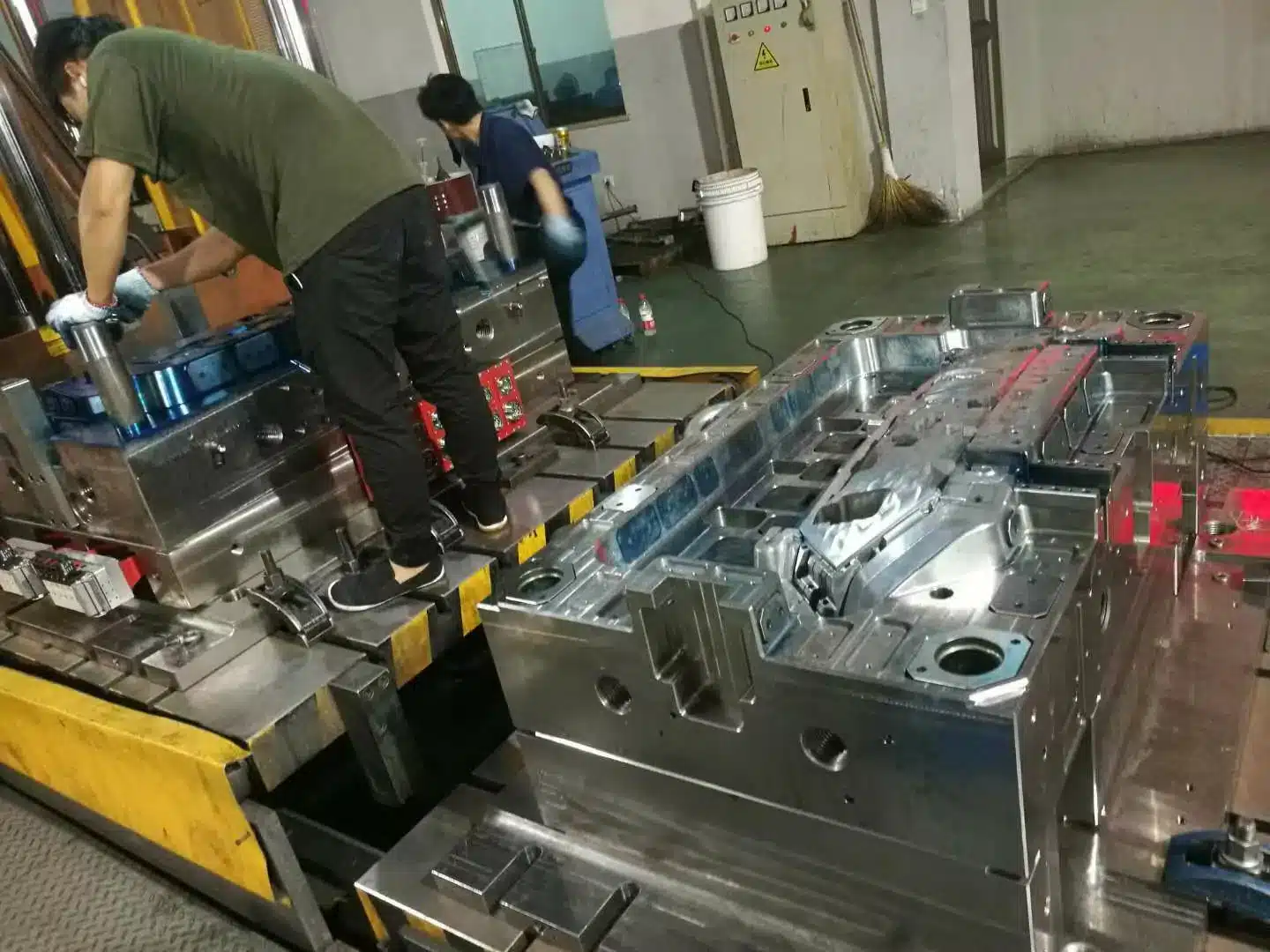

“I Need a Mold” or “I just have an image” Is a Good Start — But Not Enough for an Accurate Quote
If you are new to injection molding, this is completely normal. Many buyers begin with one sentence: “I need a mold.” The goal of this guide is not to make things complicated — it is to show what details help us quote faster, more accurately, and with fewer surprises.
Why a Mold Quote Needs Details
When someone asks, “How much is a mold?” it sounds like a simple question. But a mold is not a standard product sitting on a shelf. It is custom-built around one exact part, one material, one production plan, and one set of quality requirements.
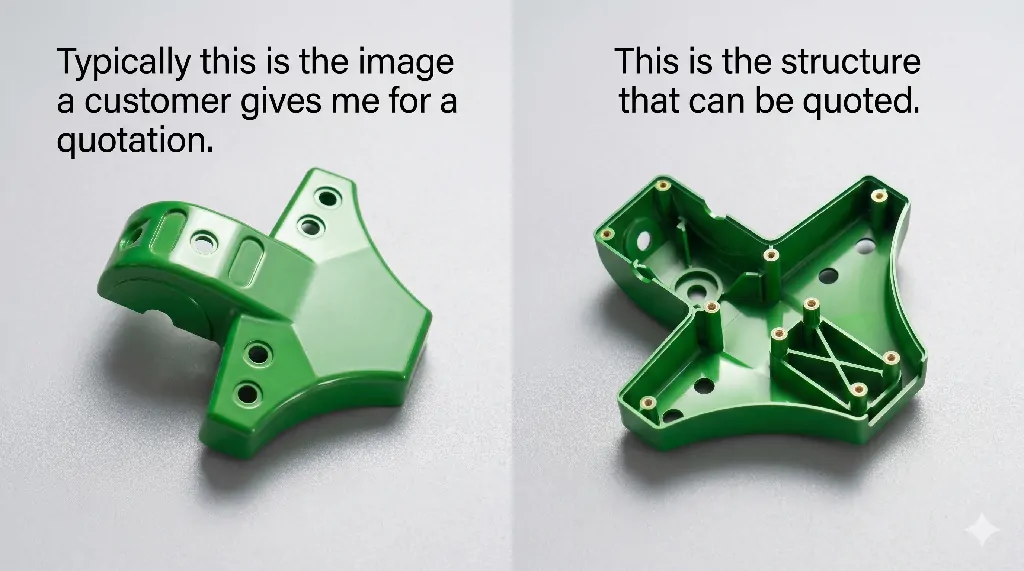
Asking for a mold price with only a photo is like asking a tailor: “How much to make a suit?” The tailor still needs your measurements, fabric choice, style, lining, buttons, and when you need it. A photo can show the look, but it cannot show the construction. A plastic part works the same way.
The Visible Part Is Only the Beginning
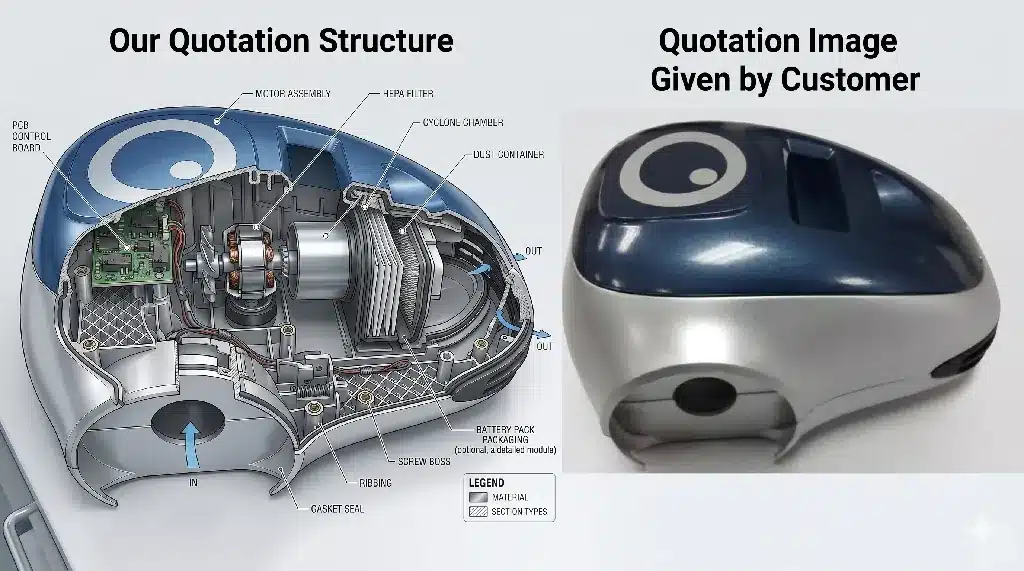
A photo is useful, but it is only the top of the iceberg. The details under the surface are what determine mold structure, machining time, steel choice, cycle time, and final cost.
A Rough Budget Is Possible. A Firm Quote Needs a Complete Picture.
We can often give a very rough budget range from photos, samples, or early sketches. But a detailed quotation needs enough information to calculate the mold structure, machining process, material usage, production cycle, and risk.
+
Steel & Machining
+
Material × Qty
+
Finish & Testing
If you call a pizza shop and only say, “I want pizza,” they cannot give the final price. They need size, crust, toppings, quantity, and delivery address. A mold quote is similar: the more clearly we understand the order, the more accurately we can price it.
Why One Small Side Hole Can Change the Mold Price
To a new buyer, a side hole may look like a small detail. To a mold maker, it can change the mold from a simple open-and-close tool into a more complex tool with moving side actions.
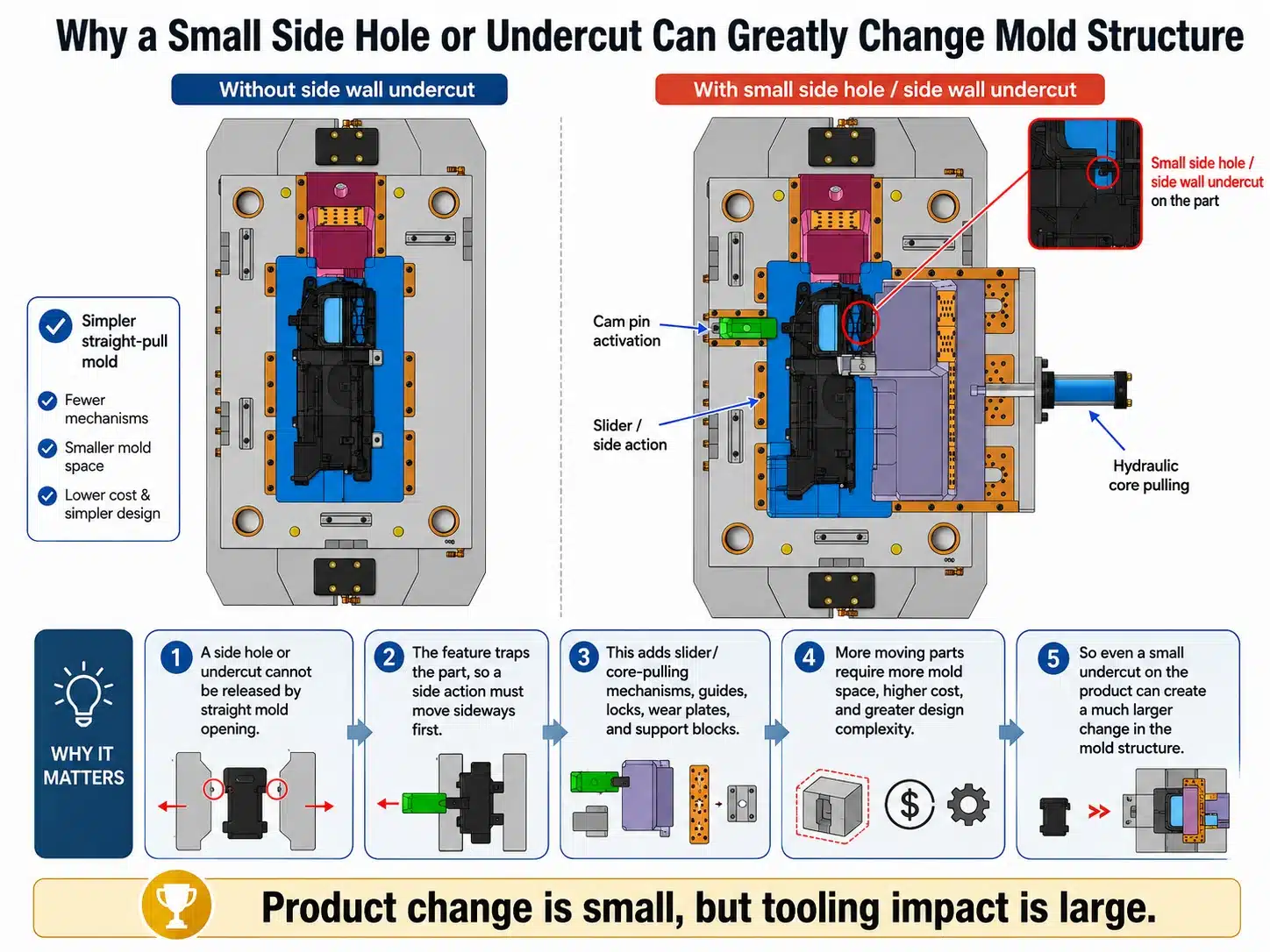
A basic injection mold opens in one direction. The two mold halves separate, and the part is pushed out. This is usually the simplest and most cost-effective structure.
But when a part has a hole, clip, hook, or groove on the side, the molded part may be locked onto the steel. The mold needs an extra moving component called a slider, side-action, or lifter. This part moves sideways before the main mold opens, so the plastic part can be released safely.
That is why we ask for CAD files and design details early. We can check the part before steel is cut, explain what increases cost, and suggest simpler design options when possible. Get a free DFM review →
What a Slider Adds
Before finalizing the part, ask: “Can this side hole move to the top or bottom?” or “Can this hole be drilled after molding instead?” Sometimes one small design adjustment can make the mold simpler, faster, and less expensive.
How to Help Us Give You a Real Quote
You do not need to be a molding expert. Just provide as much of the information below as possible. If something is unknown, tell us — we can guide you step by step.
Share a 3D CAD File If You Have One
A 3D CAD file is the digital blueprint of your part. It shows exact size, wall thickness, holes, curves, ribs, and hidden features.
Best formats: STEP (.stp) or IGES (.igs). STL is better for 3D printing, but usually not enough for mold quoting.
No CAD yet? Send photos, sketches, or samples first — we can still advise the next step.
Tell Us the Material or How the Part Will Be Used
If you do not know the plastic name, describe the job of the part: indoor or outdoor, flexible or rigid, food contact or not, heat resistance, strength, appearance, and safety needs.
| If your part needs to… | Common Material Direction |
|---|---|
| Be low-cost and general-purpose | PP or PE |
| Look good and feel rigid | ABS |
| Handle heat, wear, or strength | PA, PC, POM, or reinforced materials |
Give an Estimated Quantity
Quantity affects the mold plan. A small test run, a first production order, and a long-term mass-production project may need different mold steel, cavity number, and automation level.
Useful numbers: first order quantity, annual quantity, and expected product life.
Explain Appearance and Quality Requirements
Tell us if the part needs a glossy surface, matte texture, high transparency, tight fit with another part, logo, painting, plating, or special packaging.
These details affect polishing, texture, mold steel, inspection, and post-processing cost.
Share the Project Goal
Are you checking feasibility, comparing suppliers, preparing a prototype, or ready for production? A clear goal helps us respond with the right level of detail.
Best message to send: “Here is my part file/photo. I need about ___ pieces per year. The part is used for ___. I need the mold cost, unit price, lead time, and any design suggestions.”
The Golden Rule
A short message can start the conversation, but details create the quote.
Send what you have today — CAD, drawing, sample, photo, quantity, or even a rough idea — and we will help turn it into a clear quotation path.

