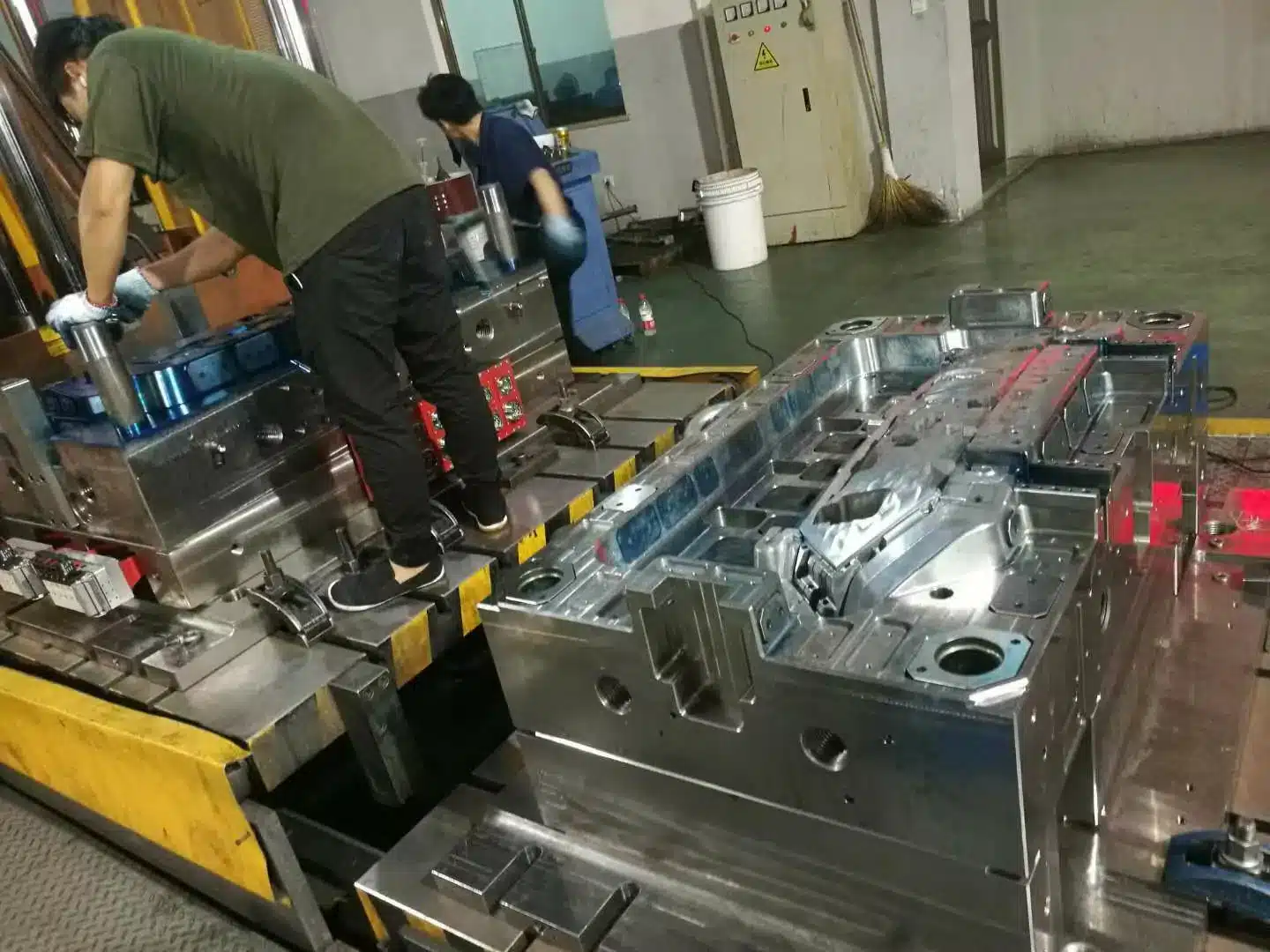

A PET preform mould looks dead simple. Molten PET goes in. Preforms come out. That simplicity is a trap. Cavity count sets your output. Steel grade sets how long the tool lasts. Neck finish decides whether the cap actually fits. Cooling decides whether you earn money per hour or babysit a slow machine.
Quoting your first PET preform mould? Wondering why one supplier asks double another? Here’s the mistake. Don’t rank moulds by cavity count and price alone. That’s how buyers end up with a shiny tool that runs slow and flashes early. One spelling note. “Mould” is British and international. “Mold” is American. Same tool.
A PET preform mould is a precision injection tool that shapes molten PET into a threaded, test-tube-shaped preform — later reheated and stretch-blown into the finished bottle. Cavity counts run 4 to 144, sized to real demand rather than the biggest number on offer. Cavities and cores typically use S136 steel (48–52 HRC) or NAK80 (38–42 HRC) for mirror polish and corrosion resistance, with H13 at the hot runner interface and P20/2738 for structural plates. Valve-gate hot runners avoid stringing; cooling — which eats 50–70% of cycle time — should hold inlet-to-outlet ΔT at 2–4°C, never above 5°C. Neck finish (PCO1881/1810, 28/38/48mm) must match the cap and filler exactly. A well-built mould is rated for 1 million+ cycles.
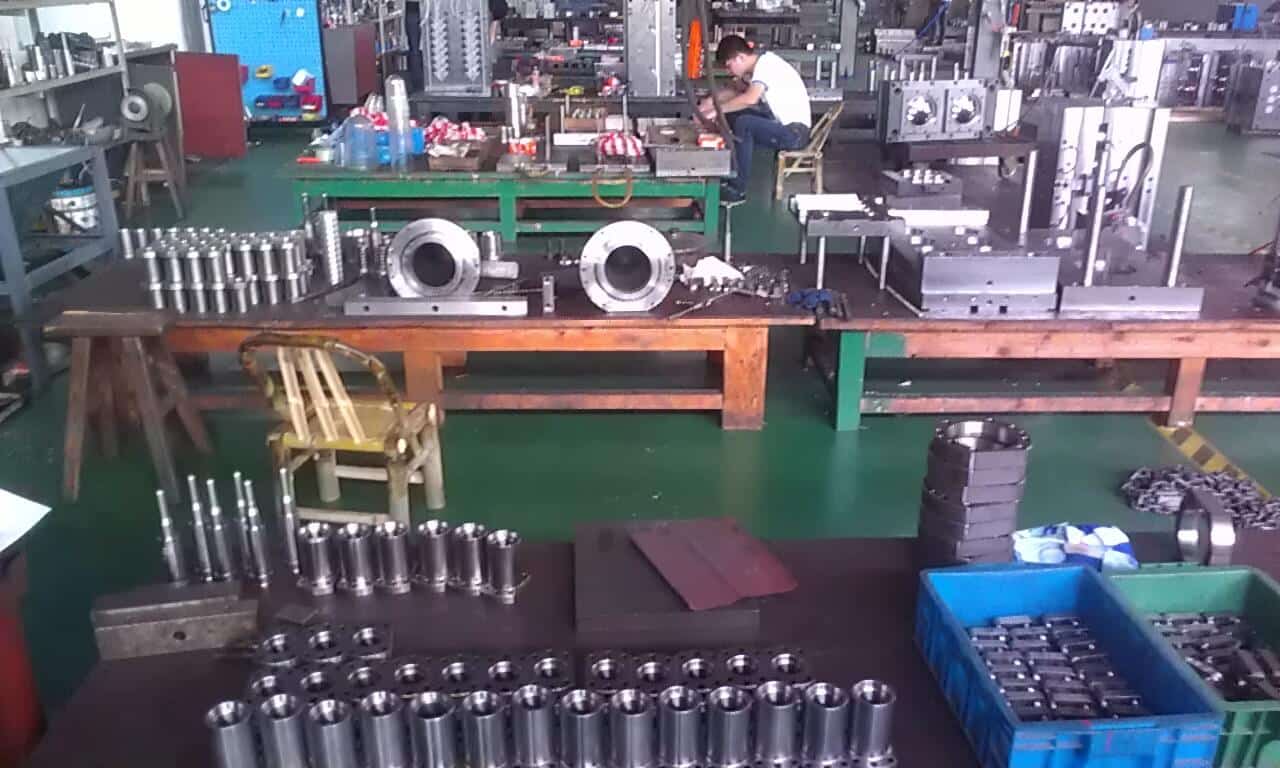
What Is a PET Preform Mould?
A PET preform mould is a precision injection tool. It turns molten PET — polyethylene terephthalate — into preforms. Preforms are short, thick-walled, test-tube-shaped parts with a finished threaded neck. The preform isn’t the bottle. It’s what becomes the bottle later.
Bottle production runs in two steps:
- Injection moulding — the mould shapes hot PET into preforms.
- Stretch blow moulding — preforms are reheated, stretched, and blown into the final bottle inside a separate blow mould.
This two-step split isn’t a textbook trick. It’s how the industry stays flexible. Mould preforms in one place. Ship them compact. Blow bottles next to the filling line. That’s why PET preforms dominate water, beverage, edible-oil, pharma, and personal-care packaging. PET gives clarity, low weight, recyclability, and an efficient production route.
Here’s the buyer’s point. Once the preform is wrong, the bottle is already in trouble. Poor core alignment turns into uneven wall thickness. A bad neck finish turns into leaking caps. Slow cooling turns into higher part cost every cycle. Get the mould right and clarity, wall distribution, weight, and cycle speed get easier to hold. Get it wrong and no blow mould saves you. For a broader intro to injection tooling, see our guide on what is a plastic mold.
How a PET Preform Mould Works
A PET preform mould runs thousands of cycles a day inside an injection machine. The cycle looks simple. Every step leaves fingerprints on the final preform.
- Drying — PET absorbs moisture. Skip drying and you get bubbles, haze, and weak preforms.
- Melting — dried resin heats until it flows.
- Injection — the screw drives the melt through the nozzle into the mould.
- Distribution — the hot runner splits the melt and feeds every cavity at once.
- Packing and cooling — pressure packs PET into the neck threads while cooling channels pull heat out.
- Ejection — the mould opens, preforms drop, the cycle restarts.
CNC work and polishing get all the attention at quoting time. In production, the boring stuff decides the money. Runner balance. Venting. Cooling water flow. And whether every cavity acts like the one beside it.
Core components buyers should understand
| Component | What it does |
|---|---|
| Core | Forms the inside (hollow area) of the preform; slides into place when the mould closes |
| Cavity | Forms the outside surface of the preform |
| Neck ring / thread split | Forms the threaded neck; usually corrosion-resistant steel |
| Hot runner system | Keeps PET molten and feeds each cavity with little waste |
| Cooling channels | Circulate water to set preforms fast — the biggest lever on cycle time |
| Guide pins & backing plates | Align the two mould halves at the parting line |
When a supplier sends a mould drawing, don’t stop at cavity count. Ask them to point out the core, cavity, neck ring, hot runner manifold, and cooling layout. A shop that explains these is thinking about your production. A shop that just says “high quality steel, good price” is still selling at catalogue level. That’s the tell.
The hot runner system
For PET preforms, the hot runner isn’t an add-on. It’s the heart of the tool. It keeps PET molten right up to the gate. It cuts wasted material between cycles. And it makes multi-cavity production work at all.
Two gate styles are common:
- Open-gate (open nozzle) — simpler and cheaper. Leaves a small gate mark. Strings more easily.
- Valve-gate — a pneumatic or hydraulic pin shuts the gate clean. Costs more. Gives a better finish, no stringing, tighter control.
Here’s the real difference. Open-gate saves money on the quote. Valve-gate saves trouble once the line runs. For most preform programs, that trade-off favors valve-gate. Point-gate diameters for small parts start at 0.8–1.5 mm. Larger, heavier parts scale to 1.5–2.5 mm. Gate land stays short — 0.5–1.5 mm — to cut pressure loss and shear off clean. For a deeper look at hot runner configurations, see our comparison of 2-plate, 3-plate and hot runner system molds.
Cooling Channels Decide Whether the Mould Is Fast or Just Expensive
Cooling is where cheap preform moulds lose the fight. It eats 50–70% of the total cycle. That makes it the biggest lever on output — not a side detail. Two moulds can both be 32-cavity. One earns money because it cools even and fast. The other looked cheap on the invoice and stays expensive for life.
Well-built moulds use spiral or independent rapid-circulation channels around each cavity. They pull heat out evenly. Numbers worth asking about:
- Channel diameter: φ8–12 mm for standard preform moulds. φ8–10 mm for smaller moulds, φ10–14 mm for larger tools.
- Channel center-to-surface distance: 1.5–2 × channel diameter. So 15–20 mm for a φ10 mm channel.
- Channel center-to-center spacing: 3–5 × channel diameter. So 30–50 mm for a φ10 mm channel.
- Inlet-to-outlet water temperature rise (ΔT): aim for 2–4 °C, never above 5 °C.
- Minimum clearance from ejector pins or other bores: ≥ 5 mm.
That ΔT number is worth asking about straight. If water enters cold and leaves much hotter, one side of the preform shrinks differently. That’s how you get warped preforms and uneven wall thickness. Operators call it a “process problem.” It was designed into the mould. For a full breakdown of cooling system design, see our page on injection mold cooling.
Venting
Buyers rarely ask about venting. Then they see burn marks or short shots. In high-speed PET preform moulds, trapped gas has almost no time to escape. Shallow vents, blocked vents, or vents in the wrong spot send the operator chasing pressure and temperature. The real problem sits in the steel.
Standard vent parameters:
- Vent depth (cavity vent clearance): 0.02–0.05 mm
- Vent width: 3–12 mm
- Vent land (flat section next to the cavity): about 1.5 mm. Perimeter lands run 3.2–6.4 mm.
Vents go at the flow end opposite the gate. At runner terminations. And wherever thin sections or converging flow fronts appear. Ask the supplier where air leaves the cavity. Can’t answer simply? They haven’t thought hard about filling.
Types of PET Preform Moulds
Suppliers describe PET preform moulds a dozen ways. Most buying decisions come down to three choices. Single-cavity or multi-cavity. Hot runner or cold runner. And the mould structure.
| Type | Output per cycle | Best for | Relative cost | Cycle / waste |
|---|---|---|---|---|
| Single-cavity | 1 preform | Prototyping, specialty bottles, small batches | Low | Slower per unit |
| Multi-cavity | Up to 144 preforms | High-volume mass production | High | Fast, low cost per unit |
| Hot runner | — | Automated, high-speed lines | Higher | Minimal waste, faster |
| Cold runner | — | Simple, lower-volume runs | Lower | More waste, slower |
A few structure terms help too. Suppliers use them to separate basic tools from serious production tools:
- Two-plate vs three-plate moulds — two-plate is simpler and more common. Three-plate allows more complex gating.
- Long-tail vs short-tail vs self-lock — long-tail preforms need a tail trimmed by hand or machine. The mould is cheaper but adds a step. Short-tail and self-lock cost more and skip the trimming.
For most commercial bottle programs, the answer is a multi-cavity, hot runner mould. Single-cavity and cold runner tools fit when you’re proving a design or running specialty bottles. Or genuinely small batches. The trap is buying “low cost” and paying for it every cycle. Waste, slow production, manual trimming.
Cavity Count: How Many Do You Actually Need?
Match cavity count to your real annual demand and machine capacity. Not to the biggest number a supplier offers.
Common configurations: 4, 8, 16, 32, 48, 72, 96, 128, and 144 cavities. More cavities mean more preforms per cycle and lower cost per unit. They also mean a higher mould price, a bigger machine, more cooling demand, more hot runner complexity. And more ways for one cavity to drift from the rest.
Most buyers miss this. The cheapest preform isn’t made in the highest-cavity mould. It’s made in the mould that fits your demand and your machine.
How to size cavity count in practice:
- Work out required preforms per hour from your target bottle volume.
- Match that to a cavity count that hits the number at a realistic cycle time.
- Leave headroom for growth. Don’t massively over-buy.
A useful rule of thumb. Below about 5,000 bottles/day, a dedicated high-cavity mould often isn’t the economical route. Above that, a well-chosen multi-cavity mould is hard to beat. Above ~10,000 units/day, hot runner or stack configurations start to make clear sense.
“Well-chosen” is the load-bearing word. A 96- or 144-cavity mould isn’t just a big version of a small tool. It needs a large machine, high uptime, accurate runner balance, stable cooling, and real high-cavity experience. If demand can’t justify it, you’ve tied up capital you can’t keep busy. Worse, when one big high-cavity tool goes down, you don’t lose one cavity. You can lose the whole program until maintenance brings it back.
Before ordering, ask the supplier for estimated part cost at 4, 8, 16, 32, 48, 72, 96, 128, and 144 cavities. Build the comparison from real supplier spec sheets. Not generic internet numbers. A serious shop shows you where the tooling stops paying for itself.
Quick machine-sizing reference: clamp force ≈ melt pressure × projected part area × safety factor (1.1–1.3). For multi-cavity preform moulds at high injection pressure, this climbs fast. Confirm the mould spec against your planned machine before ordering. Not after the mould lands. Our guide to mastering injection molding costs covers how cavity count and tonnage interact with project economics.
Mould Steel & Build Quality: Where Cheap Tools Hide Their Cost
Steel is where PET preform mould quotes look alike on paper and behave very differently in production. A preform mould runs under high pressure and temperature, shot after shot, often past a million cycles. The steel has to hold polish, resist corrosion, keep the neck finish accurate, and take heat and wear. Without turning maintenance into a monthly event.
Grades you should recognize:
| Steel grade | Type | Typical hardness | Typical use | Why it’s chosen |
|---|---|---|---|---|
| S136 / ASSAB S136 | Martensitic stainless | 48–54 HRC (working); commonly 48–52 HRC | Cavity, core, inserts | Hard, takes a superior polish, corrosion-resistant — the standard for mirror finish and PET contact surfaces |
| NAK80 | Pre-hardened, age-hardening | 37–43 HRC (typically 38–42 HRC) | High-gloss cavity, parts needing weld repair | Uniform hardness through section; easy to polish and repair by welding |
| H13 / DIN 1.2344 | Hot-work tool steel | ~44–50 HRC (after heat treatment) | Hot runner seats, valve pin areas, high-wear zones | High-temperature strength and wear resistance where the hot runner meets the mould |
| P20 / 1.2311 | Pre-hardened | ~28–32 HRC | Mould base, backing plates, lower-wear structural parts | Tough and cheap for structural parts not touching PET |
| 2738 | P20 variant (thick-section) | ~30–36 HRC | Large moulds, thick cross-sections | Better hardness uniformity through thick sections than standard P20 |
The buyer question isn’t “Do you use good steel?” Every supplier says yes. The real question: “Which steel goes in the cavity, core, neck ring, hot runner seat, and mould base — and can you send certificates and heat-treatment reports?” That one question splits a real mould builder from a reseller fast.
You’ll also see “nitrided steel” on datasheets. Be careful with that word. Nitriding is a surface hardening treatment. It often reaches 60+ HRC at the surface. It’s not a steel grade on its own. Shops apply it to neck-ring or thread parts because those wear hard. When a supplier says “nitrided,” ask for the base steel. For a full overview of mould steel grades and selection, see our detailed guide on mould steel.
PET preform wall thickness usually runs 2–4 mm. That’s thicker than many general injection parts. Draft angles on exterior surfaces normally sit at 0.5–1°. Deep interior features may need 1–2°. Textured surfaces need more — 1–3° depending on texture depth.
Tolerance claims deserve a hard look. General cavity dimensions hold to about ±0.05–±0.25 mm. Precision inserts and critical fits — core-to-cavity alignment, neck-ring sealing faces — run ±0.01–±0.05 mm. If a supplier claims “0.01 mm tolerance” across the whole mould, ask which features. A real engineer answers by feature. A salesman repeats the number.
The rule that never bends. Always request steel certificates and heat-treatment reports. A solid supplier hands them over without drama. A supplier who won’t identify the steel grade isn’t giving a small warning. That’s the biggest red flag in the whole buying process.
Before you sign, your quality checklist should cover: certified steel grade, heat-treatment report, cavity-to-cavity deviation spec, polishing standard, and cooling channel documentation.
Neck Finish & Thread Standards
The neck finish is the threaded top of the preform. It has to match the closure, the cap, and the filling line exactly. This mistake is easy to avoid. And expensive to find late. A preform can have perfect clarity, weight, and cycle time. Wrong neck, useless preform.
Common neck-finish diameters include 28mm, 30mm, 38mm, and 48mm. Each has specific thread profiles. The thread standard matters as much as the diameter:
| Neck finish | Typical application | Notes |
|---|---|---|
| PCO1881 | Water, carbonated soft drinks | Current lightweight standard for beverages |
| PCO1810 | Water, CSD (older standard) | Being phased toward 1881 in many markets |
| 28mm (various) | Beverages, general | Most common beverage range |
| 38 / 48mm | Juice, edible oil, wide-mouth | Larger openings for thicker products |
PCO1881 and PCO1810 are standard for water and CSD. They’re wrong for lotion bottles, food jars, detergent, or other closures. Before you cut steel, confirm the neck finish against your cap supplier, filler, and customer spec. Don’t trust “28mm” alone. The diameter isn’t the full specification. The ASTM plastics standards are the authoritative reference for thread-finish dimensions used worldwide.
What Drives PET Preform Mould Price?
Cavity count, steel, hot runner type, precision, polishing, and cooling. Plus how much risk the builder engineers out of the tool.
Every buyer asks price first. The better question is what’s hidden inside it. A PET preform mould isn’t pricey because the supplier feels like charging more. The quote is built from real work, not markup.
| Cost driver | Effect on price | Buyer guidance |
|---|---|---|
| Cavity count | Major | More cavities = higher price, lower cost per preform |
| Steel grade | High | Certified S136 or NAK80 costs more than P20. The gap shows up in life and surface quality. |
| Hot runner type | High | Valve-gate is premium. Open-gate is cheaper. |
| Design complexity | Medium–High | Custom geometry, special necks, tight tolerances add cost |
| Machining precision | Medium–High | High-precision CNC/EDM and polishing raise cost and quality |
| Brand / origin | Medium | Established makers price higher. Often justified by reliability. |
Price gaps between suppliers usually trace to materials, design complexity, and machining precision. Not random markup. When two quotes sit far apart, ask what steel goes in each working area. What hot runner is included. What tolerance applies to critical features. What cooling layout is built.
Purchase price is the first line, not the whole cost. The real number is total cost of ownership. Maintenance. Spares. Downtime. Scrap. Cycle time. And how many cycles before major work. A cheap mould with uncertified steel and poor cooling can cost more than a good one. The bad tool doesn’t send one invoice. It charges you every shift through defects, slow cycles, and early replacement. For a structured framework on total injection moulding investment, see our article on how much does it cost to get a plastic mold.
One pricing note. Be careful publishing hard dollar amounts unless you can stand behind them. Your market, cavity count, hot runner, and steel package all move the number. Cost drivers and relative ranges read more credible than invented price tags.
Mould Lifespan, Maintenance & Cycle Life
A good PET preform mould isn’t a consumable. It’s a capital asset. Well-built moulds are commonly rated for 1 million cycles or more. Premium tools run well past that — some makers cite 2.5 million-plus shots at steady quality. Lifespan isn’t printed in by marketing. It comes from steel grade, heat treatment, machining, polishing, cooling, and how the tool gets run daily.
Treat maintenance as production insurance — not cleanup after defects show:
- Regular cleaning. Stop residue building up in cavities and cooling channels.
- Proper lubrication of moving parts — slides, ejection, and neck-ring splits.
- Scheduled inspection of cavities, cores, and cooling channels for wear, pitting, and blockage.
- Standardized operation — run within rated tonnage and pressure, with properly dried resin.
- Clean material — properly dried PET. PET typically needs drying at 160–180 °C for 4–6 hours. Dry resin cuts abrasion and contamination inside the mould.
One factor is getting harder to ignore. Recycled PET (rPET). As more producers blend rPET in, viscosity can swing batch to batch. Harder inclusions can speed up cavity wear. Running rPET? Tell the supplier before steel is specified. That talk changes steel grade, surface hardness, and maintenance expectations. For a complete maintenance framework for all injection tooling, see our ultimate mold maintenance guide. The Society of Plastics Engineers (SPE) also publishes technical resources on mould maintenance.
How to Choose the Right Supplier
The mould is only as good as the people who build and back it. This matters more with PET preforms than with simple injection parts. High-cavity balance, neck finish accuracy, hot runner stability, and cooling all have to work together.
Most suppliers fall into three groups:
- Specialized mould manufacturers — focus on mould design and production. Usually the deepest tooling expertise.
- Machine OEMs — sell complete injection or blow systems. May offer moulds as part of the package.
- Traders / intermediaries — resell moulds. Handy sometimes, but they add a layer between you and the actual maker.
A practical vetting checklist:
- ✅ Certifications — ISO 9001, and FDA/food-grade where relevant.
- ✅ Precision evidence — ask about cavity-to-cavity deviation and tolerance control. General cavity tolerances should sit at ±0.05–±0.25 mm. Critical fit features at ±0.01–±0.05 mm. Ask which features their claim actually applies to.
- ✅ Engineering capability — Moldflow / thermal simulation, CNC + EDM machining, automated polishing.
- ✅ Material transparency — steel certificates and heat-treatment reports, handed over without pushback.
- ✅ Scale match — high-cavity expertise differs from low-cavity. Match the supplier to your configuration.
- ✅ After-sales support — spare parts, maintenance programs, response time. You’ll need support for years, not a one-time sale.
Here’s the question that reveals a supplier’s level fast. “Which parts of this mould worry you most for my target volume and material?” A real preform builder talks hot runner balance, cooling, neck-ring wear, cavity-to-cavity deviation, or machine tonnage. A weak supplier says “no problem” before studying the project. “No problem” sounds nice. In tooling, it usually means they haven’t found the problems yet.
The strongest supplier relationships match technical capability to your production goal. You’re not just buying a tool. You’re buying the ability to keep it running. Our guide on choosing the right injection molding manufacturer in China covers the full due-diligence process. For independent third-party auditing standards, the ISO 9001 quality management standard is the global benchmark to verify against.
Send us your bottle drawing and target volume. We’ll come back with a practical mould design and quote based on your real production.
Common Defects & Troubleshooting
Preform defects get blamed on the operator first. Sometimes that’s fair. But many “process problems” are mould problems showing up after the tool is in production. The trick is knowing where to look.
| Defect | Likely cause | Where to fix |
|---|---|---|
| Bubbles / haze | Moisture in resin | Drying process (resin), not the mould |
| Short shot (incomplete fill) | Pressure drops too soon / poor venting | Process settings + mould venting (vent depth 0.02–0.05 mm; check vent land for blockage) |
| Stringing at gate | Gate temperature / open-gate design | Hot runner temperature control / switch to valve-gate |
| Weight inconsistency | Cavity-to-cavity flow imbalance | Runner balance + cooling channel uniformity |
| Uneven wall thickness | Core misalignment / uneven cooling | Mould design (taper lock, cooling channel layout) |
| Surface defects / burn marks | Trapped gas / insufficient venting | Vent depth and placement; clean existing vents |
| Sink marks | Excessive wall thickness variation or premature gate freeze | Gate sizing (gate depth ≈ 0.5–0.75 × local wall thickness); packing pressure |
| Warpage | Uneven cooling. ΔT between inlet/outlet above 5 °C. | Cooling circuit balance; check water flow rate (target Re ≥ 10,000 for turbulent flow) |
The pattern is simple. Bubbles and haze usually start with resin drying. Short shots come from pressure, venting, or both. Weight swings and uneven walls point back to runner balance, core alignment, or cooling. A good supplier kills most of that second group before the mould ever ships. Thermal simulation, correct machining, and a cooling layout that isn’t an afterthought. For a defect reference covering all injection-moulded parts, see our full guide to troubleshooting product defects.
Frequently Asked Questions
What is a PET preform mould and what does it do?
A PET preform mould is an injection tool. It shapes molten PET into test-tube-shaped preforms with a threaded neck. Those preforms are later reheated and blown into finished bottles.
What’s the difference between a preform mould and a blow mould?
The preform mould makes the intermediate preform by injection. The blow mould shapes that preform into the final bottle by stretch blow. Two separate tools, one two-step process.
How many cavities do I need?
It depends on your target output. Work out required preforms per hour. Then pick a cavity count that hits the number at a realistic cycle time. Below ~5,000 bottles/day, a small configuration may be enough. Above ~10,000/day, high-cavity hot runner moulds start to make sense.
What steel is best for a PET preform mould?
S136 at 48–52 HRC is the standard for cavities and cores needing mirror polish and corrosion resistance. NAK80 at 38–42 HRC suits parts that may need weld repair. H13 / 1.2344 at 44–50 HRC fits hot runner interface zones. P20 or 2738 covers structural plates and bases. Always request steel certification and heat-treatment records.
How long does a PET preform mould last?
Quality moulds are typically rated for 1 million cycles or more. Premium moulds run well beyond that. The condition is proper maintenance and running within spec.
Hot runner or cold runner?
Hot runner is the standard for automated, high-speed, low-waste commercial production. Cold runner fits simpler, lower-volume work. Choose cold runner only when upfront cost beats efficiency.
What affects the price?
Cavity count, steel grade, hot runner type, design complexity, machining precision, and supplier reputation. Valve-gate costs more than open-gate. Certified S136 or NAK80 costs more than P20. The gap shows up in lifespan, surface quality, and production stability.
Which neck finish should I choose?
Match the neck finish to your closures and filling line. PCO1881 and PCO1810 are standard for water and soft drinks. Food jars, oils, personal-care products, and detergent use different finishes. Confirm compatibility before ordering.
What cooling water temperature difference should I target?
Keep ΔT (inlet-to-outlet rise) at 2–4 °C. Treat 5 °C as the hard upper limit. A larger ΔT usually means low flow or a poorly balanced cooling circuit. That causes uneven shrinkage and warped preforms.

