
China Sourcing Guide
Buying Injection Molding Services in China: A Beginner’s Guide That Assumes You Know Nothing
By Steven Cheng — 20 years in injection molding, tooling, and production sourcing
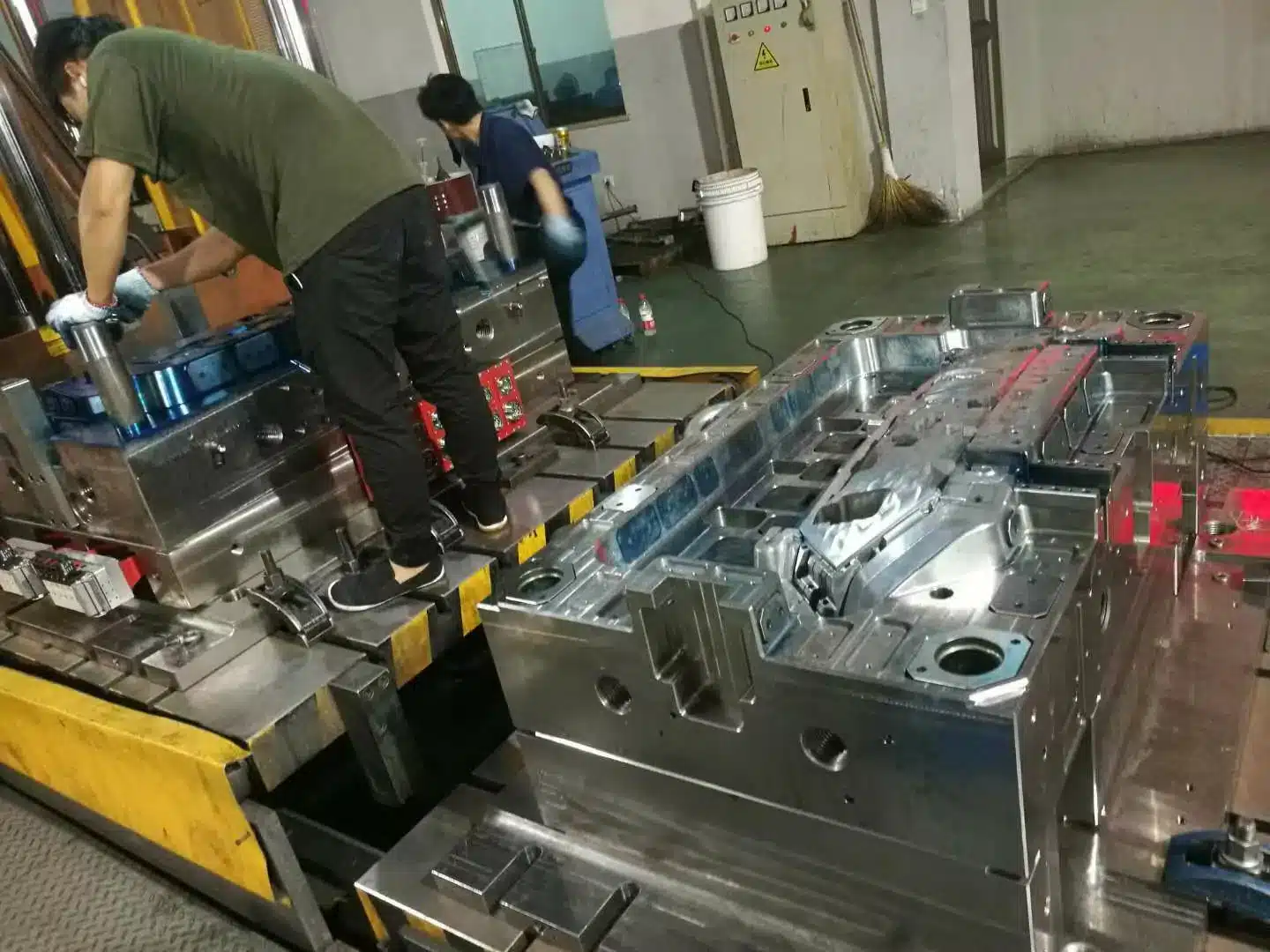
The deal changes character the moment your tooling deposit clears. Before that wire, you’re a prospect and three factories are competing for you. After it, you’re a project — and the steel that makes your product sits in a building you’ve never visited, owned on paper by someone you’ve never met.
Buying injection molding services in China means paying a Chinese factory to build a steel mold of your part and then run plastic parts from it, usually for years. That’s the whole transaction. Everything else in this article is about not getting hurt during it.
I’ve watched first-time buyers lose $6,000 molds because they never asked one question about ownership. I’ve also watched a founder with zero manufacturing background run a clean $4,200 tooling project and land parts at 61 cents each. The difference was never technical skill. It was knowing which four or five things to be stubborn about.
You’re buying two things, and only one of them is the part
Every injection molding quote splits into tooling and piece price. Tooling is the one-time cost of cutting a steel mold. Piece price is what each part costs after the mold exists. Beginners fixate on piece price because it looks like the product; the tooling number is where the risk lives, because it’s non-refundable, front-loaded, and hard to move once cut.
Rough ranges for China-built China-built tooling in 2026, from what crosses our quoting desk:
| Tool type | Typical China cost (USD) | US/EU equivalent | Realistic life |
|---|---|---|---|
| Single-cavity, simple geometry, aluminum or P20 | $1,200 – $4,000 | $6,000 – $15,000 | 10k – 100k shots |
| Single-cavity with slides/lifters, P20 or 718H | $4,000 – $12,000 | $18,000 – $40,000 | 300k – 500k shots |
| Multi-cavity production tool, hardened H13 | $12,000 – $45,000 | $50,000 – $150,000 | 1M+ shots |
| Overmold / two-shot | $15,000 – $60,000+ | $60,000 – $200,000 | Varies |
Piece price for a typical consumer-sized ABS or PP part — say something that fits in your hand, 20 to 60 grams — usually lands between $0.20 and $1.50 ex-works, before shipping and duty. Resin is often less than half of that. The rest is machine time, labor, packaging, and the factory’s margin.
Here’s the part nobody tells beginners: a cheaper tool almost always means a more expensive part. Single-cavity tooling is cheap to build and slow to run. If your annual volume is 100,000 pieces and you saved $8,000 on a single-cavity mold, you’ll pay that back four times over in cycle time. Match the tool to the volume you actually have, not the volume in your pitch deck.
Do you actually need a mold yet?
Probably not, if you’re under about 500 units.
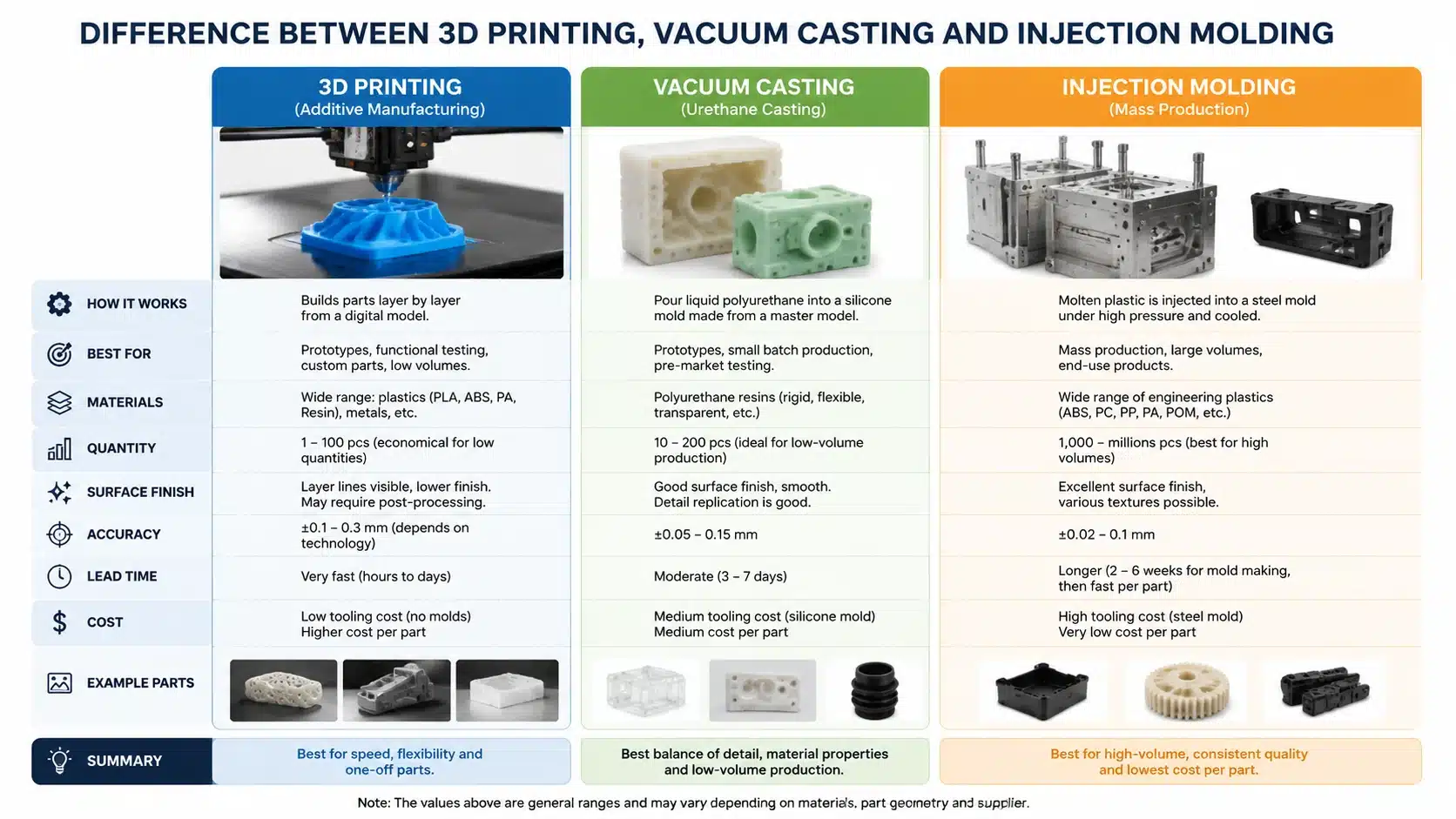
CNC machining or high-quality 3D printing in the same resin will cost more per part but nothing in tooling, and you can change the design on Tuesday. Injection molding wins somewhere between 500 and 1,500 pieces for most consumer parts, and the crossover moves earlier as the part gets bigger. Run the math before you wire anything: (tooling ÷ units) + piece price versus your machined quote. If molding doesn’t clearly win at your real first-year volume, wait.
I’ve refused tooling orders over this. A buyer needed 300 enclosures for a pilot; a $9,000 mold would have made each one cost $32 all-in. Machined parts were $19. He came back nine months later with a design that had changed three times in between — and by then, the mold he almost bought would have been scrap.
Buying injection molding services in China starts before you email anyone
A good quote requires six inputs. If you send a factory less than this, you’ll get a number that’s either padded for unknowns or quietly missing half the scope — and you’ll have no basis for comparing two suppliers.
What to have ready before the first message:
- A 3D file — STEP or IGES, not a JPEG, not a PDF drawing alone. STEP is the universal one. Learn more about briefing your designer on a plastic part.
- A 2D drawing with critical dimensions and tolerances. You don’t need to tolerance everything. Mark the three to eight dimensions that must be right — mating surfaces, hole positions, snap-fit engagement — and let the rest ride at ±0.1 mm to ±0.3 mm general.
- Material. If you don’t know: ABS for rigid enclosures, PP for living hinges and chemical resistance, PC for transparency and impact, nylon for gears and structural parts. For most consumer housings, specify ABS and stop agonizing.
- Annual and first-order volume. Both. Tooling design depends on annual; the quote depends on first order.
- Cosmetic requirements. Where is the visible surface? Textured or gloss? A “Class A” surface anywhere multiplies tooling cost and scrap rate.
- Target landed price, if you have one. Sharing it doesn’t weaken you. It filters out suppliers who were never going to be close.
Send that package to three or four suppliers simultaneously. Never one.
Factory, trading company, or agent — who are you talking to?
| Channel | What it is | Tooling markup | Best for |
|---|---|---|---|
| Direct factory | Owns machines and tooling shop | None (their cost) | Buyers who can read a DFM and manage details |
| Trading company | Resells factory capacity, often unnamed | 15% – 40% | Buyers wanting one contact, willing to pay for it |
| Sourcing agent | Works for you, paid by fee or % | 5% – 10% fee | First-timers with a complex or high-value program |
| Platform (Alibaba, Made-in-China) | Directory, not a supplier | Varies | Finding candidates — not for vetting them |
The honest verdict: for a first project under about $15,000 in tooling, a good trading company is often the better buy, even though you’ll pay more. They absorb the translation, the time-zone lag, and the chasing. A direct factory relationship saves real money but assumes you can catch a bad DFM report yourself.
What I’d avoid is the worst of both — a trading company that pretends to be a factory. You pay factory-relationship prices for reseller-level control.
How to tell whether the “factory” is a factory
Ask three questions and watch how fast the answers come.
Ask for their machine list with tonnages. A real molder rattles off “we run 80 to 650 ton, twelve machines, mostly Haitian and Yizumi” without pausing. Ask which of those machines your part would run on, and why. Tonnage is roughly 2 to 5 tons of clamp force per square inch of part projected area, so a molder should be able to point at a specific press for your part within a minute.
Then ask for a live video walk of the floor — right now, not a scheduled tour. Reluctance is data. I’ve had buyers discover on a five-minute video call that the “factory” was an office with a whiteboard.
Finally, ask whether the mold shop is in-house or subcontracted. Subcontracted is not disqualifying — plenty of excellent molders buy tooling from specialist shops. Lying about it is disqualifying.
What a real quote looks like
A complete injection molding quote states tooling cost, number of cavities, mold base and core steel grades, expected mold life in shots, part price at two or three volume tiers, resin grade with a named manufacturer, cycle time, packaging, and lead time to first samples. A quote missing cavity count and steel grade is not a quote — it’s a number.
That last point deserves emphasis, because it’s where beginners get burned by “cheap” suppliers. Two quotes at $5,000 and $8,000 look comparable until you notice the first is a single-cavity mold in unspecified steel and the second is a two-cavity 718H tool rated for 500,000 shots. They’re different products.
Things a quote should also tell you and often doesn’t: who pays for engineering changes after the mold is cut (assume you do, at $200 to $2,000 per change), what the sample charge is, whether the price includes resin colorant, and what the MOQ is per production run. Ask for all four in writing before you commit.
If a supplier can’t or won’t break out their number, that’s your answer.
Mold ownership is a contract question, not a moral one
You paid for the mold. That does not automatically mean you can get it.
In practice the factory holds physical possession, and possession is most of the power. The fix isn’t outrage; it’s a purchase order or tooling agreement that says, in plain terms: the buyer owns the mold outright on final payment; the mold will be tagged with the buyer’s name and a tool number; the factory will release the mold within a stated number of days of a written request, subject only to unpaid invoices; and the factory won’t run parts from this mold for anyone else.
Add one more clause that costs nothing and saves projects: the factory provides the full mold drawing set and the last known process parameter sheet on request. Without those, transferring a mold to a new supplier means half the tuning starts over.
Two practical notes. First, mold transfers do happen and they do work — expect to pay for disassembly, cleaning, and crating, and expect the new molder to need a fresh sampling round. Second, if your part design is genuinely novel, file for protection in the US and consider a Chinese utility model before the drawings go out, because Chinese IP enforcement follows Chinese registration, not yours — WIPO’s patent resources are a reasonable starting point for cross-border filing basics.
Steel and mold class, minus the mystique
You mostly need to know four terms.
P20 is pre-hardened steel, the default for low- to mid-volume tools, good for roughly 100,000 to 300,000 shots with unfilled resins. 718H is a step up in toughness and polishability, common in Chinese tooling and a fine mid-tier choice. H13 is hardened tool steel for high volume and abrasive materials. NAK80 shows up when you need a high-polish cosmetic surface. See our full P20 vs 718H vs H13 vs S136 comparison for how these actually behave in production.
The rule that actually matters: if your resin is glass-filled, jump to hardened steel for the core and cavity regardless of volume. Glass fiber eats soft steel. I’ve seen a 30% glass-filled nylon part chew a P20 gate area into uselessness in under 40,000 shots — the tool didn’t fail dramatically, it just started making parts with a growing flash line until nobody could sign off on them.
For classification, ask where the tool sits against SPI mold classes 101 through 105. A supplier who can answer that has built tools to a spec before — the Society of Plastics Engineers maintains reference material on these classifications.
The DFM report is the interview
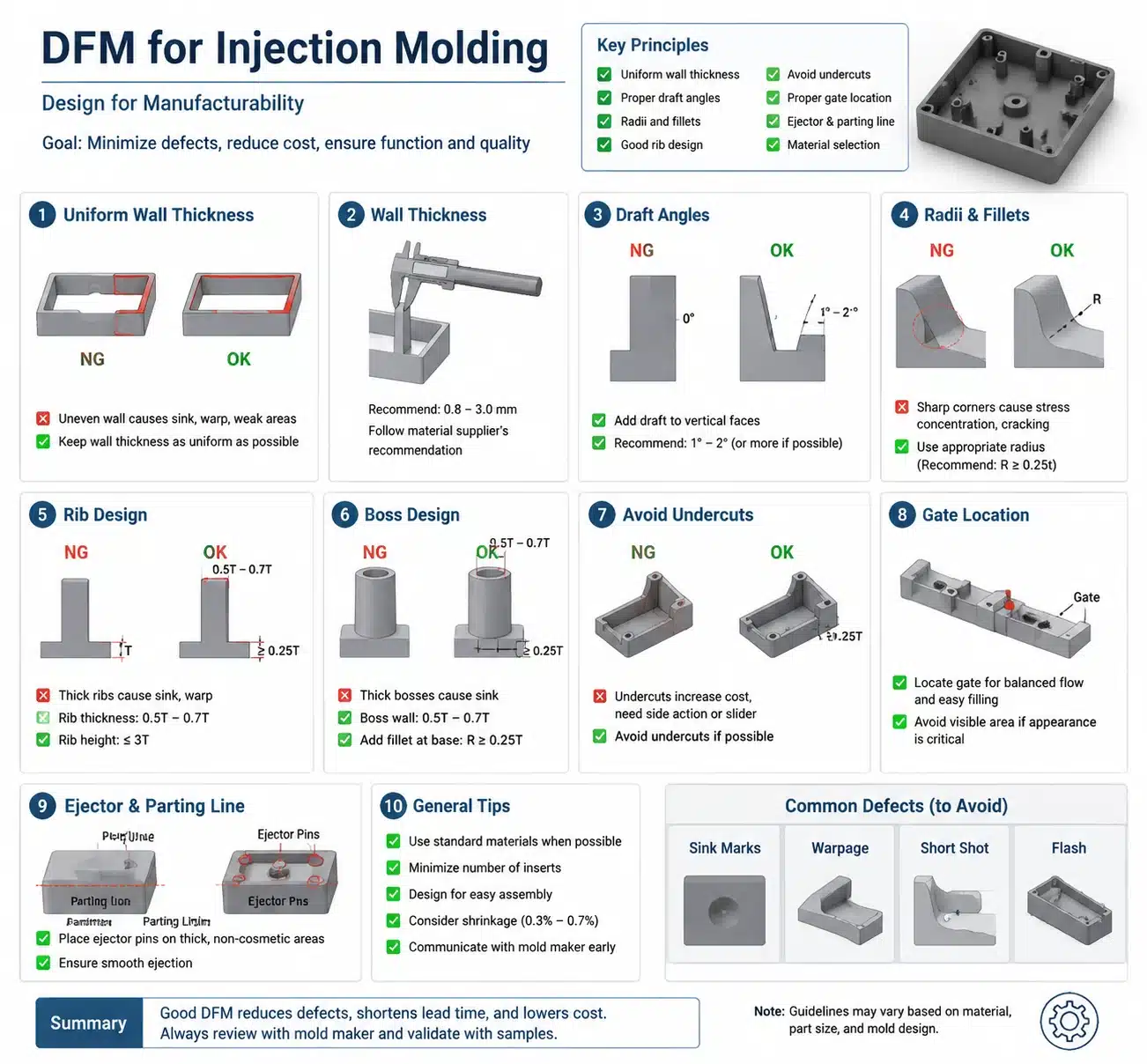
Design for Manufacturability review is the document a factory sends after your files and before the mold is cut. It should show gate location, parting line, ejector pin positions, draft angles, wall thickness analysis, predicted weld line and sink locations, and a list of geometry changes they need from you. A one-page DFM that says “part is OK for molding” tells you the supplier didn’t look.
Read it even if you don’t understand all of it. You’re checking whether they engaged.
Specific things to look for: Did they flag anything as a problem? A DFM with zero requested changes on a first-time design is almost always a supplier who skipped the analysis. Did they show you where the gate goes — and did they explain why? Gate position determines where knit lines and cosmetic blemishes land, so if the gate is on your logo surface, now is the moment to say so, not after T1.
Are draft angles called out? Vertical walls need draft to eject. One degree per side is the working minimum for smooth surfaces; textured surfaces want three degrees or more depending on texture depth. A DFM that ignores draft on a deep-draw part is a DFM from someone who will be scrapping steel later.
T1 samples and the dangerous word “approved”
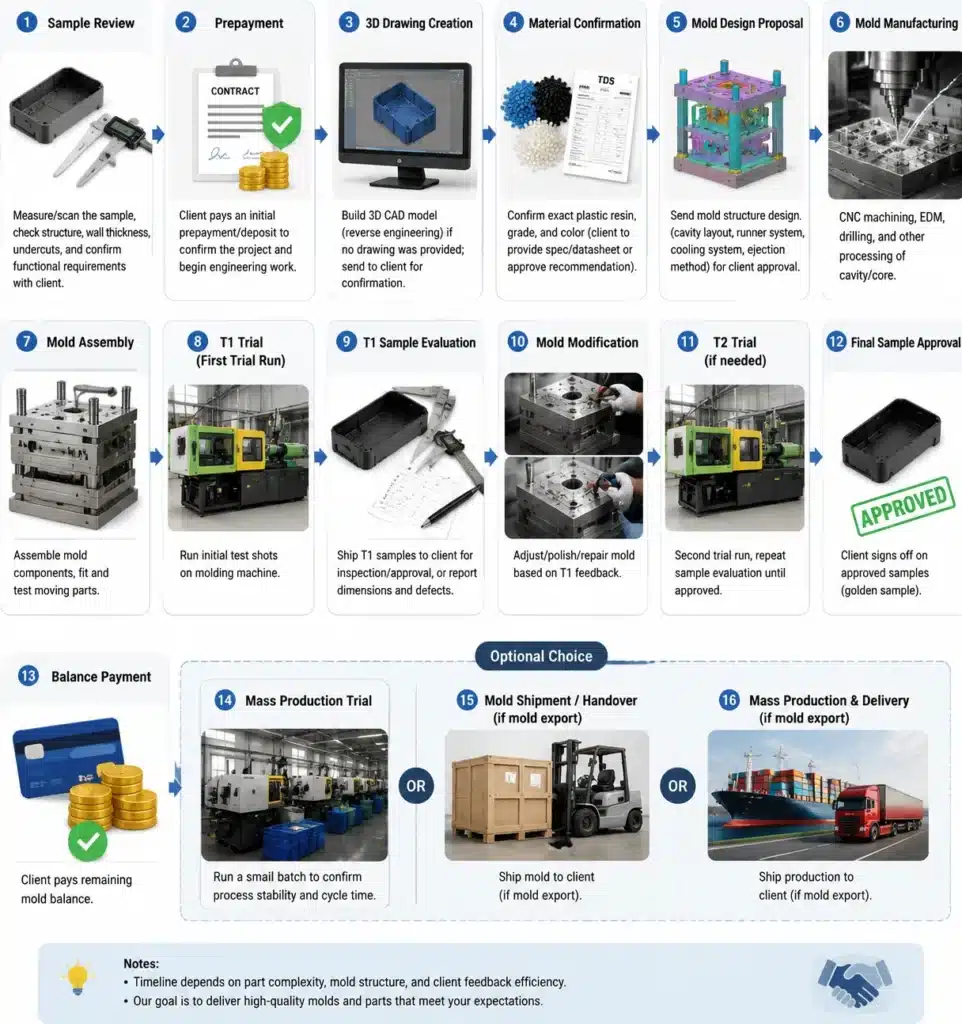
T1 means the first shots off the new mold. T2 and T3 are the rounds after corrections. Almost no mold is right at T1, and a supplier who promises otherwise is managing your expectations rather than your project.
When T1 samples land, do four things: measure your critical dimensions with calipers or a gauge, assemble the parts with their mating components, run whatever functional abuse the product will see, and look at the cosmetic surfaces under the lighting the customer will use. Then send written feedback, not a phone call.
Be careful with the word “approved.” Signing off on T1 samples generally closes the supplier’s obligation to fix tooling at their cost. Once you approve, changes become engineering-change charges. So approve deliberately, and when you do, keep two or three signed and dated golden samples — one at your office, one at the factory. Every future production lot gets judged against those, and it ends the argument about whether the color drifted.
Steel-safe changes — adding steel to remove plastic — are cheap. The reverse means welding or a new insert. Ask which category each of your requested changes falls into before you request it.
Payment terms that don’t leave you naked
Standard for tooling is 50% deposit, 50% after T1 sample approval. Some factories ask 30/30/40 across order, T1, and shipment. Either is fine. What isn’t fine is 100% upfront on a first project with a supplier you’ve never used.
For production orders, 30% deposit and 70% against a copy of the bill of lading is the common structure, and it means the factory can’t collect until the goods are physically on a ship.
Pay by bank wire to a company account whose name matches the entity on your contract. If someone asks you to wire to an individual’s account or a Hong Kong entity that doesn’t appear on any of your paperwork, stop and ask why in writing.
Landed cost in 2026
Your ex-works part price is not what the part costs you. Landed cost = part price + international freight + US duty + customs fees + domestic freight. For small parts shipped by sea in reasonable quantity, freight often adds a few cents per part. Duty adds a lot more.
As of mid-2026, most finished plastic articles from China carry an MFN base duty in the low single digits (commonly 3% to 5.3% depending on HTS code) plus a 25% Section 301 additional duty that has been in force since 2018 and remains fully in effect. On top of that sat a 10% Section 122 global surcharge introduced in February 2026 — which expires by statute on July 24, 2026, with a proposed Section 301 replacement in the 10% to 12.5% range still pending as of that date. Add the Merchandise Processing Fee (0.3464% of value, minimum around $30) and the Harbor Maintenance Fee (0.125%) on ocean shipments. Current rates should always be confirmed against trade.gov’s Section 301 guidance at the time you actually import.
Practically: budget 30% to 40% of your FOB value for duty on Chinese-molded plastic parts in 2026, then get your exact 10-digit HTS classification confirmed by a licensed customs broker before you commit to a price to your own customer. Classification is where the money is — the difference between two plausible HTS codes can be 25 points of duty. This is a fast-moving area of policy; verify current rates at the time you import rather than trusting any article, including this one.
One consequence worth thinking about now: the duty applies to parts, not to the mold. Tooling built in China and shipped later is a small dutiable item. That asymmetry is why some buyers build tooling in China and eventually move the mold to a molder in Mexico or the US when volume justifies it. If that’s a future you want available, the ownership and drawing-release clauses above are what make it possible.
How long this actually takes
| Stage | Typical duration |
|---|---|
| Quoting (3–4 suppliers) | 3–7 days |
| DFM review and design revisions | 1–2 weeks |
| Mold build to T1 | 25–45 days |
| T1 evaluation and corrections | 1–3 weeks per round, usually 1–2 rounds |
| Production run | 1–3 weeks |
| Ocean freight to US West Coast + customs | 4–6 weeks |
Call it three to five months from first email to parts on your shelf, for a straightforward part with one round of corrections. Chinese New Year swallows two to three weeks every January or February and the two weeks on either side run at reduced capacity. Plan around it or lose a quarter.
Things I’d walk away from
- A tooling quote dramatically below the others, with no explanation for why.
- Refusal to specify steel grade or cavity count in writing.
- No DFM report, or a DFM that requests no changes.
- Any pushback on a written mold-ownership clause.
- Payment to a personal account or a mismatched company name.
- A “factory” that won’t do a live video walk of the floor.
- Sample lead times that keep slipping by a few days at a time, with new reasons each week. Schedule slip before tooling is cut predicts schedule slip after.
A first order that won’t hurt
Order tooling and a small first production run — 500 to 2,000 pieces — rather than tooling plus a full year of inventory. You’ll learn more from one real shipment than from six months of emails, and if the supplier turns out to be wrong for you, you’ve lost weeks instead of your working capital.
Then do the boring thing: keep a written record of every commitment, in English, in a numbered document, with dates. Not because Chinese suppliers are uniquely unreliable — most are straightforward to work with — but because manufacturing arguments are always about what was agreed, and the person with the document wins.
FAQ
Can I get a mold made in China if I only have a sketch or a physical sample?
Yes, but you’ll pay for the design work and you’ll own less of the outcome. Most Chinese tooling shops offer 3D modeling from a sample or drawing for a few hundred dollars. Insist that the resulting STEP file is delivered to you and that you own it — otherwise you’re locked into that supplier for every future revision.
What’s the minimum order quantity for injection molded parts?
Once the mold exists, MOQs are usually driven by machine setup rather than the factory’s preference, and commonly land between 500 and 5,000 pieces per run. Small runs are possible but the per-part price rises because a setup and purge costs the same whether you run 500 parts or 50,000.
Do I need an NDA before sending my 3D files to a Chinese factory?
An NDA is worth signing but shouldn’t be mistaken for protection. Enforcement across borders is slow and expensive. Registered design or utility model protection in China, filed before disclosure, gives you far more practical leverage than a contract clause.
How much does it cost to modify a mold after it’s built?
Steel-safe changes — removing steel to add plastic — typically run $200 to $800. Changes requiring welding, new inserts, or re-cutting a cavity run $800 to $3,000 and add one to three weeks. Cosmetic surface changes on a polished cavity can cost more than either.
Can the factory refuse to release my mold?
Physically, yes — possession is with them. Contractually, a well-written tooling agreement with an ownership clause, a mold tag with your name and tool number, and no outstanding invoices makes release the normal outcome. Disputes almost always trace back to money owed or an agreement that never specified ownership.
Is it cheaper to mold in Vietnam or India instead of China?
Piece prices can be competitive, but China’s tooling ecosystem is still faster and deeper, particularly for complex molds with slides and lifters. A common structure in 2026 is building the mold in China and molding elsewhere, which works only if you own the tool and hold the drawings.
How do I inspect parts if I can’t fly to China?
Hire a third-party inspection firm for a pre-shipment inspection against an AQL standard — typically $300 to $600 per man-day. Give them your golden sample specification and your critical dimensions in advance. Uninspected first shipments are the single most common source of expensive surprises.
What resin should I pick if I have no idea?
ABS for rigid enclosures and general-purpose parts, PP for anything needing a living hinge or chemical resistance, PC for transparent or high-impact parts, nylon for gears and load-bearing components. Ask your supplier to quote a named grade from a named manufacturer rather than “ABS” — grade variation within a material family is larger than most buyers expect.
The one rule
If you remember nothing else: the mold is the asset, and everything you do before the deposit determines whether you own it in any meaningful sense. Get the tooling agreement right — ownership, release, drawings, and no exclusive use by the supplier — and every other problem in this process is survivable. Get it wrong, and a good part price won’t save you.
Quote three suppliers. Read every DFM. Sign the ownership clause. The rest is execution.
Need a second set of eyes on your China tooling quote?
Send us your part files and the quotes you’ve received — we’ll flag what’s missing, what’s mispriced, and where the ownership language leaves you exposed. No obligation, no sales pitch.

