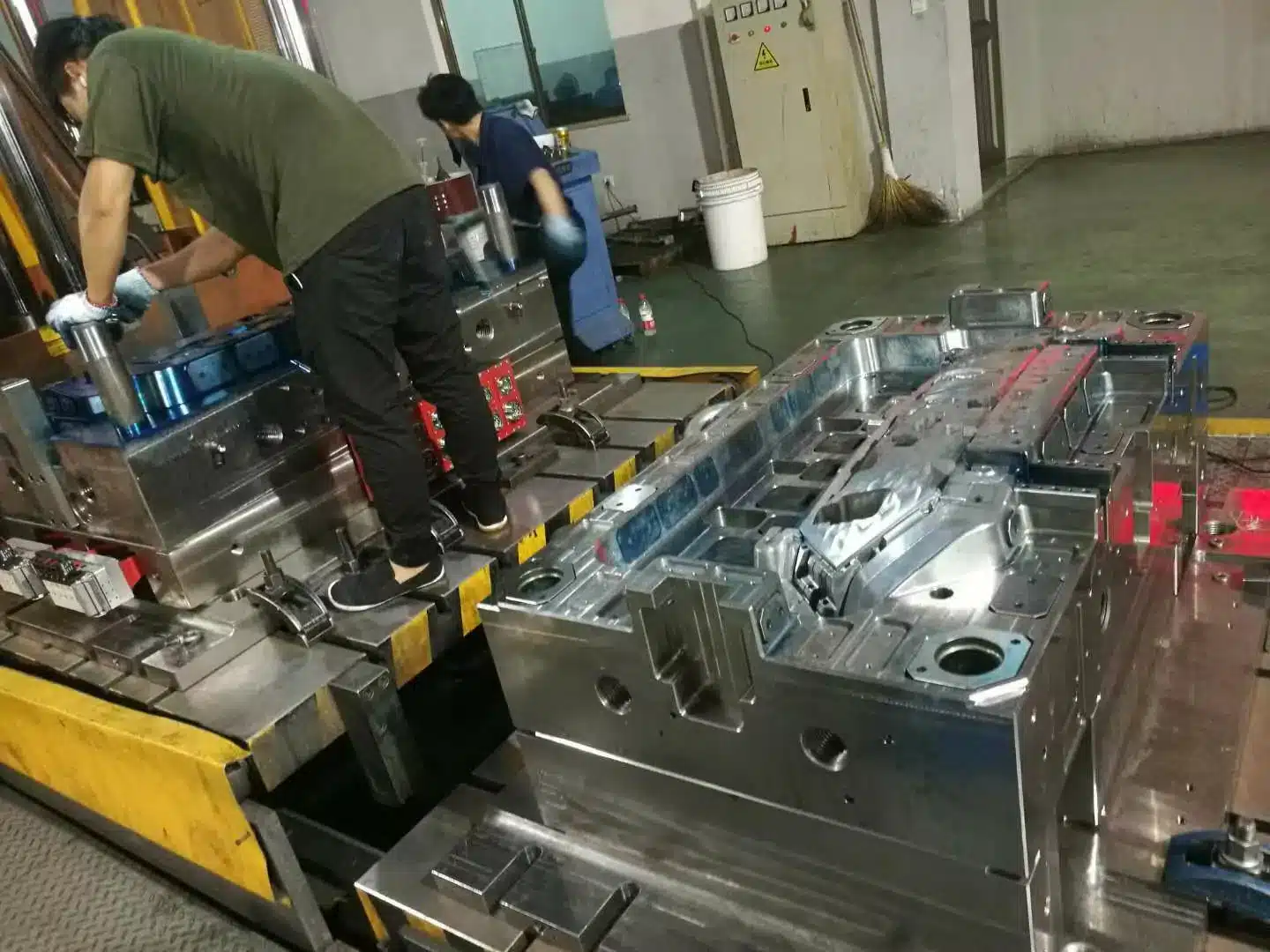

We’re a China-based mold maker. And we’re about to help you figure out if you should not buy from us.
That’s the premise behind China vs. US Tooling in 2026: The Honest Calculator Most Suppliers Won’t Give You. Between shifting tariff policies, nearshoring momentum, and real supply chain disruption risk, “where should I source my tooling?” has stopped being a simple cost question. It’s a strategic one. And most suppliers — on either side of the Pacific — have a financial incentive to steer you toward themselves.
This article gives you the actual decision framework. You’ll learn the three core questions that determine whether China or US tooling is right for your specific product, volume, and risk profile. No spin. No filler. Just the calculator your procurement team actually needs.
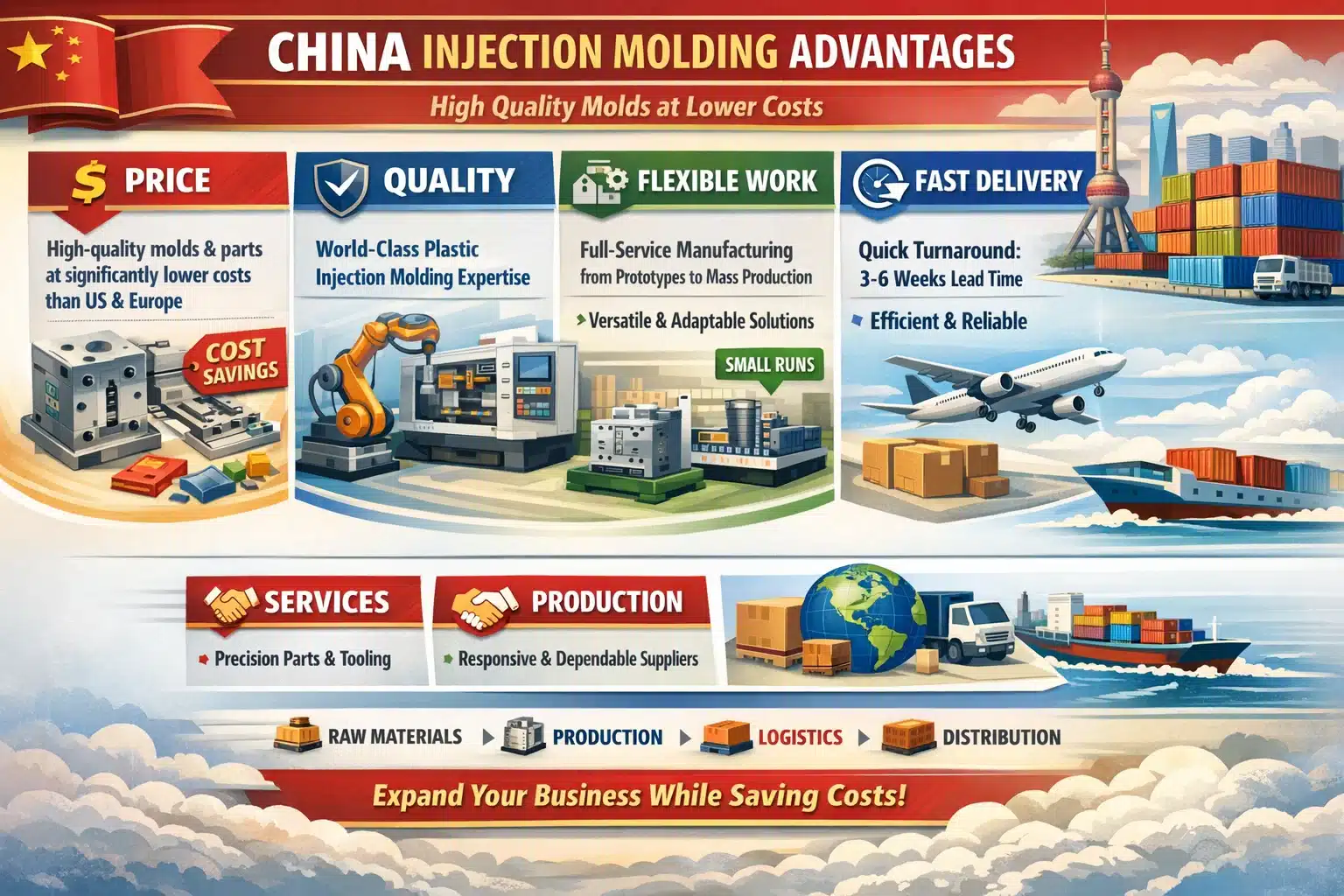
Why “Where Should I Source Tooling?” Is Now a Strategic Question
Tooling sourcing decisions in 2026 involve more variables than at any point in the past decade. Tariff structures on Chinese imports remain elevated. Nearshoring programs in Mexico and Southeast Asia are expanding. Meanwhile, buyer expectations around lead time, IP protection, and regulatory compliance keep tightening.
The result: a simple price comparison between a US quote and a Chinese quote tells you almost nothing about total cost. Understanding the competitive landscape is crucial, especially when comparing injection mold manufacturing in China vs. US & Japan.
What Changed Between 2024 and 2026?
Several structural shifts reshaped the landscape:
- Tariff escalation. US tariffs on Chinese-manufactured tooling and injection molds have increased through successive policy rounds. Exact rates depend on HS code classification, but effective duties on many mold categories now add meaningfully to landed cost.
- Nearshoring investment. Mexico’s mold and die sector has attracted significant capital, particularly for automotive applications. However, capacity remains limited relative to China’s installed base.
- Lead time compression. Domestic US rapid tooling providers have cut prototype mold timelines significantly, making short-run and bridge tooling more competitive on speed.
- Compliance pressure. Sectors like medical devices and defense now face stricter supply chain documentation requirements, adding hidden cost to offshore sourcing.
Can You Actually Decouple From Chinese Tooling?
Not entirely — and not quickly. China still accounts for a dominant share of the world’s mold and die production capacity. The skilled labor base, material supply chain, and sub-supplier ecosystem built over decades cannot be replicated overnight in any single country. For many high-volume projects, injection molding in China remains the most viable path forward.
Complete decoupling is unrealistic for most companies. The real question isn’t “China or not China.” It’s: under what conditions does each option deliver better total value?
China vs. US Tooling in 2026: The Honest Calculator Most Suppliers Won’t Give You
The honest calculator comes down to three questions. Your answers determine which sourcing path minimizes total cost of ownership — not just unit price.
Question 1: What Is Your Annual Volume and Product Life Cycle?
Volume and product maturity are the strongest predictors of where to source. You can use our smart injection mold cost calculator to estimate your initial investment.
| Scenario | US / Nearshore | China |
|---|---|---|
| Prototype / validation (<1,000 units) | ✅ Speed and iteration win | ⚠️ Shipping time erodes cost advantage |
| Mid-volume (1K–100K/year) | ⚠️ Calculate total landed cost carefully | ✅ Cost advantage usually clear |
| High-volume (>100K/year) | ❌ Unit economics hard to justify | ✅ Scale economies maximize savings |
The decision logic is simple:
- Low volume + short product life cycle = speed matters more than cost → nearshore likely wins.
- High volume + long product life cycle = cost matters more than speed → China advantage is significant.
Mid-volume is the gray zone. That’s where the rest of the calculator matters most.
Question 2: How Complex Is Your Part and What Tolerances Do You Need?
Not all tooling is created equal. A single-cavity mold for a simple enclosure is a fundamentally different purchase than a multi-cavity, hot-runner mold for an optical lens. Many engineers find that AI-driven mold flow analysis is essential for complex geometries to predict potential issues before manufacturing begins.
| Complexity Level | Typical Characteristics | Supplier Capability Required |
|---|---|---|
| Level 1: Standard | Single material, ±0.1 mm tolerance | Widely available globally |
| Level 2: Moderate | Multi-gate, side actions, ±0.05 mm | Verified capability needed |
| Level 3: High Precision | Micro-molding, optical grade, ±0.01 mm | Specialized equipment and certification |
| Level 4: Regulated | FDA or AS9100 compliance, full traceability | Rigorous supplier audit required |
Key insight: At Level 1–2, Chinese suppliers typically offer a 30–50% cost advantage over US equivalents (evidence varies by source and should be verified against current quotes). At Level 3–4, the price gap narrows, and the cost of qualifying and auditing an offshore supplier can erode or eliminate savings. For these complex projects, selecting one of the top 10 precision mold manufacturers in China can mitigate these risks.
Question 3: How Sensitive Is Your IP and How Much Risk Can You Absorb?
Risk tolerance often gets treated as a vague concern. Here’s how to make it concrete.
| Risk Dimension | Low-Risk Signals | High-Risk Signals |
|---|---|---|
| Supply chain disruption | Multiple suppliers, safety stock | Single source, JIT dependency |
| IP exposure | Mature product, public technology | Core innovation, pending patents |
| Regulatory compliance | Consumer goods, no special regulations | Medical, defense, data-sensitive |
| Communication overhead | Experienced team, established processes | First-time sourcing, limited resources |
A direct statement worth making: If your product touches the defense supply chain or requires ITAR compliance, choose a US supplier. This isn’t a cost decision — it’s a legal requirement. That kind of clarity actually builds trust with readers (and prospects) far more than hedging. You can also refer to the ISO 9001 quality management standards to evaluate a supplier’s operational consistency.
How Do Tariffs and Shipping Actually Change the Math?
Tariffs and logistics don’t just add a percentage on top. They change the total cost structure in ways that compound. When buying injection molding from China, a rough total landed cost comparison for a mid-complexity injection mold might include:
- Mold price (often 40–60% lower from China)
- Tariff/duty (can add 10–25%+ depending on classification)
- Freight and logistics (ocean shipping adds 4–8 weeks; expedited air is expensive)
- Travel and audit costs (qualifying a new overseas supplier often requires on-site visits)
- Communication and iteration costs (time zone gaps, revision cycles, engineering change management)
- Risk premium (what does a 2-week port delay cost you in lost production?)
When you layer these together, China’s mold price advantage often shrinks — sometimes dramatically — for low-to-mid volume orders. For high-volume, long-run tooling, the price gap usually survives the adjustments.
What Does a Real Decision Path Look Like?
Theory is useful, but real scenarios make the framework concrete.
Scenario A: Consumer Electronics Startup
- Situation: First production run of 5,000 units. Product design still iterating.
- Recommendation: Use US-based rapid tooling for validation and design freeze. Once the design is locked, transition to a Chinese production mold for scale manufacturing.
- Why: Iteration speed at this stage outweighs per-unit cost. A 6-week ocean shipping cycle on a mold that needs revision is a painful waste of time and money.
Scenario B: Automotive Tier 2 Supplier
- Situation: 500,000 units per year. IATF 16949 certification required.
- Recommendation: Source production tooling from China with a rigorous PPAP (Production Part Approval Process) protocol. Consider final assembly in Mexico to manage tariff exposure and logistics.
- Why: At this volume, the cost advantage is large enough to justify the upfront qualification effort. The IATF framework provides built-in quality controls.
Scenario C: Medical Device Company
- Situation: FDA Class II device. 20,000 units per year.
- Recommendation: This one requires a case-by-case evaluation. If you already have a qualified, compliant Chinese supplier relationship, it may work. If you’re starting from scratch, the cost and time of supplier qualification for a regulated product often tips the balance toward domestic sourcing.
- Why: FDA audit trails, biocompatibility documentation, and complaint handling processes all add hidden cost to offshore relationships in regulated industries.
When Should You Definitely Choose a US Tooling Supplier?
Some situations make the decision straightforward:
- Your product requires ITAR or EAR compliance.
- You need a mold delivered and shooting parts within 3–4 weeks.
- Your annual volume is under 1,000 units with an uncertain product roadmap.
- You’re in a regulated industry without an existing qualified offshore supplier.
- Your engineering team lacks experience managing overseas tooling vendors.
In these cases, the total cost of offshore sourcing — including risk, time, and management overhead — almost always exceeds the domestic premium.
When Does China Tooling Still Make Undeniable Sense?
Equally, some situations clearly favor Chinese sourcing:
- Annual volumes exceed 100,000 units with a stable, proven design.
- The part is Level 1–2 complexity with standard tolerances.
- You have an established supplier relationship with audit history.
- Your product is a consumer good with no special regulatory requirements.
- You have internal resources experienced in managing international supply chains.
China’s manufacturing ecosystem for tooling at scale remains unmatched in cost efficiency. Ignoring that reality is as unhelpful as ignoring the risks.
How to Use an Interactive Sourcing Calculator
The framework above gives you a decision structure. An interactive calculator takes it further by letting you input your specific parameters — volume, complexity level, risk profile, timeline — and receive a tailored recommendation.
If your supplier offers a tool like this, use it. If they don’t, ask why. A supplier confident in their value proposition has nothing to hide behind a transparent cost comparison. The best version of this calculator doesn’t just spit out “choose us.” It tells you honestly when you should look elsewhere.
Frequently Asked Questions
Is Chinese tooling quality lower than American tooling?
Not inherently. Quality depends on the specific supplier, not the country. Top-tier Chinese mold makers produce tooling that meets the same international standards as US shops. The key difference is the variance — the range between the best and worst suppliers is wider in China, which makes qualification more important.
How long does it take to get a mold from China versus the US?
A typical production mold from China takes 6–12 weeks for fabrication plus 4–8 weeks for ocean shipping. US mold makers often deliver in 6–10 weeks with no shipping delay. For rapid prototype molds, US providers can sometimes deliver in 2–4 weeks.
Do tariffs make Chinese tooling too expensive now?
Not universally. Tariffs add meaningful cost, but for high-volume production tooling, the base price advantage from China often absorbs the tariff impact. For low-volume or mid-complexity jobs, tariffs can tip the balance toward domestic sourcing.
What is the biggest hidden cost of sourcing tooling from China?
Communication and iteration overhead. Engineering changes, revision cycles, and time-zone-driven delays add cost that doesn’t show up on the purchase order. Companies sourcing from China for the first time consistently underestimate this factor.
Can I own my mold if I have it made in China?
Mold ownership depends on your contract, not the country. Reputable Chinese suppliers will agree to clear mold ownership terms. However, enforcing IP rights and mold transfer across borders requires contractual diligence and, ideally, legal counsel familiar with Chinese manufacturing law.
Should I use a sourcing agent or go directly to a Chinese mold maker?
For first-time buyers, a reputable sourcing agent reduces risk by handling supplier vetting, communication, and quality inspection. Experienced teams with established supplier relationships often save money by working directly. The agent’s value decreases as your internal capability increases.
Conclusion
The sourcing decision between China and US tooling in 2026 isn’t binary. It’s conditional. Your volume, part complexity, risk tolerance, regulatory environment, and internal capability all shape the right answer — and that answer might be different for different SKUs within the same company.
China vs. US Tooling in 2026: The Honest Calculator Most Suppliers Won’t Give You exists because most suppliers benefit from oversimplifying this decision. The framework here — three questions, clear thresholds, honest trade-offs — gives marketers and procurement leaders the structure to push past sales pitches and make sourcing decisions grounded in total cost reality.
The supplier who helps you decide against them when it’s the right call is the supplier worth keeping on your list for when it is the right call.

