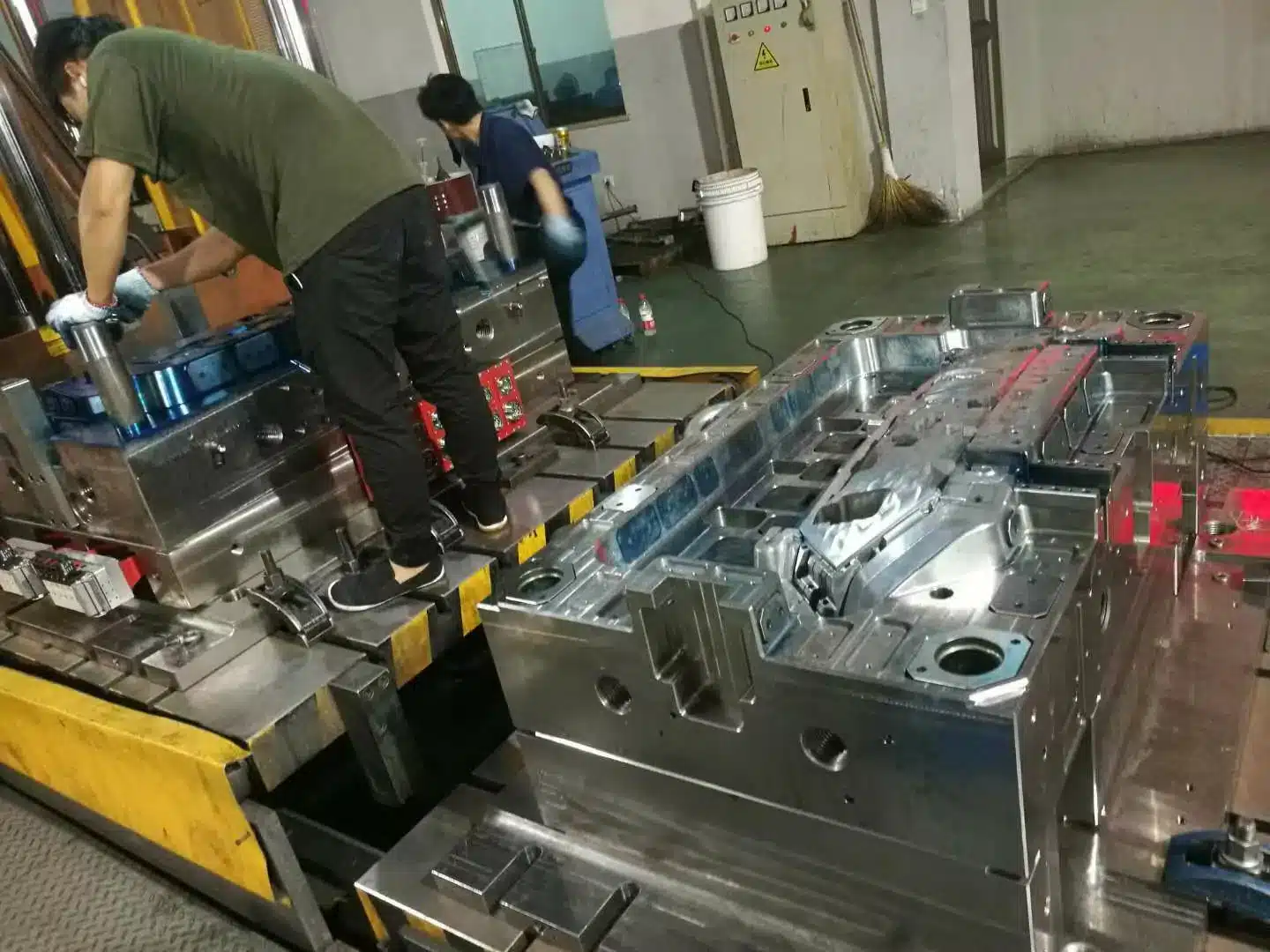

The quote that told me everything
A US buyer sent me a drawing last spring. Housing clip, 0.4 g, PA66, 500,000 per month. Three Chinese quotes were already on his desk.
The cheapest by far listed a single-cavity mould and a 12-second cycle. That math doesn’t work.
To hit that volume, one machine runs 24 hours a day, six days a week. And never scraps a shot. They were lying about cycle time, or planning to run the tool into the ground. Then quote a replacement in six months. Probably both.
I’ve watched this pattern for twenty years. Small plastic injection moulding parts look forgiving because they’re cheap and light. They aren’t.
The margin for error shrinks with the part. Thin walls flash easier. Gates freeze faster. Ejection marks show more. Multi-cavity balance becomes a full-time problem. Source these out of China and most of your money is saved or wasted before the first shot.
Design for Injection Molding
Eight checks that decide whether your part molds clean, or fights the tool for its whole life.
Wall thickness rules the whole job
Wall thickness sets cycle time, sink marks, warpage and fill pressure. Cooling time rises with the square of the wall. Double the wall and you roughly quadruple the time the part sits in the tool.
The second rule matters just as much: keep the wall uniform. Plastic shrinks as it cools. A thick zone cools last, keeps shrinking after the gate freezes, and pulls the surface in. That is a sink mark. If the skin is stiff enough to resist, the shrinkage tears a void inside instead.
Hold the nominal wall within ±10% across the part. Where a change is unavoidable, keep the step under 25% of the nominal wall and blend it over a length of at least 3× wall. Never step the wall with a square shoulder.
Cooling time is a first-order estimate from the one-dimensional plate solution. It ignores gate freeze-off, hot runner effects and mold cooling layout. Treat it as a comparison tool, not a quote.
Stiffness comes from ribs, not from thicker walls
Bending stiffness scales with height cubed. A rib 3× the wall height adds far more stiffness than doubling the wall, and it costs almost nothing in cycle time. This is the single highest-value move in plastic part design.
The catch is the rib root. Where the rib meets the wall, material mass builds up. That local thick spot cools last and pulls a sink mark onto the show surface directly opposite the rib.
Base thickness 0.5–0.6× wall for amorphous resins, 0.4–0.5× for high-shrink semi-crystallines. Height up to 3× wall. Draft 0.5–1.5° per side. Root radius 0.25–0.5× wall. Spacing at least 2× wall so the steel between ribs still cools.
Three fixes, in order of cost: move the rib off the show face, break the opposite face with a texture or a styling groove, or core out the wall behind the rib so the mass balances. Adding hold pressure only hides small sinks and often adds stress instead.
Draft is what lets the part leave the steel
A molded part shrinks onto the core. Ejector pins then push it off. With no taper, the part drags the full depth of the core and picks up scuff lines, stress whitening or a torn wall. Draft turns that sliding contact into an instant release.
Texture makes it worse. A grained surface is a field of tiny undercuts. Every 0.025 mm of texture depth needs roughly 1.5° of extra draft on top of the base requirement.
0.5° is the practical floor for a polished vertical face. 1–2° is the normal default. 3° suits a light grain, 5° and up a coarse one. Deep ribs and tall cores want at least 0.5° per side even when the drawing says the face is critical. Shut-off faces and sealing surfaces are the exception, and they need a written agreement before steel is cut.
Sharp inside corners are stress risers
A sharp internal corner concentrates stress, blocks flow and creates a local hot spot in the steel. It is also the place parts break first in drop tests. Adding a radius is free at the design stage and expensive after the tool is cut.
The chart below is the classic stress-concentration curve. Below R/T = 0.3 the factor climbs steeply. Above R/T = 0.6 you gain almost nothing, and you start adding mass that sinks.
Outside radius = inside radius + wall thickness. Do that and the material thickness through the corner stays equal to the nominal wall. Use the same inside radius everywhere so the polisher runs one ball cutter, not five.
Bosses: strong enough to hold a screw, thin enough not to sink
A boss is a rib rolled into a tube. Every rib rule still applies, plus two more. The wall of the boss has to stay thin relative to the nominal wall, and the boss must not sit directly against a side wall, or the two masses merge into one thick lump.
Core the boss from the parting line so the wall stays even. Give the core 0.25–0.5° draft, or it will not release. Stand the boss off the side wall by at least one wall thickness and tie it back with a gusset. Keep thread engagement at 2–2.5× the screw diameter, and add a counterbore at the mouth so the screw starts straight and the top of the boss does not split.
Every undercut buys a moving part in the tool
The cheapest mold opens in one direction and the part falls out. Anything that traps the part needs a slide, a lifter, a collapsible core or an unscrewing unit. Each one adds cost, adds cycle time, adds a witness line on the part, and adds something that can fail at 200,000 shots.
Pick the features your part actually needs. The panel adds up what they do to the tool.
Many undercuts disappear with a small change. Add a pass-through hole in the opposite face so a core pin can form the feature on straight pull. Move the parting line onto a styling break. Split one part into two and weld or clip them. Turn a rigid snap into a shallow bump-off that a flexible resin can strip over. Each of these is worth an hour of CAD work before the RFQ.
The gate decides where the weak lines land
Melt enters at the gate and races outward. Where two flow fronts meet, they form a weld line. That line can be 20–60% weaker than the bulk material, and on a glass-filled resin it is worse, because the fibers lie parallel to the line instead of across it.
Click anywhere in the plate to move the gate and watch the fill pattern change. Openings split the flow and put a weld line downstream of every hole.
Click the plate to place the gate.
Choosing a gate type
| Gate | Auto de-gate | Vestige | Best for | Watch out for |
|---|---|---|---|---|
| Edge / side | No | Trimmed nub | Flat parts, most tooling | Manual trim adds labor |
| Submarine (tunnel) | Yes | Pin mark, hidden | Small to medium parts | High shear, not for filled or brittle resins |
| Hot tip / valve gate | Yes | Small dimple or flat | Cosmetic parts, no runner scrap | Highest tool cost, needs controller |
| Direct sprue | No | Large scar | Thick single-cavity parts | Sink under the gate, long cooling |
| Fan | No | Wide trimmed edge | Wide flat panels, low warp | Needs trim fixture |
| Diaphragm | No | Ring on the bore | Round parts needing concentricity | Secondary machining |
Where can a gate vestige be accepted? Which surface is cosmetic, so the weld line must be moved off it? Is the longest flow path within reach for this resin at this wall? Answer those and the filling analysis usually confirms what you already chose.
Shrinkage first, tolerance second
The cavity is cut larger than the part. How much larger depends on the resin, the wall, the hold pressure and the direction of flow. Semi-crystalline resins shrink two to four times more than amorphous ones, and glass fiber makes shrinkage directional.
That is why a tolerance that is routine in aluminum can be impossible in PP. Ask for tight numbers only where the function needs them, and say which datum they are measured from.
Hold pressure and hold time change shrinkage more than any other setting. Mold temperature comes next, then wall thickness. A part measured hot off the press is not the part you get 48 hours later, especially in PA and POM. Set your inspection window and write it on the drawing.
Values shown follow the general shape of the SPI and DIN 16742 guidance for standard and fine tolerance grades. Use them to sanity-check a drawing early. A final capability statement comes from the mold flow study and the first-article report.
Self-check
Eight questions from the sections above. Answers explain themselves as you go.
What counts as a small plastic injection moulding part?
Small plastic injection moulding parts are thermoplastic components under roughly 50 grams and 100 mm in the longest dimension. They usually run on 30–120 ton clamping tonnage in multi-cavity moulds where per-piece cycle economics dominate the quote.
That covers most of what actually gets quoted as “small parts.” Connector housings, gears, caps, clips, medical disposables, cosmetic closures, electronic bezels, fasteners. Anything you can hold a hundred of in one hand.
The industry has no hard cutoff. I use 50 g because below that weight, sprue and runner mass often exceed part mass. That changes how you think about material cost, cycle time, and gate design. Above 50 g the calculus flips — part mass dominates.
Why small parts fail differently than big ones
Small parts cool fast. Sounds like an advantage — shorter cycle, more shots per hour. It is, until it isn’t.
The melt front can freeze before it reaches a thin rib or a distant boss. That’s hesitation. It shows up as short shots, weld lines in weird places, or dimensional drift that only appears in half the cavities.
Small parts also amplify tooling error. A 0.02 mm parting-line mismatch on a bumper cover is invisible. On a 6 mm cap it’s a visible flash line the customer rejects.
The mould has to be built tighter, polished better, and vented more carefully than a large tool. Even though it looks simpler.
The lesson: don’t let a supplier convince you a small tool is a small job. The cavity count is where the difficulty lives.
Cavitation is the first number to argue about
For any small part above roughly 20,000 pieces per month, cavity count drives unit cost more than material or labor. This is where US buyers leave the most money on the table. They accept whatever cavitation the supplier proposes without checking the math against their own volume forecast.
Rough rule I use in quoting meetings: divide annual volume by 200,000. That’s the minimum cavity count that keeps machine time reasonable.
So 2 million per year → at least 8 cavities. 8 million per year → 32 cavities, or a family tool with a second shift.
4, 8, 16, 32 — what changes at each step
| Cavities | Typical tooling cost (USD, China) | Reasonable annual volume | What gets harder |
|---|---|---|---|
| 2–4 | $3,500 – $7,000 | Under 500 K | Almost nothing — good for prototypes and low-volume |
| 8 | $8,000 – $15,000 | 500 K – 2 M | Cavity balance, hot runner selection |
| 16 | $15,000 – $28,000 | 2 M – 5 M | Filling balance, uniform ejection, gate freeze-off |
| 32 | $28,000 – $55,000 | 5 M+ | Everything. Needs a good moulder, not just a good mould |
Ranges assume P20 or 718H steel, single parting line, moderate polish. Hardened steel (H13, S136) for medical or optical parts adds 30–60%.
A 32-cavity tool is not “four times an 8-cavity tool.” It’s a different animal. Hot runner manifolds, sequential valve gates, sometimes servo-driven ejection.
If a supplier’s quote for 32 cavities comes in under double the 16-cavity price, they are cutting something. You’ll pay for it later.
Small plastic injection moulding parts and gate location
Gate location decides whether you get a clean part or spend three months in mould trials. The gate should feed the thickest section. Vents at the last-to-fill area let air escape. On cosmetic parts, the gate sits where the customer will never see or touch.
Sub-gates (submarine gates) are almost always the right answer for small multi-cavity work. They shear off automatically at ejection. Witness mark is small. No secondary trimming.
Pin-point gates from a hot runner are better for cosmetic parts. They also push tooling cost up 40% or more.
Edge gates are fine for prototypes. Rarely fine for production.
If a quote for 8+ cavities specifies edge gates, ask why. The honest answer is usually “cheaper to build.” Cheaper for the moulder, not for you — you pay in degating labor for the life of the program.
I’ve seen moulds scrapped over gate location. One that stays with me: a cosmetic cap, gated on the visible outer surface because the original DFM missed the branding rule. The customer rejected the first 60,000 pieces. Mould got re-cut. Everyone lost a month.
Materials: what actually makes sense under a gram
For most small plastic injection moulding parts, material choice comes down to five options. Everything else is a variation.
- ABS — the default. Easy to mould, good surface, dimensionally stable, cheap. If your part isn’t structural, isn’t outdoors, and isn’t food-contact, just use ABS. Stop overthinking it.
- PP — living hinges, low-cost caps, chemical resistance. Shrinks 1.5–2.5%, which matters at tight tolerances. Weld lines are weaker than ABS.
- PA66 (nylon) — small gears, clips, anything that needs stiffness and heat resistance. Absorbs moisture. Dimensions change with humidity. Needs proper drying — 4 hours at 80 °C minimum. Half the field failures I’ve investigated on nylon parts trace back to a supplier who skipped it.
- POM (acetal) — the right answer for self-lubricating, tight-tolerance moving parts. More expensive, harder to gate cleanly, releases formaldehyde if you over-cook it. Great material, ugly to run.
- PC — clear parts, high impact. Sensitive to residual stress. Needs slow injection and annealing for optical work.
For most small consumer parts, the sequence is simple: try ABS first, upgrade only when a real requirement forces it. Too many programs specify PC/ABS or glass-filled nylon when plain ABS would have worked at half the material cost.
The tolerances your supplier won’t push back on
Buyers routinely put ±0.05 mm on drawings without knowing what it costs. On a small part that tolerance is achievable but expensive. It forces hardened steel, tighter mould construction, in-process SPC, often a longer cycle.
On a 32-cavity tool, keeping all 32 cavities inside ±0.05 mm across a year of production is a full-time engineering job.
Reasonable defaults for small moulded parts, unless a mating requirement forces tighter:
- Non-critical dimensions: ±0.1 mm or DIN 16742 class TG5
- Critical fits: ±0.05 mm — flag them explicitly and expect the price to reflect it
- Cosmetic surfaces: SPI A2 finish unless the customer specifies otherwise. A1 (mirror) doubles polishing cost
A supplier who accepts ±0.02 mm across the entire drawing without a single comment is not reading it. That’s a red flag, not confidence.
Reading a quote for hidden costs
A proper quote should show all of these as separate lines. If any are bundled or missing, ask.
- Mould base and steel grade (P20, 718H, S136, H13 — specify)
- Cavity count and gate type
- Hot runner or cold runner. If hot: brand — YUDO, MoldMaster, INCOE
- Estimated cycle time in seconds
- Guaranteed shots: 500,000 minimum for P20, 1,000,000+ for hardened steel
- Sample lead time and sample quantity
- Texture/finish spec (SPI grade or VDI number)
- Packaging and export packing crate
- Ownership of the mould after payment
That last one matters more than it sounds. If the contract doesn’t say the mould belongs to you after final payment, it doesn’t. I have seen buyers discover this the hard way when they tried to move production and the original moulder wouldn’t release the tool.
What a good DFM report looks like
A useful DFM report from a Chinese moulder should include, at minimum: a fill simulation showing gate location and fill balance, a wall-thickness map flagging areas above or below the recommended range, a draft-angle check on all vertical faces, a parting-line proposal with pull direction, and a shrinkage compensation estimate.
If what you get is a two-page PDF with a rendered picture and the words “no issues found,” that’s not a DFM report. That’s a sales document.
Ask for the Moldflow output or the equivalent. Any moulder running small multi-cavity work has this software. Refusing to share the output means either they didn’t run it, or they don’t want you to see what it said.
Landed cost from China to the US
For small plastic injection moulding parts, ocean freight is usually the wrong choice under a full pallet. Cost per kilo evens out. But lead time — 30–45 days port to port, plus drayage and customs — kills responsiveness.
Air freight runs $4–8 per kilo depending on lane and season. On a 2-gram part that’s fractions of a cent per piece.
Duty rates depend on HTS classification. Most moulded plastic parts land under 3926.90 at 5.3% or thereabouts. Check with a customs broker for your specific part.
Section 301 tariffs on China-origin goods remain a moving target. Assume 25% on top of base duty unless your broker tells you otherwise, and price accordingly. [VERIFY]
MOQ from a Chinese moulder on small parts is usually 10,000–20,000 pieces per shipment. Machine setup time drives it. Need less? Expect a 20–30% surcharge or a partial-shot fee.
Red flags in the first email
Fast screen before you invest real time in a supplier.
The quote comes back in under two hours. Nobody costed a mould properly in two hours. That’s a template with a markup.
They can’t tell you the machine tonnage they’d run your part on. Small-part moulders usually run 50–90 ton machines. If they answer “any machine, we have many,” they’re a broker, not a moulder.
They won’t send factory photos with a date-stamped whiteboard, or refuse a video call to walk the shop. Legitimate factories are happy to prove they exist.
Payment terms are 100% before shipping with no third-party inspection allowed. Standard is 30/70 or 50/50 with pre-shipment inspection. Anyone refusing inspection is telling you what they think of their own quality.
The English on their website is perfect but the English in the quote is broken. Or vice versa. Two different people wrote them. Fine — but ask who your project manager will actually be. Get the name in writing.
FAQs
How thin can walls be on a small injection moulded part?
0.5 mm is achievable for short flow lengths in ABS or PC. Below that you’re into micro-moulding, which needs specialized machines and vents. For most consumer parts, 0.8–1.2 mm gives a manufacturable range without pushing tooling cost.
What’s the minimum draft angle for small moulded parts?
0.5° works for polished surfaces on shallow features. Textured surfaces need more — roughly 1° per 0.025 mm of texture depth. A standard MT-11010 texture needs about 3°. Skimping on draft is the fastest way to get scuff marks or ejector-pin dents.
Can a single mould run different materials?
Yes, but shrinkage differences change dimensions. A mould built for ABS won’t hold spec in PP without steel safe corrections. Tell the moulder before they cut steel if you plan to switch. The correction is cheap upfront and expensive later.
How long does a small production mould last?
P20 pre-hardened steel: 500,000 to 1,000,000 shots before major refurbishment. 718H: 1–2 million. Hardened S136 or H13: 3 million and up, at higher build cost. Life depends heavily on material — glass-filled resins can cut mould life by 60% or more.
What’s the real lead time from tool kickoff to first article samples in the US?
For a small 8-cavity mould from a competent Chinese shop: 25–35 days for tool build, 5–7 days for T1 samples, plus air freight. Realistic door-to-door for approvable first articles is 6–8 weeks. Anyone quoting three weeks is either lying or already has a similar tool on the shelf.
Do I need to visit the factory, or can I skip it?
For programs under $30K in tooling and volumes under 500K/year, a good third-party inspection service plus a video walkthrough is usually enough. Anything larger — visit, or send someone. I’ve never seen a program regret a factory visit. I’ve seen many that regretted skipping one.
The one rule that keeps you out of trouble
The cheapest quote for small plastic injection moulding parts is almost never the cheapest program.
The gap between the low bid and the median bid is usually the cost of things being left out. Proper cavity count. Proper steel. Proper DFM. Proper inspection.
Pay the median. Ask for everything itemized. Get the mould ownership clause in writing.
That’s the whole game.

