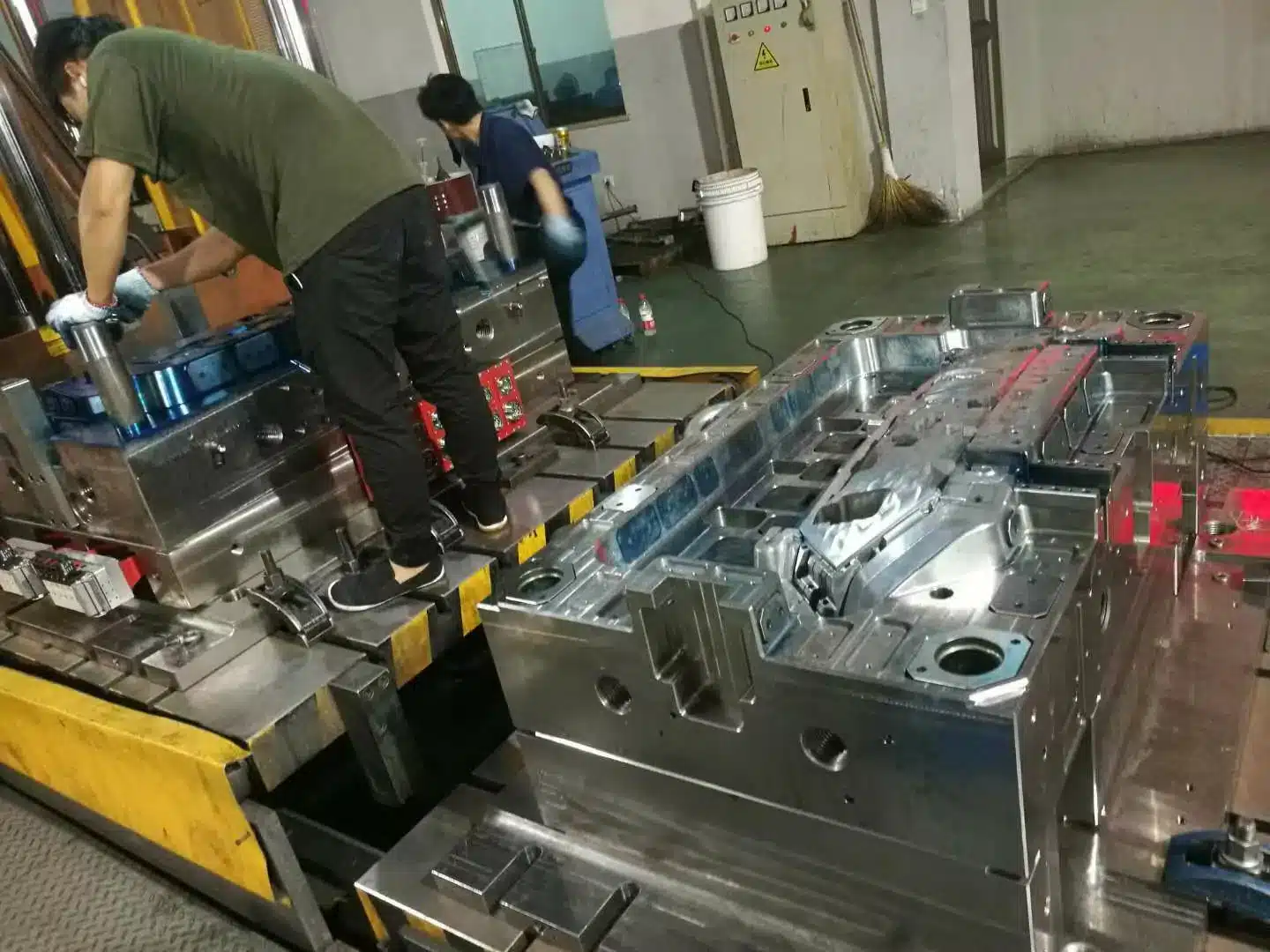

Mold Steel Showdown: P20 vs. 718H vs. H13 vs. S136 — Pick By Volume, Resin, and Finish — turn the murky decision into a clear matrix. This guide breaks down every steel grade by production volume, resin type, and surface finish requirement so your team buys right the first time.
Why Mold Steel Choice Directly Impacts Product Cost
Choosing the wrong mold steel is one of the most expensive mistakes in injection molding tooling. A steel grade that is too soft wears out prematurely on high-volume runs, inflating resurfacing and replacement costs. A steel grade that is over-engineered for a low-volume prototype adds unnecessary upfront tooling spend.
The four grades most commonly evaluated are P20, 718H, H13, and S136. Each one performs best within a specific intersection of production volume, resin type, and surface finish requirement. Understanding that intersection turns a confusing procurement decision into a straightforward matrix.
Mold Steel Showdown: P20 vs. 718H vs. H13 vs. S136 — Pick By Volume, Resin, and Finish
This is the core question every mold designer and procurement manager faces. The Mold Steel Showdown: P20 vs. 718H vs. H13 vs. S136 — Pick By Volume, Resin, and Finish — turn the murky decision into a clear matrix — comes down to three variables: how many parts you need, what resin you are running, and what surface the end-market demands.
Here is the top-level decision matrix:
| Steel Grade | Typical Hardness (HRC) | Best Production Volume | Compatible Resins | Surface Finish Capability |
|---|---|---|---|---|
| P20 | 28–32 | Low to mid (< 500K shots) | ABS, PP, PS, PC/ABS | Standard texture, light gloss |
| 718H | 30–36 | Mid to high (up to 1M shots) | ABS, PP, PA, PC/ABS | Standard to semi-gloss |
| H13 | 44–50 (after HT) | High (> 1M shots), abrasive resins | GF-PA, GF-PP, PPS | Standard, functional surfaces |
| S136 | 48–52 (after HT) | Mid to high, optical/medical | PC, PMMA, medical-grade resins | Mirror polish, high gloss |
Use this table as your entry point, then confirm against the sections below.
What Is P20 Steel and When Should You Use It?
P20 (also known as 1.2311 or 3Cr2Mo) is a pre-hardened plastic mold steel delivered at approximately 28–32 HRC. Because it ships pre-hardened, it eliminates the heat-treatment step, reducing lead time and tooling cost.
P20 works best for:
- Prototype and bridge tooling where volumes stay below 500,000 shots
- General structural parts made from ABS, PP, or PS
- Mid-complexity molds where texturing is standard and high polish is not required
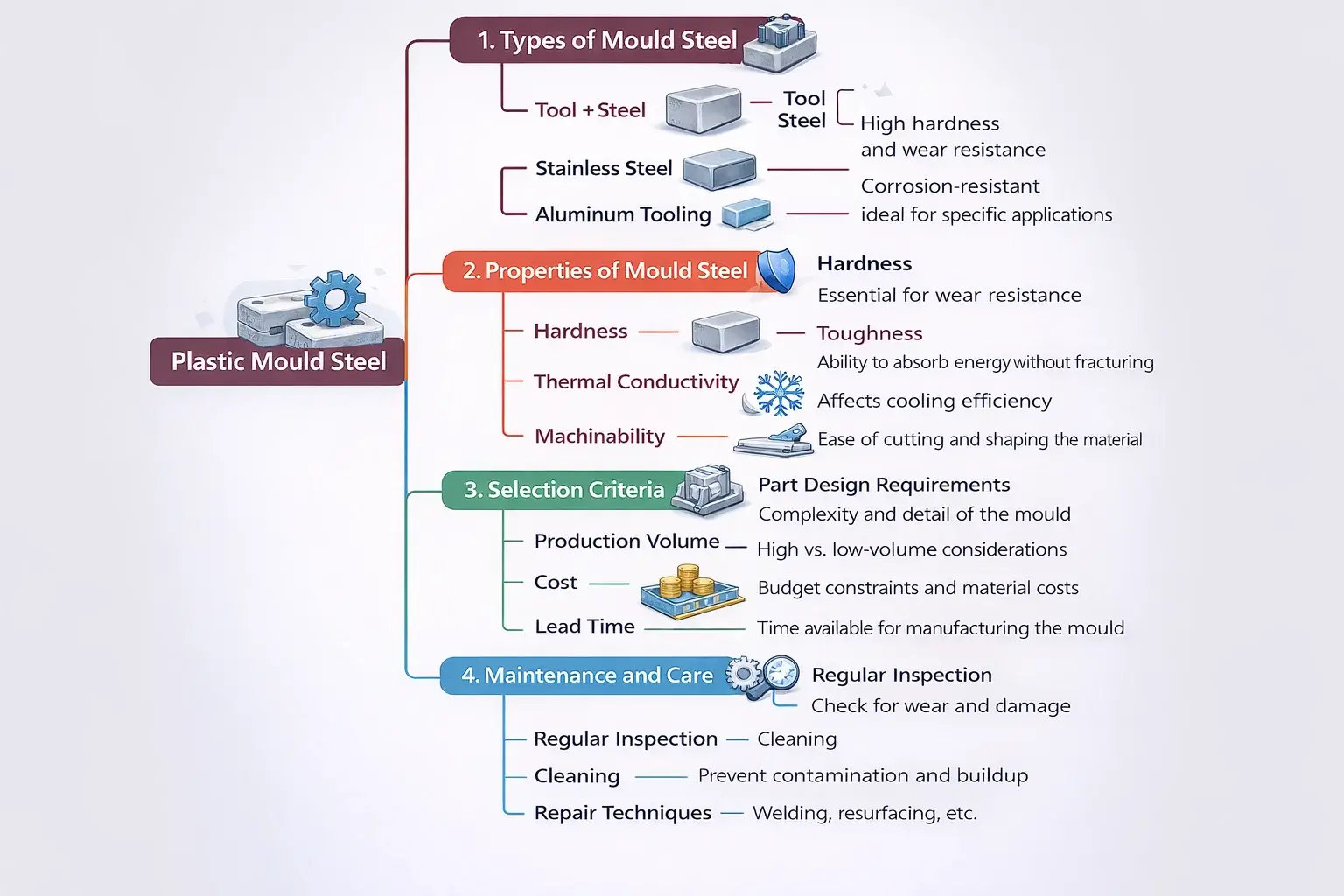
P20 does not perform well under abrasive glass-fiber resins or in environments requiring mirror-finish polishing. Its relatively moderate hardness means it wears faster when running PA66 GF or PPS. For a deeper look at how mould steel properties affect long-term tool performance, see our dedicated steel guide.
What Is 718H Steel and How Does It Differ from P20?
718H is a nickel-modified P20 variant engineered for large cross-sections. The nickel addition improves through-hardening, making it the preferred choice when the mold block exceeds the depth where standard P20 achieves uniform hardness.
Key differences versus P20:
- Hardness range: 30–36 HRC — slightly harder and more uniform in thick sections
- Cross-section performance: 718H maintains consistent hardness deeper into large mold bases
- Weldability: Both grades weld well, but 718H is commonly specified for large automotive or appliance molds where consistent toughness matters throughout
If your part is large, your mold block is thick, and you need reliable hardness at depth, 718H replaces P20 as the correct choice.
What Is H13 Steel and When Does It Outperform the Others?
H13 (AISI H13, DIN 1.2344) is a hot-work tool steel that requires heat treatment after rough machining, reaching a working hardness of 44–50 HRC. That hardness range makes it the go-to grade when abrasion resistance and elevated-temperature stability are the dominant requirements.
H13 outperforms P20 and 718H when:
- Running glass-fiber-reinforced resins such as PA66 GF30, PP GF, or PPS — these resins erode softer steels at the gate and in thin channels
- Cavity inserts around hot runner gates where thermal cycling and high injection pressure occur simultaneously
- High-volume production above 1 million shots on demanding structural parts
The tradeoff is longer lead time (heat treatment required) and higher machining cost due to its hardness. H13 is not the right choice for prototype tooling or simple cosmetic parts. When evaluating injection molding costs, the added lead time from heat treatment must be factored into your budget from the start.
What Is S136 Steel and Why Do Transparent Parts Need It?
S136 is a martensitic stainless mold steel that achieves 48–52 HRC after quenching and tempering. Its two standout properties are corrosion resistance and exceptional polishability.
S136 is mandatory or strongly preferred when:
- The part is optically transparent: PC lenses, PMMA light guides, acrylic covers
- The resin is corrosive or hygroscopic: PVC, flame-retardant grades, or resins that release acidic gases at melt temperature
- Medical or food-contact parts require rust-proof cavity surfaces between production runs
- Class-A cosmetic surfaces demand mirror polish (VDI 0–3 range)
S136 costs more than P20 and requires skilled polishing to achieve the SPI A1–A2 finishes that transparent parts demand. Justify the premium only when part requirements make lower grades technically unacceptable. For medical applications, also review FDA compliance and clean room requirements that govern cavity surface standards.
How Production Volume Drives Steel Selection
Volume is the first filter in the decision. Apply it before considering anything else.
- < 50,000 shots (prototype or low-volume): P20 covers most applications. The lower tool cost outweighs any wear concern.
- 50,000–500,000 shots (mid-volume): P20 or 718H depending on part size and resin. S136 enters the picture for optical or corrosion-sensitive applications.
- 500,000–1,000,000 shots: 718H for general resins; H13 inserts for gate areas; S136 for optical parts.
- > 1,000,000 shots: H13 for abrasive resins; S136 for optical/medical; 718H remains viable for non-abrasive, non-optical high-volume applications.
Volume-driven wear is not linear. Abrasive resins degrade soft steel at a disproportionate rate, collapsing a P20 tool’s effective life by 50–70% relative to a non-filled resin at the same shot count. Understanding how to scale injection molding costs with production volume will help you model the total cost of ownership for each steel option.
Which Resins Demand Which Steel Grades?
Resin chemistry and filler content directly determine minimum acceptable steel hardness.
| Resin Type | Filler / Characteristic | Minimum Steel Recommendation |
|---|---|---|
| ABS, PP, PS | Unfilled | P20 or 718H |
| PC, PMMA | Optical / high clarity | S136 |
| PC/ABS | Blend, moderate demand | P20, 718H, or S136 |
| PA66 GF30 | 30% glass fiber | H13 inserts at minimum |
| PP GF | Glass-filled | H13 or equivalent |
| PPS | High-temp, abrasive | H13 |
| PVC, FR grades | Corrosive off-gas | S136 |
| Medical-grade resins | Purity, rust-free | S136 |
For glass-fiber-reinforced resins, gate inserts and core pins should step up to H13 even when the main cavity block is 718H. The gate region sees the highest velocity and the most abrasive shear — it wears first. To understand how plastic material types impact final part dimensions, material selection and steel grade must be considered together.
How Surface Finish Requirements Narrow Your Options
Surface finish requirements eliminate steel grades from consideration quickly.
- Texture / SPI D (matte): Any grade works, including P20
- Semi-gloss / SPI B–C: P20, 718H, S136 all achieve this; H13 can, but its hardness makes polishing labor-intensive
- High gloss / SPI A3: 718H or S136 preferred
- Mirror polish / SPI A1–A2: S136 only — its fine carbide structure and corrosion resistance make it the only reliable choice for sustained mirror finishes
Attempting to mirror-polish P20 is possible but produces inconsistent results due to its softer matrix and tendency to pit. Toolrooms that try it typically require re-polishing after minimal production, negating any upfront savings. For a broader view of how surface finish standards are applied in injection molding, including SPI and VDI classifications, see our dedicated reference.
Hardness Ranges Explained: HRC Numbers That Matter
Understanding hardness ranges prevents misspecification:
| Grade | Delivery State | Working Hardness |
|---|---|---|
| P20 | Pre-hardened | 28–32 HRC |
| 718H | Pre-hardened | 30–36 HRC |
| H13 | Annealed (needs HT) | 44–50 HRC after heat treatment |
| S136 | Annealed or pre-hardened | 48–52 HRC after heat treatment |
Pre-hardened grades (P20, 718H) allow direct machining after receipt — a significant schedule advantage. Grades requiring heat treatment (H13, S136) must go through rough machining → heat treatment → finish machining, adding 2–4 weeks to the tooling timeline. For authoritative metallurgical data on these grades, ASM International publishes detailed property tables for H13, P20, and their international equivalents.
Cost Implications of Each Steel Grade
From lowest to highest material and processing cost:
- P20 — lowest material cost, no heat treatment, fastest lead time
- 718H — modestly higher than P20, similar lead time
- H13 — moderate material cost, heat treatment adds time and cost
- S136 — highest material cost, heat treatment required, polishing is skilled labor-intensive
For marketers managing tooling budgets, the cost hierarchy maps directly to required performance. Overspending on S136 for a non-optical ABS housing wastes tooling budget. Under-specifying with P20 on a glass-fiber structural part generates rework costs and shortened tool life that exceed the upfront savings. Our guide on how much it costs to get a plastic mold walks through all the cost drivers, including steel grade selection.
Can You Upgrade Steel Mid-Project?
Upgrading steel mid-project is costly and usually impractical. Once a mold block is machined, the investment in that material is sunk. Switching steel grade means rebuilding the tool.
The practical implication: get the steel selection right before cutting metal. Use the volume, resin, and finish matrix above during the design-for-manufacturing (DFM) review, not after tooling has started.
How Glass-Fiber Resins Accelerate Tool Wear
Glass-fiber-reinforced resins create abrasive wear at every point of high velocity: the gate, thin ribs, core pins, and ejector pin holes. In unfilled resin, a P20 mold may achieve 500,000+ shots before visible wear. With PA66 GF30, the same P20 mold may show gate erosion and dimensional drift at 100,000–200,000 shots.
The engineering response is to use H13 inserts in the gate area and for any core pins running through glass-filled flow paths, even when the primary mold body is a less expensive grade. The Society of Plastics Engineers (SPE) publishes technical papers on wear mechanisms in glass-filled resin tooling that provide deeper data for high-stakes material decisions.
Venting, Cooling, and Ejection: Does Steel Choice Affect Them?
Steel grade does not change the rules for vent depth, cooling geometry, or ejector clearance — those are governed by part geometry and resin. However, harder steels (H13, S136) tolerate tighter vent clearances over time without deforming. Softer steels may close up vent slots under repeated clamping pressure, requiring more frequent maintenance.
Cooling channel proximity rules apply equally across all grades: channel centerline to cavity surface at 1.5–2× the wall thickness, channel-to-channel spacing at 2–3× the channel diameter, and a minimum 5 mm clearance from ejector pins and other bores. For detailed cooling circuit design principles, see our guide on injection mold cooling. Simulation tools such as Autodesk Moldflow can validate gate placement, cooling efficiency, and warpage before any steel is cut.
FAQs
Is P20 suitable for PC parts?
P20 can run unfilled PC for moderate volumes and standard gloss surfaces. For transparent PC requiring SPI A-grade finishes or for high-volume production, S136 is the better specification. PC at melt temperature (280–320 °C) does not corrode P20, so corrosion resistance is not the limiting factor — polishability and hardness are.
Does 718H require heat treatment before use?
No. 718H is delivered pre-hardened at 30–36 HRC and can be machined directly. This is one of its key advantages for large mold bases where heat treatment would risk distortion in thick sections.
Can H13 be used for cosmetic exterior surfaces?
H13 can be textured and finished for functional cosmetic surfaces, but achieving mirror-polish on H13 is difficult and expensive due to its hardness. If the application requires SPI A1–A2 polish, S136 is the correct choice. H13 is best reserved for structural, wear-critical, or hot-runner-adjacent components.
How does S136 perform in humid or saltwater environments?
S136 is a martensitic stainless steel with good corrosion resistance, making it well suited for humid environments, medical clean rooms, and molds that sit idle between production runs. P20 and H13 require surface treatment or regular maintenance in the same conditions to prevent rust.
What is the typical lead time difference between P20 and H13 tooling?
Pre-hardened P20 tooling typically reaches first article faster than H13 tooling by 2–4 weeks, primarily because H13 requires a heat-treatment cycle between rough and finish machining. For development programs with tight timelines, this difference influences steel selection as much as performance does.
Can the same mold use different steel grades in different components?
Yes, and it is common practice. A typical approach pairs a 718H mold base with H13 gate inserts and core pins for glass-filled resins, or combines a P20 A-plate with S136 cavity inserts for optical parts. Mixing grades lets engineers allocate budget to the highest-wear or highest-finish areas without upgrading the entire tool.
Conclusion
The Mold Steel Showdown: P20 vs. 718H vs. H13 vs. S136 — Pick By Volume, Resin, and Finish — turn the murky decision into a clear matrix resolves when you apply three filters in sequence: production volume, resin abrasiveness, and surface finish requirement. P20 covers most low-to-mid-volume general applications. 718H extends that logic to larger or thicker mold blocks. H13 becomes necessary when glass-fiber or high-temperature resins are involved at significant volume. S136 is the only viable option for optical clarity and sustained mirror polish.
For marketers and procurement teams, the takeaway is straightforward: align steel grade to the intersection of these three variables early in the DFM process, and the tooling investment will match the production requirement without over- or under-spending.

