
Material Selection Guide
Nylon Injection Molding: Why It Punishes a Sloppy Molder Faster Than Any Other Resin
A customer once shipped us a competitor’s nylon bracket and asked us to copy it. We molded a batch that measured dead-on at the factory — every dimension inside print. Three weeks later they called. The parts had grown. Not warped: grown, a few thousandths across a bore, enough to bind the mating assembly on their line. Nothing was wrong with the tool. The nylon had simply done what nylon does — it pulled moisture out of the humid summer air and swelled.
That story is the whole reason this article exists, so I’ll start with the definition and then keep coming back to water.
Nylon Injection Molding Lives or Dies on How Dry the Pellets Are
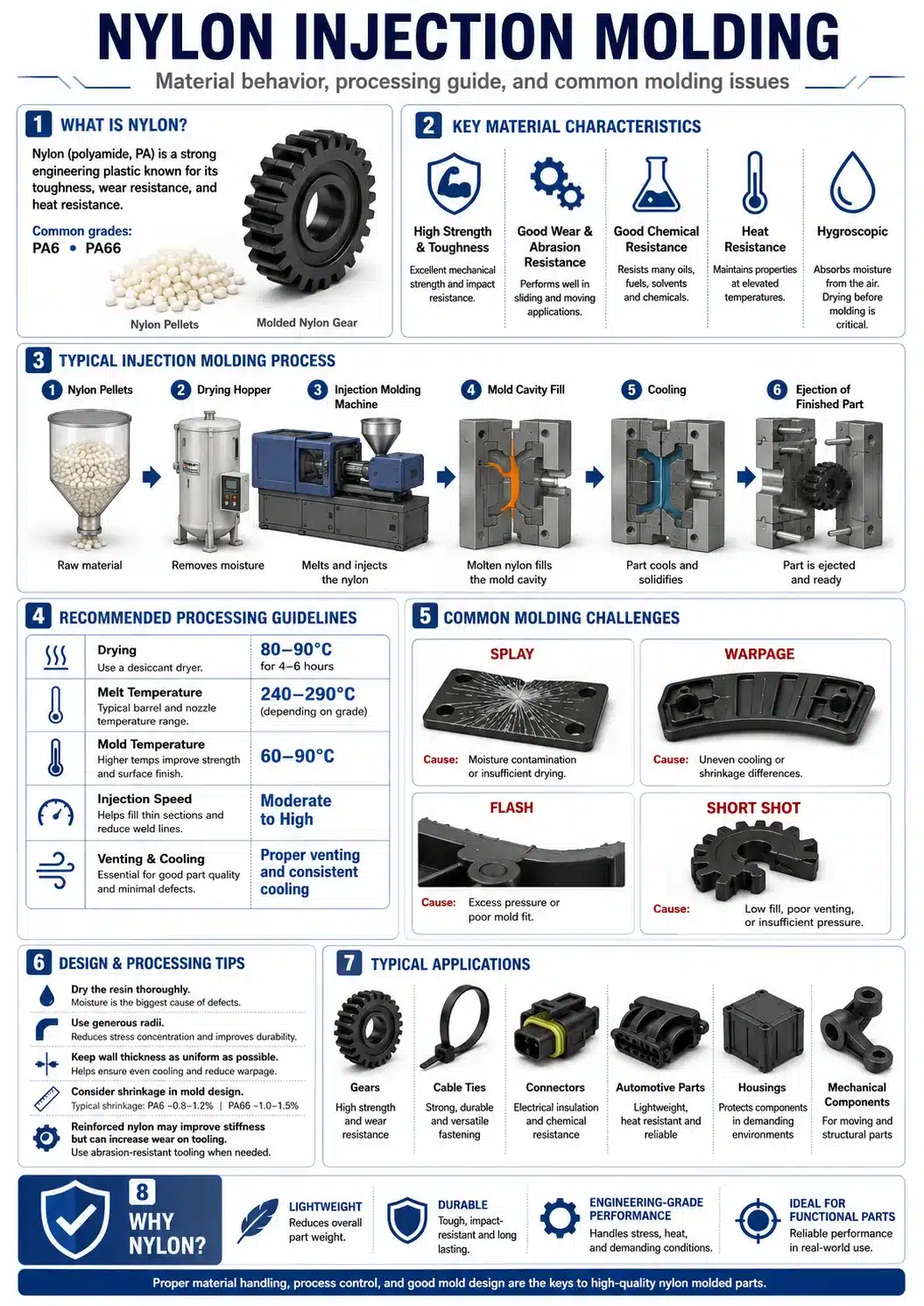
Nylon absorbs moisture from the air, and wet nylon molds into weak, ugly, dimensionally unreliable parts. Before processing, the resin has to be dried in a desiccant dryer to below roughly 0.2% moisture — typically around 80°C (176°F) for four hours. Skip that step and water in the melt turns to steam, which shows up as silver streaks and, worse, snaps the polymer chains.
That last part is the one that hurts. Moisture doesn’t just make the surface ugly. At nylon’s melt temperature, water hydrolyzes the polymer — it chemically chops the molecular chains shorter — and a part with shorter chains is a brittle part. Here’s the trap for a buyer: the part can look perfect. Right color, full, no obvious flash. But its impact strength is half what the datasheet promised, and you only find out when it cracks in the field six months later.
I’ve seen a shop run nylon straight from a freshly opened bag because the dryer was tied up on another job. The parts looked fine. They failed a drop test that the same part, properly dried, passed without a thought.
How do you, sitting in a sourcing chair, catch this? You ask the supplier two questions and watch how fast the answer comes. What’s your dryer setpoint and residence time for this resin, and how do you verify moisture before molding? A shop that dries nylon as a habit will answer in one breath — desiccant dryer, dew point monitored, sometimes a moisture analyzer on incoming lots. A shop that hesitates, or says “we leave it in the hopper overnight,” is telling you it dries with a regular hopper and ambient air, which does nothing for nylon. If your supplier can’t answer this cleanly, that’s your answer.
When Nylon Is the Right Call — and When You’re Paying for Nothing
Use nylon when the part needs real mechanical strength, heat resistance, or wear resistance — gears, load-bearing clips, anything that gets hot or slides against another part. Don’t use nylon for a cosmetic enclosure that just needs to look good and hold its shape. For that, ABS is cheaper, easier to mold, more dimensionally stable, and won’t drink water. Picking nylon for a glove-box-grade housing is a common, expensive habit.
Most over-specs I see come from a developer copying a datasheet from an unrelated product or from a well-meaning engineer who picked the strongest material on the shelf “to be safe.” Strength you don’t use is cost you do pay — in resin price, in drying, in tooling, and in the headaches below.
Here’s the rough decision map I’d give a buyer choosing among the usual suspects:
| Material | Reach for it when | Watch out for | Relative cost |
|---|---|---|---|
| Nylon (PA6 / PA66) | Strength, heat, wear, fatigue; gears, structural parts | Absorbs moisture; swells and moves in humidity; needs drying | Mid–high |
| ABS | Cosmetic housings, stable dimensions, easy molding | Low heat and chemical resistance | Low |
| POM (acetal) | Slippery, dimensionally stable precision parts, gears | Poor adhesion (hard to bond/paint); gassing concerns | Mid |
| PC | Clarity, high impact, heat | Notch-sensitive; needs careful gating | High |
| PP | Living hinges, chemical resistance, low cost | Low stiffness and strength | Lowest |
Two judgment calls people get wrong: nylon versus POM for gears, and nylon versus ABS for housings. For a gear that runs dry and needs fatigue life, nylon usually wins. For a gear that needs to hold a tight dimension in a humid environment, POM is the safer bet because it barely moves with moisture. And for a housing, if it’s cosmetic, just use ABS and stop overthinking it.
PA6 or PA66?
PA6 and PA66 are the two workhorse nylons, and for most parts the difference is smaller than the marketing suggests. PA66 has a higher melting point and a bit more stiffness and heat resistance, which is why it dominates under-hood automotive work. PA6 is slightly cheaper, flows a little easier into thin or detailed parts, and absorbs a touch more moisture.
If your part doesn’t see sustained high heat, PA6 will almost always do the job and quote a few cents lower. Reach for PA66 specifically when there’s continuous heat exposure or you need that extra rigidity — and expect a slightly narrower processing window, because PA66 runs hotter and freezes faster.
One practical note for sourcing in the US with tooling in China: both grades are widely stocked there, so neither one creates a supply problem. The grade choice should come from the part, not from what’s convenient.
What 30% Glass Fiber Actually Buys You
Adding glass fiber to nylon roughly doubles its stiffness and raises its heat resistance, at the cost of a rougher surface, more warpage, and a tool that wears faster. The standard workhorse spec is 30% glass-filled nylon (you’ll see it written as PA6-GF30 or PA66-GF30). That single spec covers a huge share of structural nylon parts.
The trade is real and worth understanding before you sign off on a DFM report. Glass makes the part stiffer and stronger, and it cuts shrinkage dramatically — unfilled nylon shrinks a hefty 1–2%, while 30% glass-filled drops to roughly 0.3–0.7%. But that lower shrinkage isn’t uniform. Glass fibers line up with the flow, so the part shrinks less along the flow direction than across it. That mismatch is what makes filled nylon warp.
Glass also reads on the surface — filled parts have a faintly fibrous, matte look and feel, and you can sometimes see fiber on a sharp edge. If your part is cosmetic and structural, raise this early. There are paint and mold-finish tricks, but the honest answer is that a glass-filled surface will never look like a polished ABS one.
A blunt rule: if you don’t have a clear reason to add glass, don’t. If you do — stiffness, heat, dimensional stability under load — go straight to 30% rather than dabbling at 13%, because 13% adds most of the abrasion downside with only part of the benefit.
Why Your Nylon Parts Warp
Nylon warps because it’s semi-crystalline and shrinks a lot, and glass fiber makes that shrinkage uneven across the part. Thick-to-thin wall transitions, ribs heavier than the wall they sit on, and gates that fill one end before the other all turn into bow, twist, or sink.
Most warp problems are designed in, not molded in. The fixes belong on the print before the steel is cut: keep walls uniform, keep ribs at roughly 50–60% of the wall thickness, add generous radii, and let the molder put the gate where the part fills evenly. On a flat glass-filled part, fiber orientation alone can pull a corner up — sometimes the only real fix is a tweaked gate or a slight reverse-crown machined into the tool.
If a supplier’s DFM report doesn’t mention wall uniformity or gate location on a glass-filled nylon part, they haven’t really looked at it.
The Dimension Nobody Warned You About: Nylon Moves After It Ships
Nylon absorbs water in service, not just during molding, and that absorbed water makes the part physically larger. PA6 can pick up a couple of percent moisture at equilibrium in a humid environment, and the part grows with it — measurably, on tight bores and long dimensions. This is the swelling that surprised my customer in the opening story.
For a buyer, this changes how you write tolerances. A nylon part measured dry-as-molded and a nylon part conditioned to ambient humidity are two different sizes. If your assembly has a tight fit, you have to decide which state your tolerance refers to, and you have to tell your supplier. Filled grades move less than unfilled — the glass doesn’t absorb water — which is one more reason structural nylon parts tend to be glass-filled.
Plain version: if dimensional stability in humidity matters to your part, either spec a glass-filled grade or look hard at POM instead. Don’t spec unfilled nylon for a tight-tolerance fit and then act surprised when it grows.
What Glass-Filled Nylon Does to the Mold
Glass fiber is abrasive, so glass-filled nylon scours the steel it flows through, especially at the gate. A soft mold steel that’s fine for ABS — common P20 — will erode at the gate and edges over a production run of filled nylon, opening up dimensions and degrading the surface as the tool wears.
For anything past a few thousand shots in glass-filled nylon, the tool should be cut from hardened steel, and high-wear areas like gates may need extra-hard inserts or a surface coating. This is a money issue, not a detail. A buyer who specs glass-filled nylon into a “cheap P20 tool” quote is setting up a mold that wears out early and a second tooling bill nobody budgeted for.
When you compare two tooling quotes for a glass-filled part and one is noticeably cheaper, ask what steel it’s cut from. That gap is often the answer.
Reading a Nylon Quote Without Getting Burned
The red flags in a nylon quote are mostly about what’s missing. A quote that names the exact grade (PA6-GF30, not just “nylon”), specifies hardened steel for a filled part, and mentions drying or a moisture spec is from someone who has molded the material. A quote that just says “nylon, P20 tool” on a structural glass-filled part is from someone who hasn’t thought it through — or is hoping you won’t.
Things worth confirming in writing before you release a PO:
- Exact resin grade and supplier, not just “nylon.” Glass percentage matters; so does whether it’s a heat-stabilized or impact-modified grade.
- Tool steel, especially for glass-filled parts. Hardened steel for production volumes.
- Drying process — desiccant drying, with a moisture target.
- Which moisture state your dimensions refer to (dry-as-molded vs. conditioned).
- Gate location and number, since it drives warp and weld lines on nylon.
You don’t need to be an engineer to ask these. You need to ask them and notice who answers smoothly.
What Actually Drives the Price
Nylon part cost is driven by resin grade, glass content, part size and wall thickness, cycle time, and tooling steel — in roughly that order for most jobs. Resin sits above PP and ABS and varies with grade and the petrochemical market, so treat any per-kilo figure as a moving target; evidence varies by source and month. Glass fill changes the math in two directions: glass is cheap as a filler, but it forces harder tooling and slower, more careful processing.
Where buyers lose money isn’t usually the resin — it’s the second tool. A glass-filled nylon part run in soft steel wears the mold, and the “savings” on the first quote get spent twice over re-cutting gates or building a replacement. Spend the money on the right steel once.
The other quiet cost is cycle time. Nylon’s high mold temperatures and the cooling needed to set a thick semi-crystalline part add seconds per shot, and over a six-figure production run, seconds are dollars. Uniform thin walls cool faster and cost less — another reason wall design pays for itself.
Complete Nylon Injection Molding Settings Guide
🎯 Key takeaway: Nylon (PA6/PA66/PA12) injection molding requires special settings due to nylon’s hygroscopic nature, low viscosity, and fast cooling. Drying is mandatory to prevent splay marks, voids, and strength reduction.
Nylon Type Comparison (PA6 vs PA66 vs PA12)
Temperature Parameters
| Parameter | PA6 | PA66 | PA12 |
|---|---|---|---|
| Melt Temperature | 230–260°C (446–500°F) | 270–295°C (518–563°F) | 230–300°C (446–580°F) |
| Barrel Temperature | 230–250°C | 260–290°C (suggest 280–290°C) | 230–280°C |
| Nozzle Temperature | 230–250°C | 280–290°C | 230–280°C |
| Mold Temperature | 60–100°C (70–90°C) | 80–100°C | 30–40°C |
| Drying Condition | 80°C × 4–6 hours | 80°C × 6–8 hours | 85°C × 4–5 hours |
| Target Moisture | <0.2% | <0.2% | <0.1% |
Key difference: PA66 has a higher melting point (255–260°C) and therefore requires higher processing temperatures.
Reinforced Nylon Settings
Glass-Filled Nylon
| Parameter | PA6 GF | PA66 GF |
|---|---|---|
| Melt Temperature | 250–300°C (482–572°F) | 280–300°C (536–572°F) |
| Mold Temperature | 90–110°C | 80–100°C |
| Injection Pressure | 75–125 MPa | 80–140 MPa (≥30% GF: 285–305°C) |
| Injection Speed | High (slightly lower) | Medium–High (reduce fiber breakage) |
| Screw Speed | 30–60 RPM (lower) | 30–60 RPM |
| Back Pressure | 20–80 bar | 2–5 MPa |
Note: Higher mold temperature increases crystallinity and strength but reduces toughness.
Flame Retardant Nylon
| Parameter | PA6 FR | PA66 FR |
|---|---|---|
| Melt Temperature | 225–260°C | 265–290°C |
| Max Nozzle Temp | ≤290°C | ≤290°C |
| Mold Temperature | 54–93°C (130–200°F) | 50–90°C |
| Drying | 82°C × 2 hours | 80°C × 2–4 hours |
| Injection Pressure | 69–103 MPa | 50–100 MPa |
Warning: Temperatures >300°C combined with long residence time cause FR additive degradation.
Special Application Settings
Thin-Wall Parts (<3mm)
| Parameter | PA6 | PA66 | PA12 |
|---|---|---|---|
| Mold Temperature | 80–90°C (higher for long flow) | 80–100°C | 80–90°C |
| Injection Speed | High (fast freeze-off) | High | High |
| Injection Pressure | Up to 180 MPa (1800 bar) | 80–140 MPa | ≤100 MPa |
| Wall Thickness | 0.76–2.92 mm | Similar | Similar |
| Cooling Time | Sufficient for crystallization | Slightly longer | 20–60 seconds |
Key: Higher mold temperature improves crystallinity and surface finish on thin-wall, long-flow parts.
Thick-Wall Parts (>3mm)
- Mold Temperature: 20–40°C (cold mold)
- Benefit: Higher, more uniform crystallinity
- Injection Speed: Moderate (prevent voids)
General Parameter Summary Table
| Parameter | PA6 Std | PA66 Std | PA12 Std | Glass-Filled | Flame Retardant | Thin-Wall |
|---|---|---|---|---|---|---|
| Melt Temp | 230–260°C | 270–295°C | 230–300°C | 250–300°C | 225–260°C | 230–280°C |
| Mold Temp | 70–90°C | 80–100°C | 30–40°C | 90–110°C | 54–93°C | 80–90°C |
| Inj. Pressure | 100–160 MPa | 80–140 MPa | ≤100 MPa | 75–125 MPa | 69–103 MPa | Up to 180 MPa |
| Inj. Speed | High | Medium–High | High | High (lower) | High | High |
| Drying | 80°C/4–6h | 80°C/6–8h | 85°C/4–5h | Same | 80°C/2–4h | Same |
| Back Pressure | 20–80 bar | 2–5 MPa | Low | 20–80 bar | Low | Low |
| Screw Speed | 30–60 RPM | 30–60 RPM | Medium | 30–60 RPM | Medium | Medium |
Critical Precautions
Common Issues & Prevention
| Issue | Preventive Measure |
|---|---|
| Hydrolysis (property loss) | Always dry properly before use |
| Splay marks / voids | Keep moisture <0.2% |
| Burn marks | Avoid overheating and excessive residence time |
| Flash | Optimize pressure and clamping force |
| Warping | Uniform cooling, balanced mold temperature |
| Coking | Good mold ventilation (nylon is prone to coking) |
| Degradation | Max 6 min residence time (<2 min at high temp) |
Moisture Control
- PA6: <0.2% (0.25% already changes molding behavior)
- PA66: <0.2% (FR grades <0.05–0.10%)
- PA12: <0.1%
Post-Treatment Options
- Annealing: 60–80°C oven for 4 hours (relieves internal stresses)
- Water conditioning: 75–90°C warm water for 1 hour (improves mechanical properties)
Quick Operation Checklist
- Dry resin — select temperature and time by nylon type.
- Set temperatures — choose melt and mold temp by nylon type.
- Pressure settings — thin-wall parts use higher pressure (up to 180 MPa).
- Speed control — thin-wall = high speed, thick-wall = medium speed.
- Residence time — keep <6 min (high temp <2 min).
- Mold ventilation — prevent coking.
- Post-treatment — anneal or water-condition if needed.
FAQ
Does nylon need to be dried before molding?
Yes, always, and it’s not optional. Nylon is hygroscopic and absorbs moisture from the air within hours of opening a bag. Molding wet nylon causes silver streaking and, more seriously, chops the polymer chains so the part comes out brittle. It must be desiccant-dried to roughly 0.2% moisture before processing.
Which is stronger, PA6 or PA66?
PA66 is slightly stiffer and handles higher continuous heat, which is why it’s favored for under-hood automotive parts. PA6 is a bit easier to mold and a little cheaper, with strength that’s more than enough for most consumer and industrial parts. For typical applications the practical difference is small.
Why does glass-filled nylon warp more than unfilled?
The glass fibers align with the flow during filling, so the part shrinks less along the flow direction than across it. That uneven shrinkage pulls the part out of shape. Uniform walls, correct rib proportions, and good gate placement control it; gate position is often the deciding factor.
Is nylon more expensive than ABS?
Yes. Nylon resin generally costs more than ABS, and it adds drying, higher processing temperatures, and — for glass-filled grades — harder tooling. If a part only needs to look good and hold its shape, ABS is the cheaper and easier choice. Nylon earns its cost when you need strength, heat, or wear resistance.
Can nylon parts hold tight tolerances?
They can, but you have to account for moisture. Nylon absorbs water in service and grows, so a dimension measured dry-as-molded won’t match the same part after it’s been in humid air. For tight fits, specify a glass-filled grade (which moves less) and tell your supplier which moisture condition your tolerance refers to.
What tool steel should be used for glass-filled nylon?
Hardened steel for any meaningful production volume, with extra-hard inserts or coatings at the gate where abrasion is worst. Soft P20 erodes under glass-filled nylon and opens up dimensions over a run. A tooling quote that uses soft steel for a filled-nylon part is usually too cheap for the wrong reason.
What’s the difference between nylon and POM for gears?
Nylon offers better fatigue life and impact resistance and runs quieter, making it good for gears that take shock loads. POM is more dimensionally stable in humidity and has a lower friction coefficient, making it better where tight, consistent dimensions matter. A gear in a humid environment usually points to POM; one needing toughness points to nylon.
The One Rule to Take Away
If you remember nothing else: nylon and water are the whole story. A molder who controls drying and accounts for in-service moisture will give you strong, stable parts; one who doesn’t will hand you parts that look perfect and fail anyway. Before you compare prices, find out whether your supplier treats nylon as a material that needs respect or as just another pellet in the hopper. That single answer tells you more than the quote does.
Not sure whether your part actually needs nylon, or which grade and steel spec it should be quoted against? Send us the drawing — we’ll run a free DFM review and tell you straight.

