
PEEK Injection Molding Sourcing
China PEEK Injection Molding Manufacturer: What Buyers Should Actually Vet
PEEK is the material people reach for when nothing else survives. Continuous service at 250°C. Autoclave cycles. Jet fuel contact. Implants that sit in a body for ten years.
A China PEEK injection molding manufacturer is a Chinese factory equipped and qualified to mold polyetheretherketone at 380–400°C barrel and 170–200°C mold temperatures. That requires tool steels and dryers built to take it. Most Chinese injection molders cannot do this work. The ones who can are a small, identifiable group. Know that before you send your first RFQ.
I’m Steven Cheng. Twenty years around injection molding in Zhejiang. PEEK doesn’t cross our quoting desk weekly — maybe once a month. Roughly half the time, the buyer has already been burned by a shop that took the job and shouldn’t have. This is the conversation I wish more buyers had with themselves first.
What “PEEK-capable” actually means on the floor of a Chinese shop
Skip the marketing pages. A shop that genuinely runs PEEK has four things, and you can verify all four in a video call.
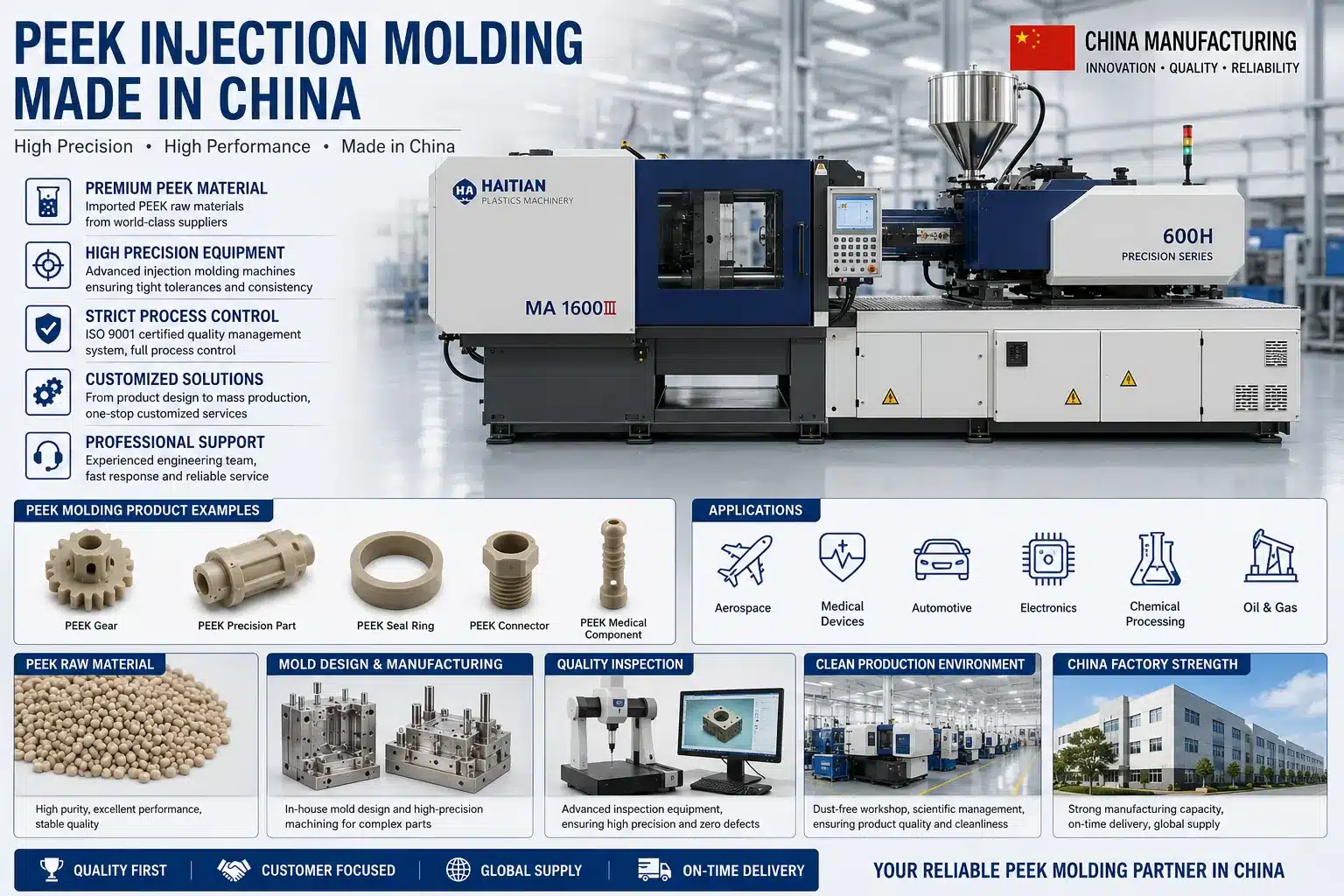
Press that holds 400°C barrel temperature without struggling. Most Chinese workhorse presses top out around 350°C. Fine for nylon, glass-filled PA, PPS at the edge. PEEK needs the next tier: high-temperature barrel package, ceramic heaters, a screw geometry built for high-viscosity polymers. Usually a tungsten-coated or bimetallic screw and barrel, because PEEK gets abrasive when filled with carbon or glass.
Desiccant dryer that hits 150°C for at least 3 hours, dew point below -40°C. PEEK absorbs moisture slowly, but it absorbs it. Mold wet PEEK and you get hydrolysis at melt temperature. That’s invisible chain scission that destroys the mechanical properties you paid for. A shop using a hot-air dryer for PEEK is a shop you walk away from.
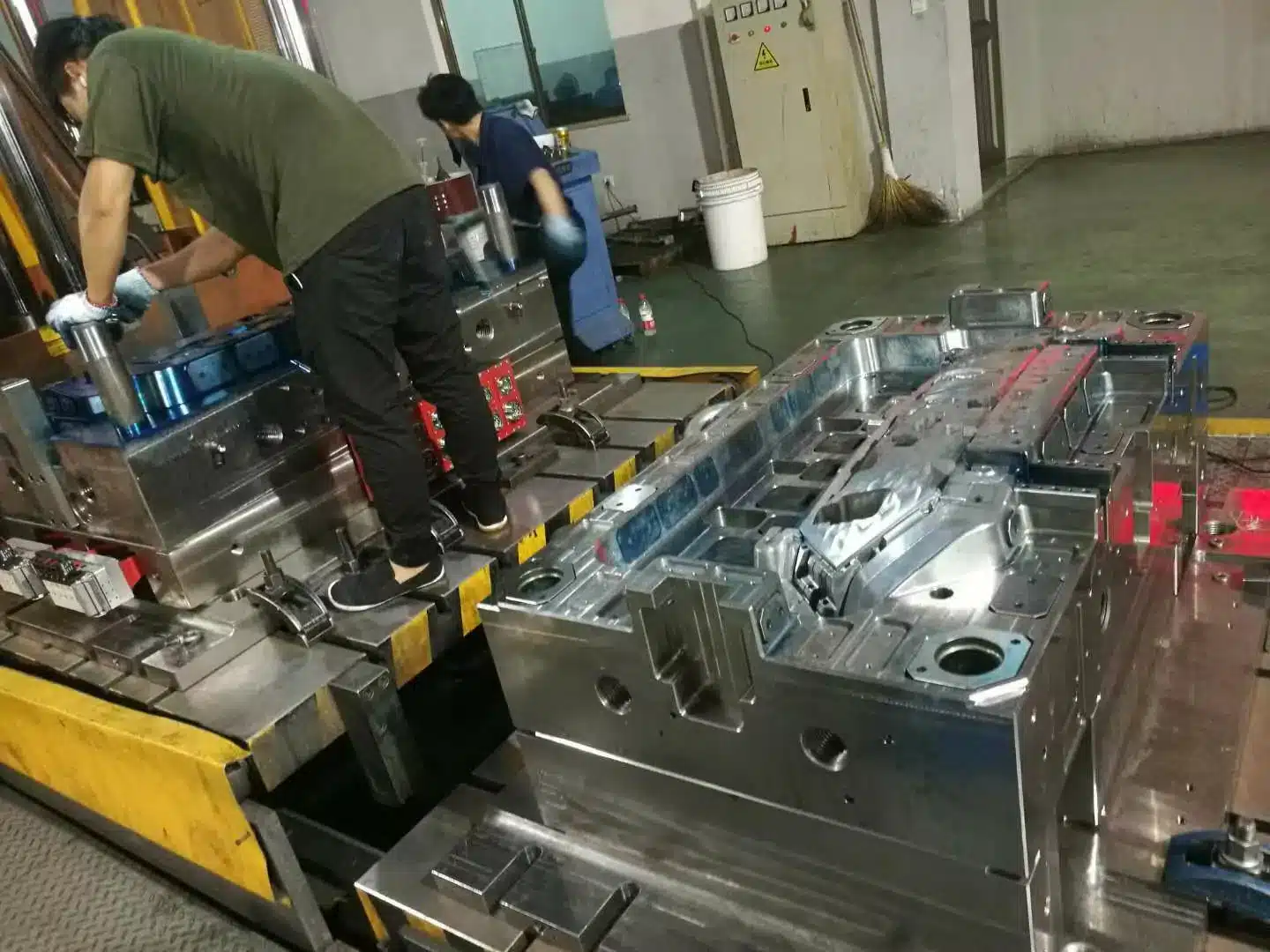
Mold built in H13 or, better, 1.2344 ESR or a maraging steel at the gate area, hardened to 48–52 HRC. Mold temperatures of 180°C cycle steel hard. P20 — the default for ABS, PP, PC — doesn’t last. You’ll see gate wear and parting line wash inside 50,000 shots.
Oil temperature controller that actually reaches 200°C. Not a water unit pretending. Two zones minimum. More if the part is anything but trivial. Without high mold temp, crystallinity collapses. A “PEEK” part with low crystallinity has the chemical resistance of cheap nylon.
Ask a supplier to walk you through these four points on video. If they pivot to “don’t worry, we have experience” — that’s your answer.
Why source PEEK molding from China at all
Honestly, some buyers shouldn’t. If your annual volume is under 5,000 parts and the application is medical-implant grade, the cost-of-failure math usually favors a US or European molder with full ISO 13485 traceability. Resin traceability outweighs mold cost there.
But if you’re making PEEK seals, semiconductor wafer carriers, oil & gas backup rings, aerospace brackets, or industrial bearings at 10,000+ parts a year — the China case is real. Two reasons.
Tooling cost. A PEEK mold built in H13 with hot runners in China typically lands at 30–55% of a comparable US-built tool. I’ve quoted $18,000 against US quotes of $42,000 on the same drawing, same steel callout. The gap closes on qualification overhead. If your part needs FAI, PPAP, full material certs traced to Victrex or Solvay lot numbers, the Chinese supplier does the same paperwork. That work costs the same everywhere.
Cycle cost. Chinese PEEK molders running 24/7 with operators trained on the material hit cycle times competitive with anywhere. The labor delta is smaller than it used to be. PEEK isn’t a hand-finishing material. Still meaningful at volume.
A blunt opinion on who NOT to use
If a supplier lists PEEK alongside fifty other materials in a “we can mold anything” section, with no case study, no reference, no material partner named — they are quoting your job hoping to figure it out on yours. This is common enough that I’d call it the default risk in the China sourcing pool.
A real PEEK shop names its resin supplier. Victrex. Solvay (KetaSpire). Evonik (Vestakeep). Jilin University’s domestic JUSEP. They tell you which grades they’ve run. They produce DSC curves showing crystallinity for past parts. If they can’t, you’re paying tuition.
What PEEK actually costs to mold in China — rough numbers
Practitioner ranges. Not a quote.
| Cost element | Typical range (China, 2025) | Notes |
|---|---|---|
| Resin (unfilled PEEK, virgin) | $80–$110 per kg | Victrex PEEK 450G street price; JUSEP grades $40–$70 |
| Resin (30% glass-filled) | $70–$95 per kg | Lower because filler displaces resin |
| Resin (30% carbon-filled) | $110–$160 per kg | Carbon fiber adds cost and machine wear |
| Mold (single cavity, simple part, H13) | $8,000–$22,000 | Hot runner adds $4,000–$9,000 |
| Mold (4-cavity, medium complexity) | $25,000–$55,000 | — |
| Cycle time, 10g part | 35–60 seconds | Versus 18–25 for ABS — PEEK takes longer to crystallize |
| Scrap rate, validated process | 2–5% | First runs can hit 15% if process windows aren’t dialed |
Resin is the budget line. On a 10g part, you’re looking at roughly $0.80–$1.10 of resin alone. That’s an order of magnitude above ABS. Buyers who assume the per-part economics will look like a normal commodity part are setting themselves up for sticker shock.
How to read a quote that’s suspiciously cheap
I’ve seen quotes come back from China for PEEK parts at 40% of what we’d quote. The buyer asks me whether to take it. Sometimes the answer is yes — the other shop has standing PEEK orders and is filling capacity. More often, one of these is happening:
- They’ve quoted PEEK-equivalent grades — Chinese PAEK blends that look like PEEK on a spec sheet but aren’t PEEK. For commodity industrial parts this may be fine. For medical or aerospace, it’s a disqualification.
- They assume they can run it on a standard 350°C press without telling you. The parts will mold. They’ll also be brittle and fail your incoming inspection if you test them properly.
- They skipped drying validation. First run looks acceptable. The fifth run, when the resin bag has been open for two shifts, doesn’t.
- They’ve quoted P20 for the mold steel. First 5,000 parts come out fine. By shot 30,000, the gate has washed and parts are out of tolerance.
Ask for the material datasheet they’re quoting. Ask the press by tonnage and barrel temperature rating. Ask what mold steel, what hardness. Vague answers mean the quote is fiction.
The drying question, because it kills more PEEK jobs than anything else
PEEK absorbs about 0.5% moisture at equilibrium. Sounds harmless. It isn’t.
At 400°C, water in the melt drives hydrolysis. Polymer chains break. The part looks fine — same color, same surface, same dimensional check. But tensile strength drops 20–40%. The part fails under load months later, in the field, where you can’t recall it cheaply.
The fix is boring and non-negotiable. 150°C desiccant drying, 3 hours minimum, dew point below -40°C, hopper covered, resin loaded directly from the dryer to the throat with no exposure to ambient air. In a humid Zhejiang or Guangdong summer, an uncovered hopper sitting for an hour will reabsorb enough moisture to matter.
Audit a PEEK shop and look at the dryer first. Is it a real desiccant unit — Conair, Motan, Wittmann, or a credible Chinese clone — or a hot-air box? Does the dew point meter work? Did anyone write down the drying time on the production log? Blank log, no discipline.
Tool steel matters more than buyers think
For ABS or PP, P20 pre-hardened steel is fine for a million shots. For PEEK, especially filled grades, it isn’t.
Glass-filled PEEK is moderately abrasive. Carbon-filled PEEK is genuinely abrasive. Add mold temperatures of 180°C — which softens P20 over time — and you get gate wear, parting line wash, dimensional drift. I’ve seen tools designed for 200,000 shots fail dimensional check at 60,000 because someone valued the lower steel cost.
What to put on your drawing:
- Cavity and core: 1.2344 ESR (premium H13) hardened to 48–52 HRC. Stavax/S136 if the part is medical and needs corrosion resistance.
- Gate area inserts: separately replaceable, hardened higher (54–58 HRC). Refresh them without rebuilding the cavity.
- Ejector pins: nitrided.
- Hot runner (if used): a real brand — Mold-Masters, Synventive, YUDO, INCOE — rated for 400°C melt. Cheap Chinese hot runners cooked to 380°C fail within months.
A China PEEK injection molding manufacturer that builds in proper steel costs more upfront. It saves you money by year two. The buyers who get burned are the ones who optimized the mold quote and ignored the steel callout.
What good PEEK molding looks like on the floor
Direct answer: a validated PEEK process holds barrel temperatures of 380–400°C across all zones, mold temperature 170–200°C oil, injection speed moderate, back pressure 5–10 bar, cycle time roughly 2x a comparable nylon part.
PEEK shears predictably and doesn’t like very fast fill. Crystallization takes time, which is why cycles run long.
When you visit the shop or watch a video, look at these:
- Hopper temperature stable, dryer running.
- Operator wearing heat-resistant gloves — the mold radiates seriously at 180°C.
- Purge compound on hand for shutdown. PEEK left in a hot barrel during a stoppage degrades. You can’t just pause.
- Process documentation visible at the press.
Ask the operator the barrel zone setpoints from memory. If they can’t tell you, the discipline isn’t there.
Certifications that actually matter for PEEK work
Not all certifications are equal here. For a US buyer, the ones that move the needle:
- ISO 9001 is table stakes. Assume every shop has it. It tells you almost nothing.
- ISO 13485 matters if your part is medical. The audit is real. Shops that hold it have invested in traceability you’ll need.
- IATF 16949 matters if your part is automotive. Less common in PEEK work. Still relevant for some powertrain and EV applications.
- AS9100 matters for aerospace. Rare among Chinese PEEK molders. A real differentiator when present.
- USP Class VI testing on the specific resin lot matters for medical parts touching the body or fluids. Ask whether the supplier produces lot-traceable certs from Victrex or Solvay.
- REACH and RoHS — assume yes, get the documents.
What doesn’t really matter: generic “high-tech enterprise” certificates from local Chinese governments, vague “PEEK specialist” awards, and certifications from organizations you can’t find on a regulator’s website.
Common defects on first-article PEEK parts from China
Three failure modes account for most of what crosses my desk.
Brittleness from inadequate drying. Part looks great, snaps in your hand. That’s hydrolysis. Reject the lot, fix the dryer.
Warpage from low mold temperature. The shop ran the mold at 120°C because their oil unit couldn’t reach 180°C. Crystallinity is wrong. The part has internal stress and cups as it cools. No amount of process tweaking fixes a mold temperature that’s too low. You need the right thermal control.
Sink and short shots from undersized gates. PEEK is viscous. Gates sized for nylon will hesitate. If the DFM doesn’t show gates 30–50% larger than you’d use for equivalent nylon, push back.
See these on the first FAI? Not necessarily out of luck — they’re fixable. But they tell you the supplier was learning on your tool. That conversation needs to happen.
What to put in your RFQ to filter the field
If I were sourcing PEEK in China today, my RFQ would force the supplier to demonstrate capability in writing, before I cared about price.
- Which PEEK grade(s) have you molded in the last 12 months? Provide three example part photos with grade name.
- Resin supplier name and a sample material certificate.
- Press tonnage and barrel temperature rating for the press you’d run this on.
- Dryer brand, model, and drying log sample from a recent PEEK job.
- Mold steel specification and heat treatment process.
- Hot runner brand if hot runner is proposed.
- Cycle time estimate and crystallinity verification method — DSC, density, or annealing study.
A serious shop fills that out in a day. A shop that can’t either won’t come back, or sends a generic capability deck. Either way, you’ve filtered.
Frequently Asked Questions
Is PEEK molded in China the same as PEEK molded in the US?
Same resin when Victrex or Solvay material is used — it’s the same lot, shipped globally. What differs is process control, quality system maturity, and traceability rigor. A top-tier Chinese shop running genuine Victrex PEEK delivers parts indistinguishable from a US molder. A bottom-tier shop using unverified Chinese PAEK blends does not.
Can I use Chinese domestic PEEK resin instead of Victrex or Solvay?
For non-critical industrial parts, often yes. JUSEP and a few other Chinese producers make legitimate PEEK at lower prices. For medical, aerospace, or anything safety-critical, stay with Victrex, Solvay, or Evonik. The lot consistency and regulatory documentation aren’t equivalent yet.
How long should a PEEK mold last in production?
A properly built H13 mold with hardened gate inserts should give 500,000+ shots on unfilled PEEK and 200,000+ on glass- or carbon-filled grades. P20 tools don’t last that long with PEEK. A supplier quoting P20 for high-volume PEEK is either misadvising you or planning for you to come back for a replacement.
What’s the minimum order quantity that makes Chinese PEEK molding worthwhile?
Tooling amortization is the driver. Below roughly 2,000 parts a year, tooling savings rarely justify the freight, lead time, and supplier-management overhead. Above 10,000 parts a year, the case is usually strong. The middle depends on part complexity and your engineering bandwidth.
Do I need to be on-site for first article inspection?
For PEEK, ideally yes — or hire a third-party inspection firm in China to attend. The defects that matter most (hydrolysis brittleness, low crystallinity) aren’t visible on a dimensional report. Someone who knows PEEK needs to handle the parts, do a flex test, and ideally pull a DSC scan.
What lead times are realistic?
Tooling for a moderate-complexity PEEK mold: 6–10 weeks. First articles: 2 weeks after tool completion. Production runs: 4–8 weeks depending on quantity. Resin lead time can extend this. Victrex inventory in China isn’t always deep, and a 200kg order may need 4 weeks if the grade isn’t stocked.
Will a Chinese supplier sign an NDA and honor it?
The NDA gets signed. Enforcement is the harder question. For PEEK applications where your competitive advantage sits in part geometry rather than a trade secret in material processing, NDAs work reasonably well. For genuinely proprietary processes, layer the protection: split the tool across two suppliers if possible, file design patents in China before disclosure, and keep critical post-molding steps in your own facility.
The one rule worth remembering
Vet the dryer and the press before you negotiate price. A China PEEK injection molding manufacturer that can show you a desiccant dryer with a working dew point meter, plus a press rated for 400°C, both running, both logged — that’s a serious supplier. Everything else — certifications, brochures, sales pitches — is downstream of those two pieces of hardware. Get the hardware question answered first. Most of the rest of the evaluation gets easier.
The buyers who get burned on PEEK in China aren’t the ones who chose China. They’re the ones who treated PEEK like ABS and chose on price.
Sourcing a PEEK part and want a second opinion on the mold steel or process spec before you commit?
Get a Free DFM Review
