
Plastic Mold Wall Thickness Rules That Protect Your Tooling Budget
Learn how plastic mold wall thickness — the steel plate dimensions in mold bases — affects tool life, deflection, and sourcing decisions.
What Is Plastic Mold Wall Thickness?
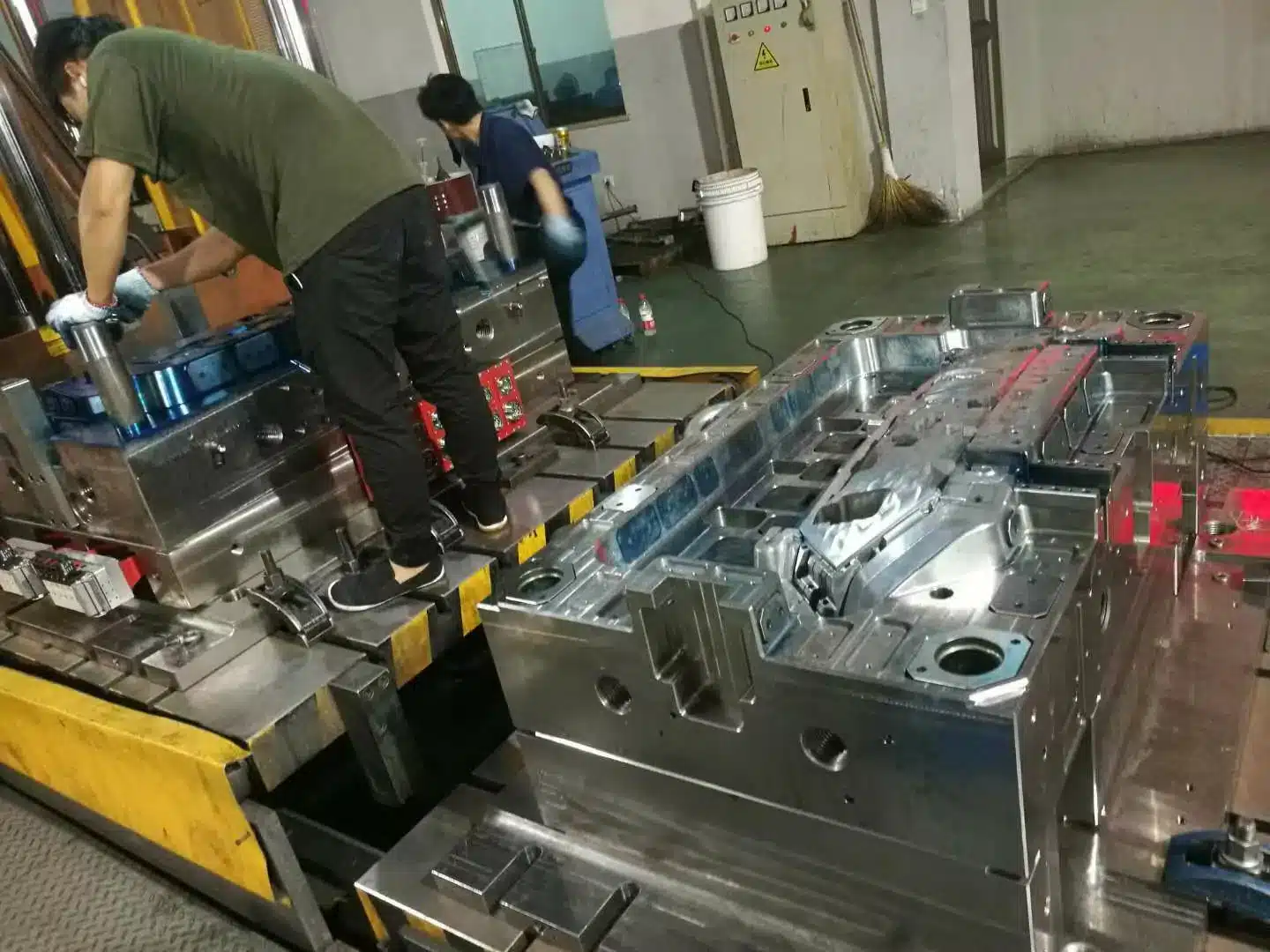
In injection mold construction, plastic mold wall thickness refers to the thickness of the steel plates that form the structural body of the mold — not the thickness of the plastic part being produced. These plates include the cavity plate, core plate, support plate, backing plate, and clamping plates. Together, they bear the full clamping force of the injection molding machine and contain the pressure of molten resin during every shot cycle.
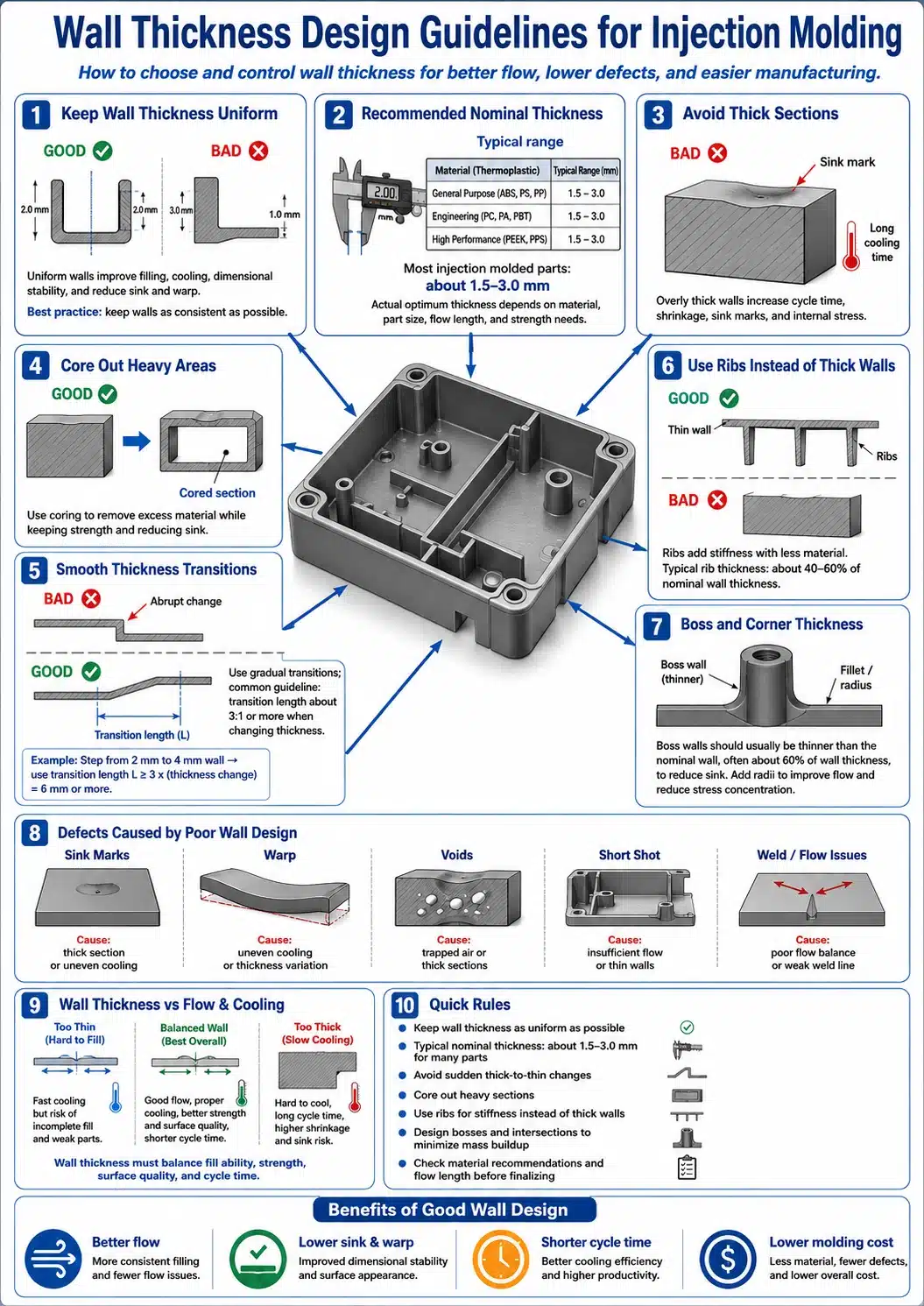
This guide explains how those steel dimensions are specified, why they matter to product quality and tooling longevity, and what marketers need to know when evaluating supplier quotes or reviewing tooling designs.
Why Does Mold Plate Thickness Matter for Marketers?
Mold plate thickness is not purely an engineering detail. It directly affects:
- Tooling cost — thicker plates require more raw material and machining time
- Mold lifespan — undersized plates deflect under clamping pressure, accelerating wear and causing dimensional inconsistency
- Part quality — plate deflection causes flash, dimensional variation, and parting line mismatch
- Maintenance frequency — molds built with marginal plate thickness require more frequent repair
- Supplier risk — low-cost quotes sometimes hide plate thickness reductions that compromise long-term performance
For marketers managing vendor selection, product launches, or tooling investments, understanding mold plate thickness helps you distinguish a well-engineered tool from a cost-cut one.
What Are the Key Steel Plates Inside an Injection Mold?
A standard injection mold base consists of several distinct steel plates, each with a specific structural role:
- Cavity plate (A plate) — contains the cavity half of the part geometry; faces injection pressure directly
- Core plate (B plate) — contains the core half; must resist ejection forces and clamping loads
- Support plate — sits beneath the core plate; prevents the B plate from deflecting under injection pressure
- Backing plate / clamping plate — connects the mold to the machine platen; distributes clamping force
- Stripper plate — present in stripper-style ejection systems; thickness affects ejection force distribution
- Spacer blocks / rails — create the ejector housing space; their height determines ejector stroke
Each plate has a thickness specification driven by the part size, injection pressure, clamping tonnage, and expected production volume.
Plastic Mold Wall Thickness: Standard Plate Dimensions by Mold Component
The table below shows general reference thickness ranges for common mold base plates. Actual specifications are set by mold designers based on load calculations and part geometry. These figures reflect common practice in the US market for medium-volume production tooling.
| Mold Plate | Typical Thickness Range (mm) | Key Function |
|---|---|---|
| Cavity plate (A plate) | 40 – 100 | Contains cavity; resists injection pressure |
| Core plate (B plate) | 40 – 100 | Contains core; resists ejection and clamp load |
| Support plate | 30 – 80 | Prevents B plate deflection under pressure |
| Clamping plate (top) | 25 – 50 | Connects mold to stationary platen |
| Clamping plate (bottom) | 25 – 50 | Connects mold to moving platen |
| Stripper plate | 25 – 60 | Distributes ejection force across part perimeter |
| Spacer blocks | 60 – 150 | Sets ejector stroke; structural side support |
Evidence varies by source and should be verified with your mold base supplier and tooling engineer.
How Is Plate Thickness Determined?
Mold plate thickness is calculated based on four primary inputs:
- Projected part area — larger parts generate higher total injection force across the cavity surface
- Injection pressure — higher-pressure materials (e.g., glass-filled nylon) demand thicker, stiffer plates
- Clamping tonnage — the machine’s closing force is transmitted entirely through the mold plates
- Production volume — high-volume tools require tighter deflection tolerances to maintain part consistency over millions of cycles
Mold designers use beam deflection formulas or finite element analysis (FEA) to calculate the minimum plate thickness that keeps deflection within acceptable limits — typically under 0.05 mm for precision tooling.
How Does Plate Thickness Cause or Prevent Deflection?
Deflection is the bending or flexing of a mold plate under load, and it is the central engineering reason that plate thickness specifications exist. When a mold closes and injection pressure fills the cavity, every plate in the stack experiences a load. Plates that are too thin bend — even slightly — and that movement causes serious problems.
Deflection in mold plates causes:
- Flash — the parting line opens microscopically, allowing resin to escape
- Dimensional variation — the cavity geometry shifts with each cycle
- Premature wear — repeated flexing fatigues steel at stress concentration points
- Parting line damage — metal-to-metal impact from plate spring-back erodes sealing surfaces
The support plate directly under the core plate is the most deflection-sensitive component. Its thickness is sized to keep mid-span deflection within tolerance across the full projected area of the part. A support plate that is too thin is one of the most common causes of persistent flash in high-volume production tools.
Like structural beams, plate stiffness increases with the cube of thickness — doubling a support plate’s thickness reduces its deflection by a factor of eight under the same load.
What Happens When Mold Plates Are Too Thin?
Under-specified plate thickness produces a predictable chain of failures:
- Persistent flash that requires hand trimming, raising labor cost per part
- Out-of-tolerance parts that fail dimensional inspection
- Increased parting line maintenance as surfaces wear prematurely
- Shortened tool life — a mold designed for 1 million cycles may fail at 300,000
- Unplanned downtime for mold repair during production runs
In the worst cases, thin plates crack under peak clamping loads. Catastrophic mold failure means weeks of downtime and full plate replacement — costs that far exceed any original savings from reducing plate thickness.
What Happens When Mold Plates Are Too Thick?
Over-specifying plate thickness wastes money without improving performance beyond a certain point:
- Higher raw material cost — premium steel plates are priced by weight
- More machining time — deeper cuts on thicker stock increase machine hours
- Heavier mold weight — affects crane capacity, handling, and machine platen load ratings
- Longer lead time — sourcing and machining thicker plates extends tooling schedules
The goal is the minimum thickness that achieves acceptable deflection under the design load. Working with an experienced mold designer ensures the specification is optimized rather than padded conservatively at the buyer’s expense.
How Does Steel Grade Interact With Plate Thickness?
Steel grade and plate thickness work together. Higher-grade steels offer greater strength and hardness, which means a given thickness resists deflection and wear better than the same thickness in a lower-grade steel.
| Steel Grade | Typical Use | Hardness (HRC) | Notes |
|---|---|---|---|
| 1045 / S50C | Mold base structural plates | 28 – 34 | Cost-effective; good for non-cavity plates |
| P20 (pre-hardened) | Cavity and core plates | 28 – 34 | Standard for medium-volume tooling |
| H13 (hardened) | High-volume cavity/core | 44 – 52 | Superior wear resistance; longer tool life |
| S136 stainless | Corrosive resins, medical | 46 – 52 | Rust resistance; optical surface capability |
| 718 / NAK80 | Pre-hardened high polish | 37 – 43 | Good machinability with improved toughness |
When a supplier uses a lower-grade steel, they may need to increase plate thickness to compensate for reduced stiffness. If you see unusually thick plates paired with lower-grade steel in a quote, ask for the deflection calculation to verify the design intent.
How Does Mold Plate Thickness Affect Tooling Cost?
Tooling cost scales with material volume and machining time. The relationship is direct:
- Increasing all major plates by 10 mm can add 8–15% to raw material cost on a mid-size mold
- CNC machining time increases with plate depth for pockets, holes, and cooling channels
- Heavier molds may require upgraded lifting hardware at the manufacturing facility
The smarter cost lever is not simply reducing plate thickness — it is ensuring plates are correctly sized through proper engineering. Oversized plates waste money. Undersized plates generate far greater costs downstream through scrap, rework, and shortened tool life.
How Does Plate Thickness Affect Lead Time?
Thicker plates affect lead time in two ways. First, sourcing large-format thick steel blocks takes longer than standard stock sizes — especially for high-grade steels like H13 or S136. Second, deep machining operations on thick plates require more passes and longer cycle times on CNC equipment.
For marketers managing product launch timelines, last-minute design changes requiring thicker plates can add one to three weeks to tooling lead time. Locking in the mold base specification early — before any machining begins — is the most effective way to protect the schedule.
Comparison: Standard vs. Heavy-Duty vs. Thin-Wall Mold Bases
| Factor | Thin-Wall Base | Standard Base | Heavy-Duty Base |
|---|---|---|---|
| Plate thickness | Below guidelines | Per DME/HASCO standard | Above standard |
| Deflection risk | High | Low to moderate | Very low |
| Flash risk | High | Low | Very low |
| Raw material cost | Low | Medium | High |
| Tooling lead time | Shorter | Standard | Longer |
| Best suited for | Prototyping, very low volume | Medium to high volume | High tonnage, precision parts |
| Tool lifespan | Short | Long | Very long |
How to Evaluate a Supplier’s Mold Plate Specs
When reviewing a tooling quote or DFM report, ask these questions:
- What mold base standard is used — DME, HASCO, LKM, or custom fabricated?
- What is the specified thickness for the cavity plate, core plate, and support plate?
- Has a deflection calculation or FEA been performed for the support plate?
- What steel grade is used for each plate, and what hardness is specified?
- What is the expected tool life in cycles, and how does plate thickness support that target?
A supplier that answers these questions clearly and provides supporting calculations demonstrates engineering rigor. A supplier that cannot should be asked to do so before tooling is approved.
Common Mistakes When Specifying Mold Plate Thickness
- Accepting a quote without reviewing the mold base specification sheet
- Choosing the lowest-cost tool without asking for deflection analysis
- Assuming a standard catalog mold base size fits all part geometries
- Not accounting for future cavitation — adding cavities later requires larger, thicker plates
- Specifying high-grade steel while reducing plate thickness, negating the material upgrade
- Overlooking support plate thickness as the primary variable in flash prevention
FAQs
What is the difference between a mold base plate and a cavity insert? A mold base plate is the structural steel block forming the outer body of the mold — it carries all mechanical loads. A cavity insert is a separate steel block seated inside the cavity plate that carries the actual part geometry. Plate thickness governs structural rigidity; insert thickness governs part detail and surface life.
How thick should a support plate be for a 400-ton injection mold? Support plate thickness for a 400-ton tool depends on the projected part area and the span between support points. Evidence varies by source and should be verified, but many toolmakers specify support plates of 60–90 mm for large-tonnage molds. A deflection calculation using actual part area and injection pressure is the only reliable sizing method.
Can mold plate thickness be increased after the tool is built? In most cases, no. Plates are machined to specific dimensions and assembled with tight tolerances. Adding thickness would require rebuilding the mold base. This is why getting plate specifications right before machining begins is critical. Some designs allow adding support pillars inside the ejector housing as a partial remedy for support plate deflection.
Does mold plate thickness affect cooling channel design? Yes, indirectly. Thicker plates allow deeper and more complex cooling channel layouts, which improves heat extraction from the cavity. Plates that are too thin restrict cooling channel depth, leading to hot spots, longer cycle times, and surface quality issues on the finished part.
How does plate thickness differ between prototype tools and production tools? Prototype tools often use aluminum or lower-grade steel with reduced plate thickness to cut cost and lead time. They are not designed for high-cycle production. Production tools use full-specification steel plates sized for the target production volume and injection pressure. The two should never be compared on price alone.
What industry standards govern mold base plate dimensions? DME and HASCO publish widely used catalog standards in the US and Europe respectively. LKM is a common standard in Asia-Pacific tooling. These standards define plate thickness ranges, hole patterns, and fit tolerances. Custom mold bases built outside these standards should always be accompanied by engineering documentation verifying deflection calculations.
Conclusion
Plastic mold wall thickness — when applied to the steel plates inside an injection mold — is a foundational specification that determines tool longevity, part quality, and production reliability. For marketers responsible for tooling investments or supplier selection, understanding how cavity plates, support plates, and clamping plates are sized against deflection and injection pressure separates informed procurement from costly guesswork.
The core principle is straightforward: plates sized correctly prevent deflection, flash, and premature wear. Plates that are too thin generate downstream costs that far exceed any upfront savings. Working with suppliers who provide deflection calculations and material certifications is the most reliable way to protect both your tooling budget and your production timeline.

