
Medical Device Molding Guide
Medical Device Injection Molding: What Really Changes vs. Consumer Parts
Medical device injection molding is the manufacture of plastic device components under a validated, documented, contamination-controlled process governed by ISO 13485 — not consumer molding done in a tidier room. That one sentence trips up more buyers than any material spec. People assume the difference is a clean space and a nicer resin. The difference is the entire quality system wrapped around the machine.
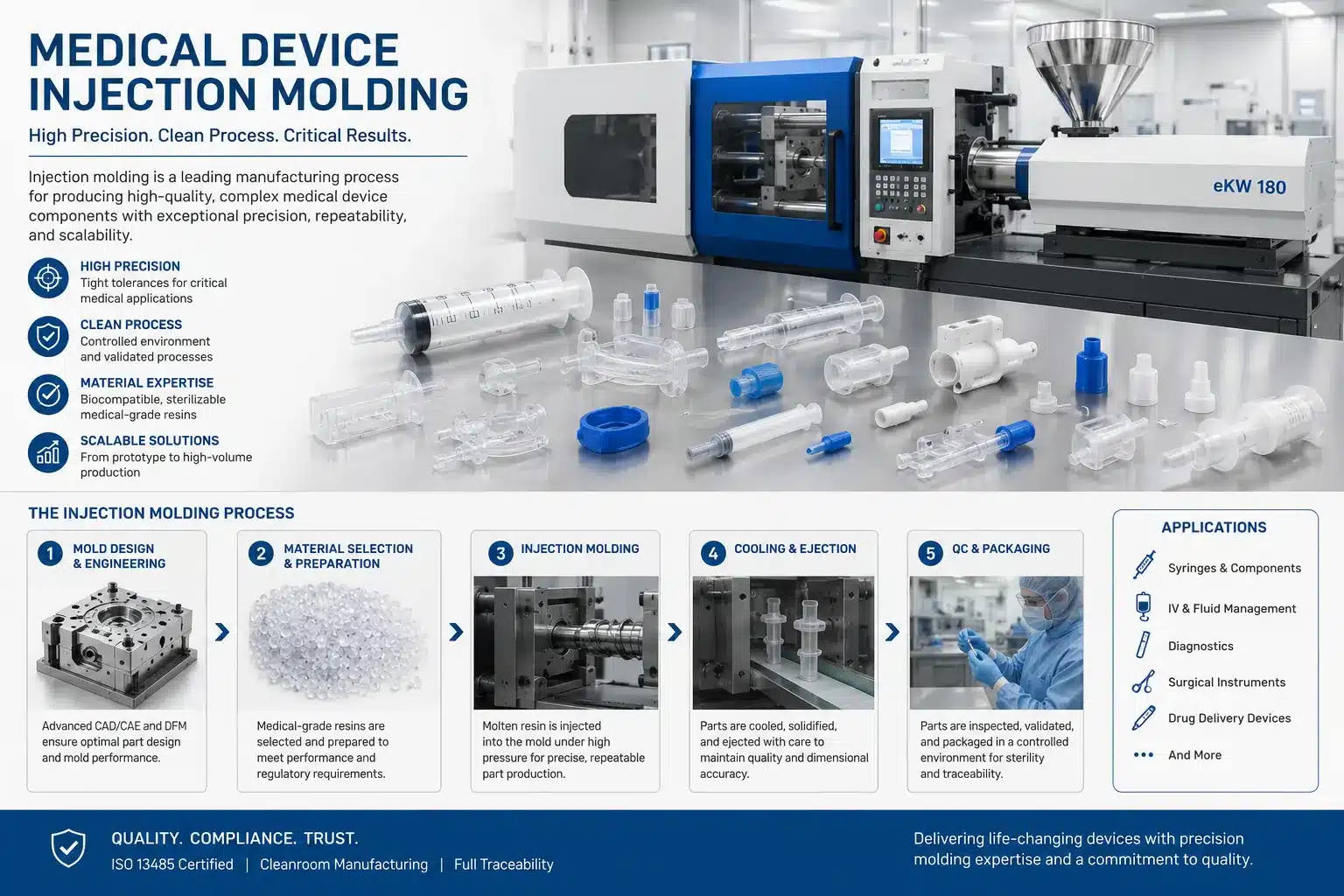
Here is the mental shift. In consumer molding, the part is the deliverable. In medical molding, the evidence that the part was made correctly and repeatably is the deliverable, and the part rides along with it. You are buying a paper trail as much as a plastic component.
It’s a Different Regime, Not Cleaner Consumer Molding
I’ve watched buyers get a medical quote back at three times their expected number and assume the molder is gouging them. Usually they aren’t. The extra money is validation, documentation, controlled materials, and a quality system somebody has to feed every single day.
That’s the thing to understand before you read another line: you are changing regimes, not upgrading a room.
Is Your Part Actually a Medical Device?
Not every part that touches a hospital is a medical device, and not every medical device needs cleanroom molding. Classification comes from your regulatory path (FDA class I, II, or III in the US), whether the part contacts the body or a fluid path, and your own device master record — not from the molder. Decide this first; it sets everything downstream.
This matters because the answer changes your cost by a factor of two or three. A plastic housing that never contacts a patient, sold as part of a Class I device, may need traceability and a controlled process but not a Class VI resin or an ISO 7 room. A fluid-path connector on an IV set needs all of it.
Most sourcing teams I talk to skip this step and ask the molder to “make it medical,” which is like asking a builder to “make it up to code” without telling them which code. You own the classification. Bring it to the quote. If you don’t know your device class, that’s a conversation with your regulatory lead before it’s a conversation with a molder.
The blunt version: over-specifying wastes money, under-specifying gets your device stopped in review. Nail the classification and hand it to your supplier as an input, not a question.
What Class VI Actually Certifies (And What It Doesn’t)
USP Class VI is a biocompatibility rating that means a resin passed three tests — systemic injection, intracutaneous reactivity, and implantation — using extracts of the plastic held at elevated temperature. It certifies the raw material’s biological safety under those specific extraction conditions. It does not certify your finished part, your process, or your device.
That last point is where quotes go sideways. A resin datasheet saying “USP Class VI” tells you the pellet is a reasonable starting point. It says nothing about what happens after you mold it, sterilize it, and glue it to something. Molding heat history, colorants, mold release, and sterilization method (gamma, EO, autoclave) all change the biological picture.
Two terms get used loosely, so let me pin them. USP Class VI is the older US pharmacopeia rating. ISO 10993 is the broader, modern biocompatibility standard your regulatory team will more likely reference, and it’s assessed at the device level, not just the resin. Many buyers ask for “Class VI resin” when their submission actually leans on ISO 10993 biological evaluation. Ask your regulatory lead which one your file is built on, then spec the resin to match. Requesting Class VI out of habit when your device needs full ISO 10993 evaluation is a common, expensive mismatch.
One term, used consistently through this article: I’ll say “medical-grade resin” for any resin the supplier certifies for biocompatibility and sells with lot traceability and a change-notification agreement.
Why Medical-Grade Resin Costs Several Times More — And Why Regrind Is Off the Table
Medical-grade resin costs meaningfully more than the identical-looking commodity grade — often several times the price per pound — because you’re paying for locked formulation, lot-level certification, biocompatibility testing, and a contract that the supplier won’t change the recipe without telling you. The plastic isn’t better. The guarantee is.
Take polypropylene. The commodity PP in a consumer housing and the medical PP in a syringe barrel can share a base polymer. The medical grade comes with a certificate of analysis per lot, a regulatory support file, and a change-control commitment. That paperwork and that promise are what you’re buying.
Regrind is where the money really diverges. In consumer work, we grind sprues and runners and blend a percentage back in — normal, sensible, cost-saving. In medical work, regrind is almost always banned, because reground material has an unknown heat history and breaks lot traceability. Every gram of runner you throw away is scrap you paid full medical price for. That’s why cavitation and runner design matter so much more on a medical tool — waste isn’t a rounding error, it’s your margin.
Colorants tell the same story. A pigment that’s fine in a toy may not be certified for body contact. Natural (uncolored) resin is the safe default for many device parts, and if you need color, it has to be a certified medical masterbatch, which narrows your options and raises cost again.
Cleanroom: When You Truly Need ISO 7 or 8, and When It’s Theater
You need cleanroom molding when your part has a critical surface — a fluid path, an implant, a lens, a sealing face — where a stray particle or a skin flake becomes a functional or biological defect. If the part is a sealed housing that gets cleaned and sterilized downstream anyway, an ISO 7 room may be paying for control you don’t use.
Cleanrooms are rated by ISO 14644-1. The two you’ll see in molding are ISO 7 (roughly the old Class 10,000) and ISO 8 (roughly the old Class 100,000). Lower number, fewer particles, higher cost. ISO 7 runs materially more per hour than open-floor molding because of air handling, gowning, monitoring, and the people-hours to keep it certified.
Here’s the honest part suppliers won’t always volunteer: a lot of “cleanroom molded” marketing is molding in open air and then packaging in a clean space, or molding under a controlled enclosure rather than a full room. Both can be legitimate — controlled packaging is genuinely useful when the concern is post-mold contamination — but they are not the same thing, and they don’t cost the same. Ask exactly which operations happen inside the classified space.
My rule of thumb for buyers: cleanroom class is a device requirement, not a supplier bragging right. If your device master record and validation don’t demand ISO 7, don’t pay for ISO 7. If they do, don’t let a molder talk you into “close enough.”
Validation Is the Real Invoice: IQ, OQ, PQ in Buyer Language
Process validation is the documented proof that the molding process makes conforming parts every time, and it’s the single biggest cost difference between medical and consumer molding. It runs in three stages — IQ, OQ, PQ — and it’s often a five-figure line item on its own, separate from the tool and the parts.
Let me translate the three stages, because the acronyms hide what you’re actually buying.
IQ, Installation Qualification, proves the machine and tool are installed and set up correctly, calibrated, to spec. It’s the “everything is what we said it is” stage.
OQ, Operational Qualification, finds the edges of the process window. The molder runs the process at deliberately extreme settings — high and low pressures, temperatures, times — usually through a designed experiment (DOE), to prove that even at the boundaries, parts still pass. This is the stage that eats the most engineering hours, and it’s the one that actually protects you, because it proves the process has margin.
PQ, Performance Qualification, runs the process at normal settings across multiple lots, often three, to prove day-to-day repeatability. It’s the “and it does this consistently” stage.
The reason this matters at the quoting stage: validation cost is largely independent of how many parts you order. Whether you need 5,000 parts a year or 500,000, the validation bill is similar. So on low-volume medical parts, validation can dominate your per-part cost, and that changes the sourcing math completely. A molder who quotes a low part price but is vague on the validation number is hiding the real invoice.
What Validation Does to Your Timeline
Add several months. A validated medical program typically runs longer than a consumer program of the same complexity because IQ/OQ/PQ, documentation, and lot builds are sequential and can’t be rushed without invalidating the result. Plan for tooling plus a validation phase, not tooling alone.
Consumer buyers are used to “T1 samples in a few weeks, production shortly after.” Medical doesn’t work that way. After the tool is built, you still have process development, the OQ experiments, the multi-lot PQ run, and the documentation package to assemble. In my experience that back half of the schedule is where programs slip, because buyers budgeted for the tool and forgot the validation runway.
If your launch date is fixed, work backward from it and put validation on the critical path from day one. A molder who can’t hand you a validation timeline with named deliverables hasn’t done many of these.
The Tooling Changes Too
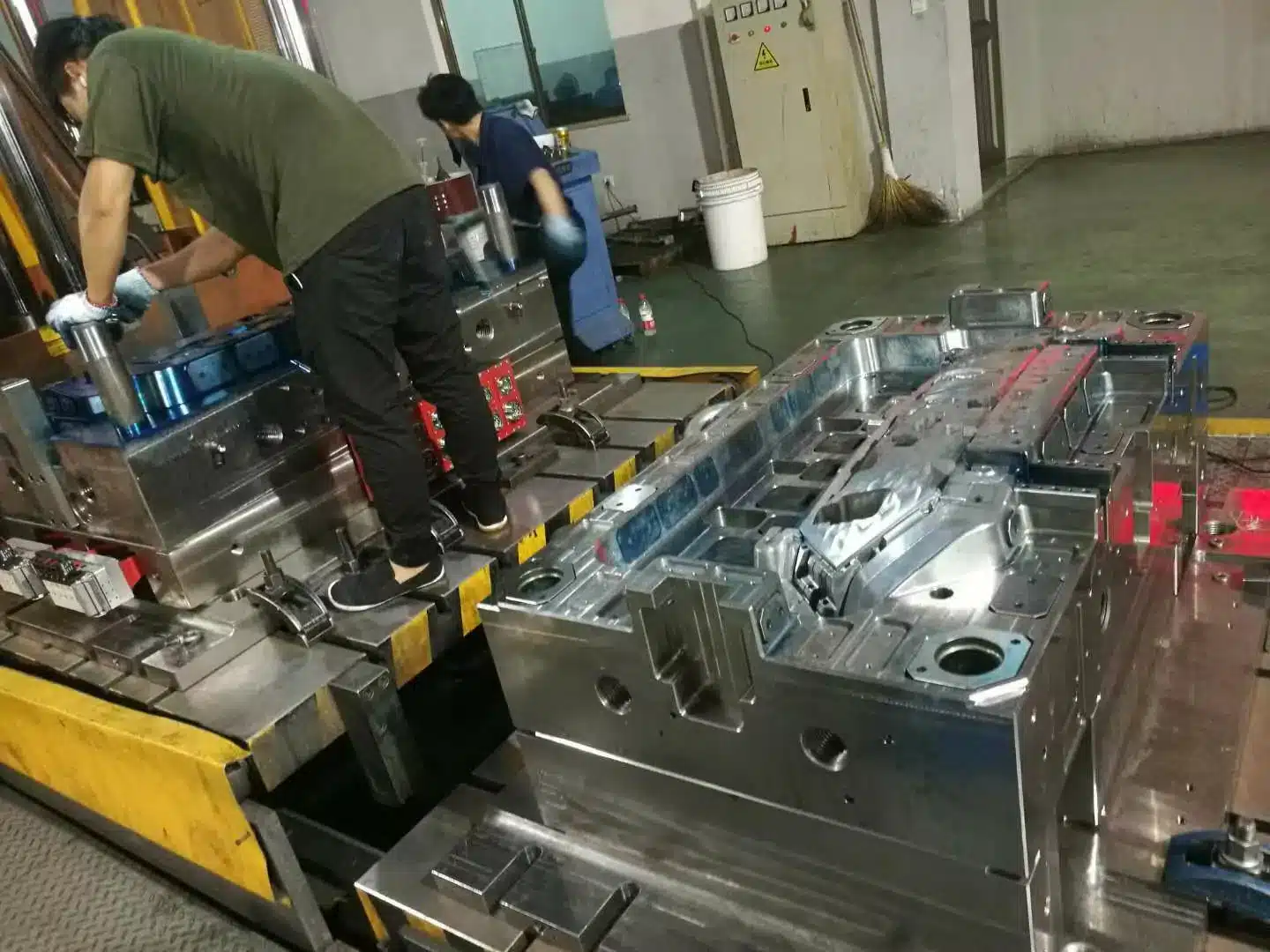
Medical tools aren’t just consumer tools built cleaner. The steel changes, the cavitation strategy changes, and the tool itself gets traceability it never had in consumer work.
Steel first. Medical molds lean toward stainless — grades like 420 stainless, S136, or 17-4 PH — because they resist the corrosion that comes from aggressive resins, frequent cleaning, and humid cleanroom environments. A corroded cavity is a particle source and a cosmetic defect, so we pay for corrosion resistance up front.
Cavitation runs the opposite direction from consumer instinct. In consumer molding, more cavities mean lower part cost, so we push cavitation high. In medical, you often validate a lower cavity count, sometimes single-cavity, because every additional cavity is another source of variation you must prove is in control, and because validating a family tool with many cavities multiplies the qualification work. Fewer cavities, more validated confidence.
The mold also joins the documented world. Its steel certs, its build records, its maintenance history — all of it becomes part of the device record. Change the ejector layout after validation and you may owe a re-qualification. The tool stops being a shop asset and becomes a controlled document with steel attached.
Change Control: Why You Can’t Just Tweak the Process Later
In consumer molding, if a part comes out slightly short you bump the pressure and move on. In medical molding, that same adjustment can require documented change control and, depending on the change, partial re-validation. The process is frozen on purpose. You trade flexibility for proof.
This is the trap buyers don’t see until they’re in it. Six months into production someone asks for a small change — a different colorant, a faster cycle, a second press to add capacity. In consumer work, a Tuesday afternoon. In medical work, a change request, an impact assessment, possibly an OQ or PQ repeat, and updated documentation.
The practical consequence for sourcing: get the part right before validation, and pick a molder with real capacity headroom, because moving your validated process to a second machine is not a phone call. If you think you’ll need to scale to a second press, validate two presses up front. It’s cheaper than qualifying one later under launch pressure.
Medical vs. Consumer Parts: What Changes, in Dollars and Weeks
Medical device injection molding changes almost every commercial variable a buyer cares about relative to consumer parts — material cost, tooling cost, timeline, minimum viable volume, and the cost of any future change. Here’s the side-by-side I use when a buyer is deciding whether a program even belongs with a medical molder.
| Variable | Consumer parts | Medical device parts |
|---|---|---|
| Resin | Commodity grade, regrind allowed | Medical-grade, lot-certified, regrind typically banned |
| Resin cost | Baseline | Often several times higher per pound |
| Environment | Open shop floor | ISO 7 or ISO 8 cleanroom, or controlled packaging |
| Quality system | Optional / ISO 9001 | ISO 13485, GMP, full documentation |
| Validation | First-article approval | IQ / OQ / PQ, often a five-figure line item |
| Tool steel | P20, H13 common | Stainless (420, S136, 17-4 PH) common |
| Cavitation | Maximized for part cost | Often minimized for validation control |
| Timeline after tool | Weeks | Add several months for validation |
| Change to process | Same-day tweak | Change control, possible re-validation |
| Traceability | Batch, if any | Lot-level, tied to device record |
The row that reorders your sourcing logic is validation cost being largely volume-independent. On a high-volume disposable, validation spreads across millions of parts and barely moves the per-part price. On a low-volume Class II part, validation can be the largest single cost in the whole program. Run that math before you pick a molder, because it can flip the decision between a domestic validated molder and an offshore one.
Red Flags in a Medical Molding Quote
A medical quote should read differently from a consumer quote, and the differences tell you whether the molder has actually done this work. Watch for these.
- They quote a part price but stay vague on validation. Validation is often the biggest number; a molder who buries or omits it either hasn’t scoped it or is planning to surprise you later.
- They say “cleanroom” without naming the ISO class or which operations happen inside it. “We have a cleanroom” is marketing. “We mold in ISO 7 and package in ISO 8” is an answer.
- They’re comfortable with regrind on your medical part. On a body-contact or fluid-path part, that’s a sign they don’t run medical work as a discipline.
- They can’t show you an ISO 13485 certificate, or it’s expired. This is the baseline quality-system credential for medical molding. No 13485, no medical program — full stop.
- They promise a consumer-style timeline. If the schedule doesn’t include a validation phase after the tool, they haven’t planned one, and you’ll pay for that optimism later.
- They can’t explain IQ/OQ/PQ in their own words on a call. A molder who does this routinely can walk you through their validation approach without reading from a script. If they fumble it, that’s your answer.
FAQ
Do I always need a Class VI resin for a medical part?
No. Class VI or ISO 10993 biocompatibility is required when the part contacts the body, blood, or a fluid path. A non-contact housing inside a device may only need a controlled process and traceability, not a certified biocompatible resin. Your device classification and risk assessment decide this, not a default rule.
Can a good consumer molder just add a cleanroom and do medical work?
Rarely, and not quickly. The hard part isn’t the room — it’s the ISO 13485 quality system, validation discipline, documentation, and change control that surround every job. A shop can buy a cleanroom in months but building a functioning medical quality system and audit history takes far longer. Ask how long they’ve held ISO 13485.
Is offshore tooling still viable for medical parts?
Yes, and it’s common. Tooling in China with parts validated and molded closer to the point of use is a normal structure. The key is that the validated molding process and quality system meet your requirements, wherever the steel was cut. What you can’t shortcut is validation and 13485, regardless of tool origin.
Why can’t I use regrind if it saves money?
Reground material has an unknown thermal history and breaks lot traceability, both of which undermine the repeatability medical validation is built to prove. On most body-contact or fluid-path parts, regrind is prohibited outright. On non-contact parts it’s sometimes allowed, but only if validated and documented, which usually costs more than the material saved.
How much does validation actually add to a program?
Validation is frequently a five-figure cost and adds several months to the schedule, and it’s largely independent of order volume. That means it barely affects per-part cost on high-volume parts but can dominate the cost of low-volume ones. Get a named, line-item validation quote before comparing molders.
What’s the difference between USP Class VI and ISO 10993?
USP Class VI is an older US pharmacopeia biocompatibility rating applied to materials. ISO 10993 is the broader modern standard, evaluated at the finished-device level and referenced by most current regulatory submissions. Many devices rely on ISO 10993 even when buyers ask for “Class VI resin” out of habit. Confirm which your regulatory file uses.
Does sterilization method affect material choice?
Yes, significantly. Gamma sterilization can discolor or embrittle some resins, ethylene oxide (EO) needs parts that outgas properly, and autoclave demands materials that survive repeated heat and moisture. Choose the resin and the sterilization method together, early, because a mismatch found after validation is expensive to unwind.
The One Rule That Matters
If you take one thing from all of this: classify your part first, then buy exactly the regime it needs — no more, no less. Over-specify and you’ll pay for validation, Class VI resin, and an ISO 7 room your device never required. Under-specify and you’ll fail an audit or a submission and rebuild the program under deadline. The molder can’t make that call for you. It comes from your device classification and your risk assessment, and everything — resin, room, tooling, timeline — flows from it.
Get the classification right, hand it to your supplier as a firm input, and demand a quote that names the validation cost and the cleanroom class in plain numbers. A molder who can do that has made medical parts before. One who can’t, hasn’t.
Sourcing Medical Device Molds?
Get a quote that names the validation cost and cleanroom class up front — no guesswork, no surprises.

