





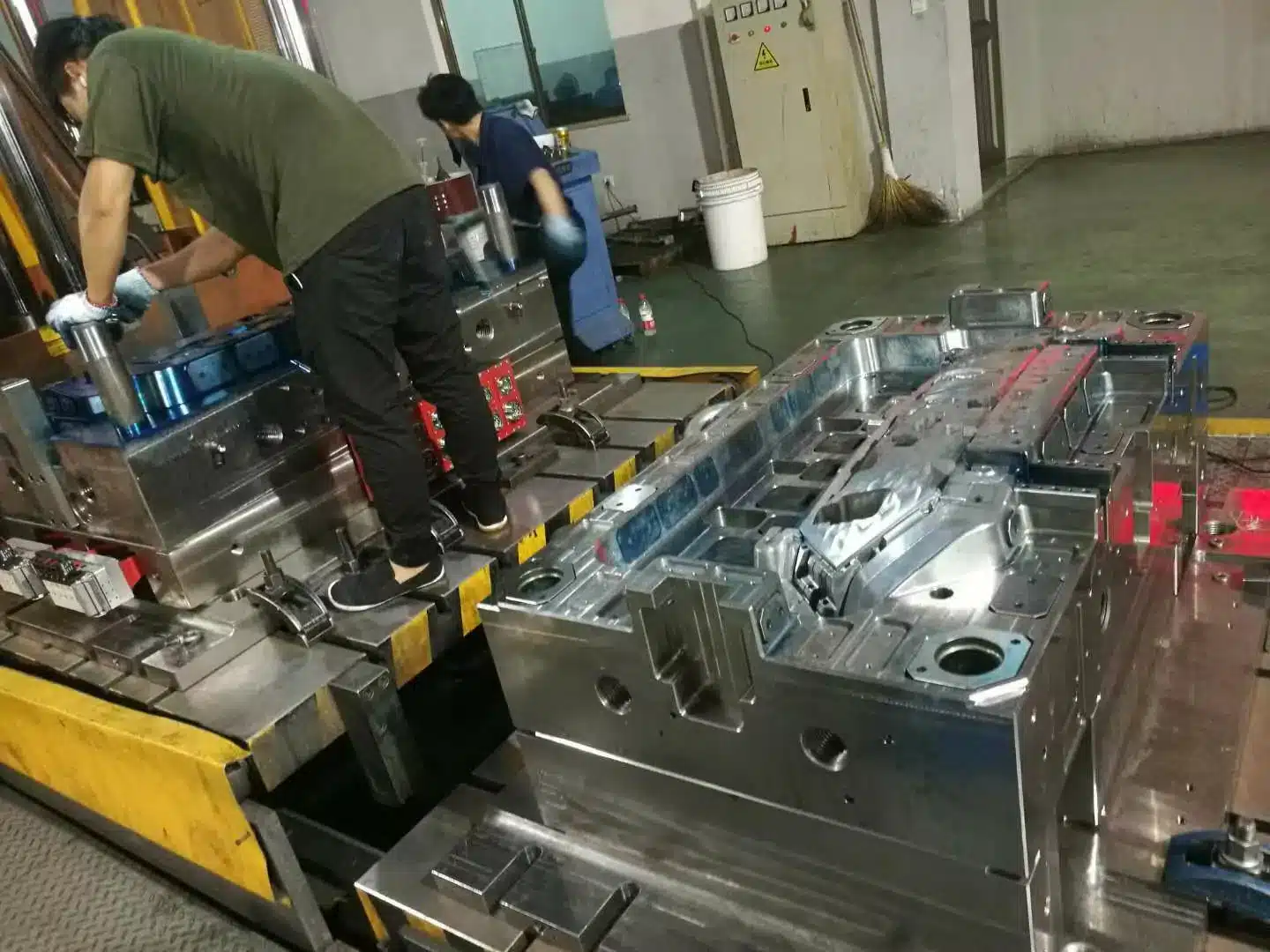

I. Mold Appearance
- Identification Plate
- Is the information on the nameplate printed clearly?
- Does it include the mold number, mold weight (KG), and mold dimensions (mm)?
- The character size should be 1/8 inch, with clear and neatly arranged text.
- Mounting of Nameplate
- Is the nameplate securely fixed to the mold leg with four rivets?
- Is its position close to the rear template and reference corner (15mm from both sides)?
- Cooling Water Nozzles
- Are the cooling water nozzles made of plastic block insert type, with a diameter of ¢10?
- Are the interface specifications G1/8″, G1/4″, G3/8″? If there are special contract requirements, should they be followed?
- Do the cooling water nozzles not extend beyond the mold frame surface? Is the head recessed within 3mm of the outer surface?
- Is the escape hole diameter of the cooling water nozzle one of the following sizes: ¢25, ¢30, ¢35mm? Is the outer edge chamfered, with a chamfer size greater than 1.5×45°?
- Are the inlet and outlet directions clearly marked on the cooling water nozzles? Is the inlet marked as “IN” and the outlet marked as “OUT,” with sequential numbers added (e.g., IN1, OUT1)?
- Marking Specifications
- Are the English characters and numbers in uppercase (5/6″)? Is their position 10mm below the nozzle, with clear, beautiful, neat, and evenly spaced text?
- Do the inlet and outlet oil nozzles and air nozzles have the same marking requirements as the cooling water nozzles? Is there a space before IN, OUT, with “G” (for gas) or “O” (for oil) added?
- Mold Installation Orientation
- If water nozzles are installed on the top and bottom sides of the mold, are they of an internal structure? Is there a flow guide or support column added below the water nozzles for protection?
- For oil nozzles or water nozzles that cannot be internally installed, is there a support column for protection?
- Reference Symbols
- Are the reference angle symbols engraved on each template? Is the symbol “DATUM” with a height of 5/16″, positioned 10mm from the edge, with clear, beautiful, neat, and evenly spaced text?
- Is the part number marked directly below the reference angle symbol, 10mm from the bottom surface? The requirements are the same.
- Impact on Lifting and Storage
- Do mold accessories affect the lifting and storage of the mold? If there are exposed oil cylinders, water nozzles, or pre-positioning mechanisms at the bottom during installation, is there a support leg for protection?
- Is the installation of support legs done by fixing screws through the support leg into the mold frame? If the support leg is too long, is it secured to the mold frame by turning external threads?
- Ejection Hole Size
- Does the ejection hole size meet the specified requirements of the injection machine? Generally, if the length or width of the mold exceeds 500mm, a single central ejection should not be used. Is the ejection hole diameter 5-10mm larger than the injection machine’s ejection rod diameter?
- Positioning Ring
- Is the positioning ring securely fixed (usually with three M6 or M8 hex screws)? Is the diameter ¢100mm or ¢150mm, and does it rise 10mm above the top plate? If there are special contract requirements, should they be followed?
- Are the mounting holes for the positioning ring countersunk? Is it avoided to mount directly on the top surface of the mold frame?
- Heavy Mold Installation
- For molds weighing over 8000KG installed on the injection machine, is a through-hole method used to tighten screws? Is it avoided to fix only with pressure plates? If the equipment uses a hydraulic locking mechanism, are screws added to prevent hydraulic failure?
- Gate Sleeve Specifications
- Is the ball head radius (R) of the gate sleeve larger than that of the injection machine nozzle?
- Is the inlet diameter of the gate sleeve larger than the injection nozzle diameter of the injection machine?
- Do the mold dimensions meet the specifications required by the designated injection machine?
- Directional Marking
- For molds with directional requirements, are arrows indicating the installation direction marked on the front or back templates? Is “UP” marked next to the arrow, and are both the arrow and text painted yellow using a stencil, with a height of 50mm?
- Surface Defects
- Are there any dents, rust, excess unused lifting ring holes, inlet/outlet water/gas/oil holes, or other defects affecting the appearance on the mold frame surface?
- Are the edges of each template processed with a chamfer greater than 1.5mm?
- Transport and Lifting Convenience
- Is the mold structure convenient for lifting and transporting? During lifting, is it unnecessary to disassemble mold components (except for oil cylinders, which need separate packaging)? If the lifting ring interferes with water nozzles, oil cylinders, or pre-positioning rods, has the position of the lifting ring hole been adjusted?
- Lifting Ring Specifications
- Does each mold component weighing over 10KG have appropriate lifting ring holes? If not, are there corresponding measures to ensure convenience in disassembly and installation? Do the lifting ring dimensions and positions comply with relevant company standards?
- Can the lifting ring be fully screwed in? Is it balanced during lifting?
- Ejection Mechanism Interference
- If there is interference between the push rods, ejector blocks, and sliding blocks, is there a forced pre-positioning mechanism? Is the top plate equipped with a reset stroke switch?
- Is the oil cylinder core extraction and ejection action controlled by a stroke switch? Is the installation reliable?
- Oil Distributor
- Is the mold oil distributor securely fixed?
- Are the oil pipes connecting the distributor and oil cylinder made of rubber hoses? Are the joints standard parts?
- Ejector Pin Plate
- Is there a garbage pin on the ejector pin plate?
- Does the total area of the mold support head reach 25%-30% of the rear template area?
- Is the support head height 0.05-0.15mm higher than the mold leg? Is there no interference with the ejection hole?
- Locking Mechanism
- Is the locking mechanism reliably installed and equipped with positioning pins? Is it symmetrically installed, with no less than 4 units (2 for small molds)?
- Is there a spring for auxiliary mold opening between the front template and the gate plate of a three-plate mold?
- Interference During Assembly
- After all components of large molds are installed, is there any interference during mold closing?
- If the injection machine uses an extended nozzle, is there enough space inside the positioning ring to ensure that the standard extended nozzle with a heating ring can smoothly enter?
- Ejection Mechanism Accessibility
- Can all inclined ejectors be disassembled through a hole that penetrates the bottom plate and matches the angle of the inclined ejector?
- Is the bottom surface of the screw mounting holes flat?
- Are screws M12 (including M12) and above made of high-strength screws (grade 12.9)?
II. Ejection Reset, Core Insertion, Part Extraction
- Ejection Action
- Is the ejection action smooth, without stalling or abnormal sounds?
- Is the lifter surface polished? Is the lifter surface lower than the core surface by 0.1-0.15mm?
- Is there a guide groove for the lifter? Is the guide groove material tin bronze, built into the rear mold frame, fixed with screws, and positioned with positioning pins?
- Ejector Rod Position
- Is the end face of the ejector pins lower than the core surface by 0-0.1mm?
- Are sliding components (excluding the ejector pins) equipped with oil grooves? Is the surface nitrided, with a hardness of HV700? (Large sliding blocks are executed according to customer requirements).
- Stop Rotation Mechanism
- Do all ejector pins have a stop rotation positioning mechanism? Is the positioning method compliant with company standards (three methods), and is it numbered?
- Does the ejector pin plate fully reset when returning?
- Limit Block Usage
- Is the ejection distance limited by a limit block? Is the limit block made of 45# steel, avoiding the use of screws as substitutes, and is the bottom surface of the limit block flat?
- Is the reset spring a standard part? Are both ends of the spring not ground or cut?
- Spring Installation Hole
- Is the bottom surface of the reset spring installation hole flat? Is the installation hole diameter 5mm larger than the spring diameter?
- For springs with a diameter exceeding ¢20mm, is there a guide rod inside? Is the guide rod 10-15mm longer than the spring?
- Spring Selection
- Generally, is a rectangular cross-section blue mold spring (light load) used? For heavy loads, is a red spring used, and for lighter loads, a yellow spring?
- Is there a pre-compression amount for the spring? Is the pre-compression amount 10%-15% of the total spring length?
- Material Specifications
- Are the materials for the pressure plates of the inclined ejector and sliding block 638? Is the nitrided hardness HV700? Or is T8A material used, quenched to HRC50-55?
- Do the sliding blocks and core extraction mechanisms have stroke limit devices? Are small sliding block limits achieved using springs, and if springs cannot be installed, are ball screw substitutes used? Is the oil cylinder core extraction equipped with a stroke switch?
- Lifter and Sliding Block Design
- Is the lifter and sliding block core extraction designed with a Z-shaped undercut? Is the angle of the lifter smaller than that of the sliding block locking face by 2-3 degrees? If the stroke is excessive, can the oil cylinder drive it?
- If the forming part of the oil cylinder core extraction has wall thickness, is the oil cylinder equipped with a self-locking mechanism?
- Reverse Ejector Mechanisms
- If the forming part of the lifter and sliding block has difficult-to-release structures, is a reverse ejector mechanism added?
- Is the large sliding block not positioned above the installation direction of the mold? If unavoidable, is a larger spring or increased number of springs used, and is the extraction distance increased?
- Sliding Block Dimensions
- Is the height-to-length ratio of the sliding block maximized at 1? Is the length dimension 1.5 times the width dimension, and is the height 2/3 of the width?
- Is the sliding length of the sliding block greater than 1.5 times the sliding direction length? After completing the core extraction action, is the length remaining in the sliding groove less than 2/3 of the total sliding groove length?
- Guide Angle Design
- Are there 3-5 degrees of guiding angles on both sides of the sliding block in all directions (especially left and right) to facilitate fitting and prevent burrs? Is the sliding distance of the sliding block greater than 2-3mm compared to the core extraction distance, with similar requirements for the inclined ejector?
- Large Sliding Block Structure
- For large sliding blocks (weighing over 30KG) using T-slot guidance, is a removable pressure plate structure used?
- If the sliding block uses spring limits, when the spring is installed internally, is the spring hole fully processed on the rear mold or sliding block? When the spring is installed externally, do the spring fixing screws have threads at both ends for easy removal of the sliding block?
- Sliding Distance Requirements
- Is the sliding distance of the sliding block greater than 2-3mm compared to the core extraction distance? Are similar requirements applied to the inclined ejector?
- Are wear plates installed beneath large sliding blocks (width over 150mm)? Is the wear plate material T8A, quenched to HRC50-55, and is the surface of the wear plate higher than the large surface by 0.05-0.1mm, with oil grooves?
- Locking Surface of Large Sliding Block
- For large sliding blocks (width over 200mm), is there a wear plate on the locking surface? Is the wear plate surface higher by 0.1-0.5mm, and does it have oil grooves?
- Is the sliding block pressure plate positioned with positioning pins?
- Guide Blocks for Large Sliding Blocks
- For sliding blocks with a width exceeding 250mm, are one or more guide blocks added in the middle of the bottom? Are the guide blocks made of T8A, quenched to HRC50-55?
- If the product tends to stick to the front mold, are the side walls of the rear mold processed with skin patterns or spark patterns? Is it avoided to process overly deep undercuts, prohibiting manual grinding or adding undercut ribs or pinholes?
- Ejector Hook Design
- If an ejector hook is added to the lifter, is the direction of the ejector hook consistent? Is the ejector hook easily removable from the product?
- Are the dimensions of the lifter head (including diameter and thickness) not altered without permission? Or are spacers added?
- Ejector Rod and Hole Specifications
- Are the fit gaps between the ejector rod and the holes, sealing segment lengths, and surface finish of the ejector rod holes processed according to relevant company standards?
- Is there any vertical movement of the ejector rod?
- Ejector Movement
- When ejecting the product, if it easily follows the inclined ejector, is there a groove or texture added to the ejector rod? Is it ensured that this does not affect the product’s appearance?
- If a push plate ejection structure is used, is the ejector rod designed for delayed ejection to prevent white marks?
- Return Rod Specifications
- Is the end face of the return rod flat, without spot welding marks? Is there no spacer or spot welding at the bottom of the head?
- Is the escape hole of the inclined ejector in the mold frame not excessively large, affecting appearance?
- Ejector Block Stability
- Is the ejector block fixed securely on the ejector rod? Is the non-forming part around it processed with a slope of 3-5 degrees, and is the lower edge chamfered?
- Is the product structure conducive to mechanical arm grabbing?
- Three-Plate Mold Mechanism
- In a three-plate mold using a mechanical arm to retrieve runner material, is the limit pull rod arranged on both sides of the mold installation direction to prevent interference with the mechanical arm? Or is a pull plate added outside the mold frame?
- Does the gate plate of the three-plate mold slide smoothly? Is the gate plate easy to pull apart?
- Oil Path Maintenance
- For molds with oil paths directly machined into the mold frame, have the iron filings in the oil paths been cleaned to prevent damage to the hydraulic system of the injection machine?
- Are the oil paths and air passages unobstructed? Can the hydraulic ejection return to the original position?
- Guide Column Specifications
- Does the guide column affect the mechanical arm’s part retrieval?
- Does the custom mold frame have a guide column with an OFFSET design to prevent misplacement?
- Exhaust Hole Design
- Does the guide sleeve bottom have an exhaust hole to release air trapped in the closed cavity formed when the guide column enters the guide sleeve?
- Is there any gap after installing the positioning pin?
III. Cooling System
- Cooling Channel Layout
- Are the cooling water channels adequately laid out and clear, meeting the design specifications?
- Is the sealing reliable, with no leaks? Is it easy to maintain, and is the water nozzle wrapped with sealing tape during installation?
- Water Pressure Testing
- Is a water pressure test conducted before mold trial? Is the inlet pressure 4Mpa, with continuous water flow for 5 minutes?
- Seal Groove Specifications
- Are the dimensions and shapes of the seal grooves for the sealing rings processed according to relevant company standards? Are they located on the mold frame?
- Is grease applied when placing the sealing ring? Does the sealing ring protrude above the mold frame surface?
- Corrosion-Resistant Materials
- Are the water isolation plates made of corrosion-resistant materials? Typically, brass plates are used.
- Do the front and rear molds use a centralized water supply method?
IV. General Injection System (Excluding Hot Runner)
- Main Flow Channel Polishing
- Is the surface of the main flow channel inside the gate sleeve polished to a finish of ▽1.6?
- Is the flow channel surface polished to ▽3.2 or ground with 320# oil stone?
- Cross-Section Shape
- Are the cross-sectional shapes of the split flow channels on the back of the front template trapezoidal or circular?
- When cutting the runner material on the gate plate, is the inlet diameter less than ¢3mm? Is there a 3mm deep step machined at the ball head on the gate plate?
- Material Reliability
- Is the ball head pull rod securely fixed? Can it be pressed beneath the positioning ring, using headless screws or pressure plates for fixation?
- Is there a gap of 10-12mm left between the top plate and the gate plate?
- Runner and Gate Design
- Is the opening distance between the gate plate and the front template convenient for removing the runner material? Generally, the opening distance = runner length / (20-25), and not less than 120mm.
- Is the limit of the front template achieved using a limit pull rod?
- Machining Specifications
- Are the gates and runners machined according to the dimensions on the drawings using machine tools (CNC, milling machine, EDM)? Is manual grinding prohibited?
- Is the structure of the point gate processed according to gate specifications?
- Point Gate Design
- Does the front mold have a small protrusion at the point gate, with a corresponding recess in the rear mold?
- Is there an extension section at the front end of the split flow channel as a cold material hole?
- Z-Shaped Undercut
- Is the Z-shaped undercut of the pull rod smoothly transitioned?
- Is the surface shape of the split flow channel on the parting surface circular? Are there any misalignments between the front and rear molds?
- Concealed Gate Specifications
- Is there a surface shrinkage defect in the concealed gate installed on the ejector rod?
- Do the cold material holes for transparent products meet the design standards for diameter and depth?
- Runner Removal
- Is the runner material easy to remove? Is the appearance of the product free from gate marks, and are there no residual runner materials at the assembly points?
- Undercut Treatment
- Are the two block inserts of the hooked concealed gate treated with nitriding? Is the hardness achieved at HV700?
V. Hot Runner System
- Wiring Layout
- Is the wiring layout of the hot runner reasonable and easy to maintain? Are the wires marked with line numbers and correspond one-to-one?
- Safety Testing
- Has safety testing (such as insulation testing) been conducted to prevent electrical leakage and other safety incidents?
- Compliance with Customer Requirements
- Do the temperature control cabinets, hot nozzles, and distribution plates meet customer requirements?
- Is the main gate sleeve connected to the distribution plate via threads? Is the bottom surface sealed by plane contact, with welding seals around?
- Contact Quality
- Is there good contact between the distribution plate and the heating plate or heating rod? Are the heating plates fixed with screws or studs, with a good surface fit and no flash gaps? Is the fit gap between the heating rod and the distribution plate no larger than 0.05-0.1mm (h7/g6) for easy replacement and maintenance?
- Thermocouple Specifications
- Is a J-type thermocouple used, correctly corresponding to the temperature control table?
- Are there dead corners for material storage at the plug ends of the distribution plate to prevent material decomposition? Are the screws at the plug ends tightened and sealed with welding?
- Air Gap Specifications
- After installing the heating plate on the distribution plate, is the air insulation layer distance between the heating plate and the template within the range of 25-40mm?
- Is each group of heating elements independently controlled by a thermocouple? Is the layout of the thermocouples reasonable to ensure precise temperature control?
- Nozzle Contact
- Is the hot runner nozzle in close contact with the heating ring? Is the exposed part at both ends as small as possible? Are the cold material section lengths and nozzle sizes processed according to the drawings, with the dimensions of the empty sections, sealing sections, and positioning sections meeting design requirements?
- Nozzle Outlet Size
- Is the outlet size of the nozzle less than ¢5mm to avoid surface shrinkage caused by oversized runner materials?
- Is the nozzle head made of purple copper or aluminum as a sealing ring? Does the sealing ring height exceed the large surface by 0.5mm? Is the inlet diameter of the nozzle head larger than the outlet size of the distribution plate to prevent overflow caused by thermal expansion misalignment?
- Reliable Positioning
- Considering thermal expansion, does the distribution plate have reliable positioning? Are at least two positioning pins set or additional screws fixed?
- Is there an insulation pad (such as asbestos mesh, stainless steel, etc.) between the distribution plate and the template for insulation?
- Seal and Insulation
- Are there pads under the main gate sleeve and above each hot nozzle to ensure sealing? Are the pads made of stainless steel with poor thermal conductivity or heat-insulating ceramic gaskets?
- If the pads on the top of the hot nozzle protrude above the top plate, should their height exceed 0.3mm, and are these pads located inside the positioning ring of the injection machine?
- Temperature Control Accuracy
- Is the temperature set on the temperature control table within ±2℃ of the actual displayed temperature? Is the temperature control sensitive?
- Is the cavity connected to the hot nozzle installation hole?
- Wiring Management
- Is the hot runner wiring bundled and covered with pressure plates to prevent wire breakage during assembly?
- If there are two identical sockets, are they clearly marked to prevent incorrect plugging?
- Are the control wires sheathed and undamaged? Usually, they should be cable wires.
- Cabinet Structure
- Is the structure of the temperature control cabinet reliable, with no loose screws inside?
- If sockets are installed on a wooden board, does the overall exceed the maximum outer dimensions of the template?
- Needle Point Specifications
- Does the needle-point hot nozzle’s needle tip protrude from the front mold surface?
- Are there any exposed wires outside the mold?
- Wire Protection
- Are all contact points between the distribution plate or template and the wires rounded to avoid wire damage?
- Are all distribution plates and nozzles made of P20 material?
- Before assembling the template, has it been confirmed that there are no short circuits in all wiring?
- Are all wire connections correct, and is the insulation good?
- After clamping and tightening the template, is a multimeter used to recheck all wiring?
VI. Forming Parts, Parting Surface, Exhaust Groove
- Surface Flatness
- Are the surfaces of the front and rear molds flat, without pits, rust, or other defects affecting appearance?
- Is the gap at the four R corners when the insert fits with the mold frame less than 1mm (maximum)?
- Cleanliness of Parting Surface
- Is the parting surface kept clean and tidy? Are there no depressions in the sealing part, and are there no traces of using a hand-held grinder to avoid emptying?
- Is the depth of the exhaust groove less than the overflow value of the plastic used? (e.g., PP less than 0.03mm, ABS, PS, etc., less than 0.05mm). Is the exhaust groove machined without traces of manual grinding?
- Insert Fitting
- Are the inserts fitted properly (multiple different inserts should be used for fitting to compensate for size errors)? Is the placement smooth, and is the positioning reliable?
- Are the inserts, insert cores, etc., reliably positioned and fixed? Are there anti-rotation measures for round parts? Is there no copper or iron piece under the insert? If a welding method is used, does the welding contact form a large surface contact and is it ground flat?
- Polishing Requirements
- Is the front mold polished to the required specifications according to the contract?
- Are the surfaces of the ribs and columns on the front and rear molds free from spark patterns and knife marks, and are they polished as much as possible? Are the needle holes on the sleeve surface finely ground without spark patterns or knife marks?
- Ejector Specifications
- Is the shape of the end face of the ejector rod consistent with the core surface?
- Is the fitting slope of the penetrating part greater than 2 degrees to avoid burrs? Is the penetrating part designed to avoid thin-edge structures?
- Surface Treatment
- Is the front mold’s face ground with an oil stone to remove all machining patterns, knife marks, and spark patterns? (If the original state is not damaged, it can be retained).
- Are all mold components marked with numbers?
- Defects in Forming Areas
- Are there any undercuts, unchamfered areas, or other defects in the forming areas of the front and rear molds?
- Are ribs deeper than 15mm constructed using a spliced structure?
- Ejection of Ribs
- Does the ejection of the ribs proceed smoothly?
- For multi-cavity molds, if they are symmetrical parts, are they clearly marked L or R? If the customer has specific position and dimension requirements, should they be followed? If there are no requirements, should they be marked in places that do not affect appearance and assembly, with a font size of 1/8″?
- Mold Locking Surface
- Is the mold locking surface fitted properly? Does the contact area exceed 70%?
- Are the ejector rods arranged close to the side wall and beside ribs and bosses? Is a larger diameter ejector rod preferred?
- Numbering of Identical Parts
- For identical parts, are they numbered 1, 2, 3, etc.? (The printing method remains the same).
- Is the cavity and parting surface wiped clean?
- Penetrating Components
- Are the penetrating components, such as the sleeve needle and ejector rods, inserted into the front mold?
- Are the contact surfaces, penetrating surfaces, and parting surfaces fitted properly?
- Does the width of the sealing part of the parting surface meet design standards? (For medium-sized molds, 10-20mm; for large molds, 30-50mm; other parts should be machined to avoid emptying).
- Surface Finish Requirements
- Do the skin patterns and sandblasting effects meet customer requirements?
- If surface etching or sandblasting treatment is needed, is the demolding slope 3-5 degrees or increased according to the depth of the skin pattern?
- Is the demolding slope for transparent products larger than that for general products? Generally, the demolding slope for PS is greater than 3°, and for ABS and PC, it is greater than 2°.
- Shrinkage Measures
- For products with appearance requirements, are anti-shrink measures taken for screw posts?
- For products requiring root corner cleaning on the front mold, are these holes and columns constructed using a spliced structure on the front mold?
- Screw Post Specifications
- For screw posts deeper than 20mm, is the forming done using sleeve needles?
- If the screw post has a chamfer, are the corresponding sleeve and insert also chamfered?
- Wall Thickness Uniformity
- Is the wall thickness of the product uniform? (The difference is within 0.15mm).
- Is the width of the rib not greater than 60% of the wall thickness of the appearance surface? (Except for special customer requirements).
- Insert Fixation
- Are the inserts on the inclined ejector and sliding block securely fixed? (e.g., screw fixation or insertion from the back end).
- Are the parts of the front mold that penetrate the rear mold or the parts of the rear mold that penetrate the front mold locked using sloped locking or machined emptying?
- Forced Demolding Structures
- Are transparent PS, AS, PC, PMMA, and other materials constructed with forced demolding structures?
- Do the mold materials (including model and processing status) meet contract requirements?
- Marking Requirements
- Are special numbers, date codes, material numbers, logos, trademarks, etc., marked as required? (Date codes according to customer requirements; if there are no requirements, use standard parts).
- Is the marking direction for transparent parts printed correctly?
- Are the front and rear molds of transparent parts polished to a mirror effect?
VII. Packaging
- Rust Prevention
- Is the mold cavity sprayed with anti-rust oil?
- Are sliding components greased?
- Is the inlet of the gate sleeve plugged with grease?
- Locking Pieces
- Is the mold equipped with locking pieces? Do their specifications meet design requirements (for three-plate molds, ensure the release plate is fixed to the rear mold)? Are there at least two locking pieces?
- Documentation Completeness
- Are the product drawings, structural drawings, waterway drawings, spare parts and mold material supplier details, user manuals, packing lists, and electronic documents complete?
- Appearance Requirements
- Is the mold exterior sprayed with blue paint? (If the customer has special requirements, follow the contract and technical agreement).
- Has the product been assembled and verified to reach a conclusion?
- Are there any surface defects or fine issues with the products?
- Spare Parts and List
- Are spare parts, spare items, and consumables complete and accompanied by a detailed list? Is the supplier’s name noted?
- Is there a release note issued by the marketing department?
- Is the mold packaged with a film?
- Wooden Crate Packaging
- If wooden crates are used for packaging, is the mold name and placement direction clearly sprayed with paint?
- Are the wooden crates securely fixed?

