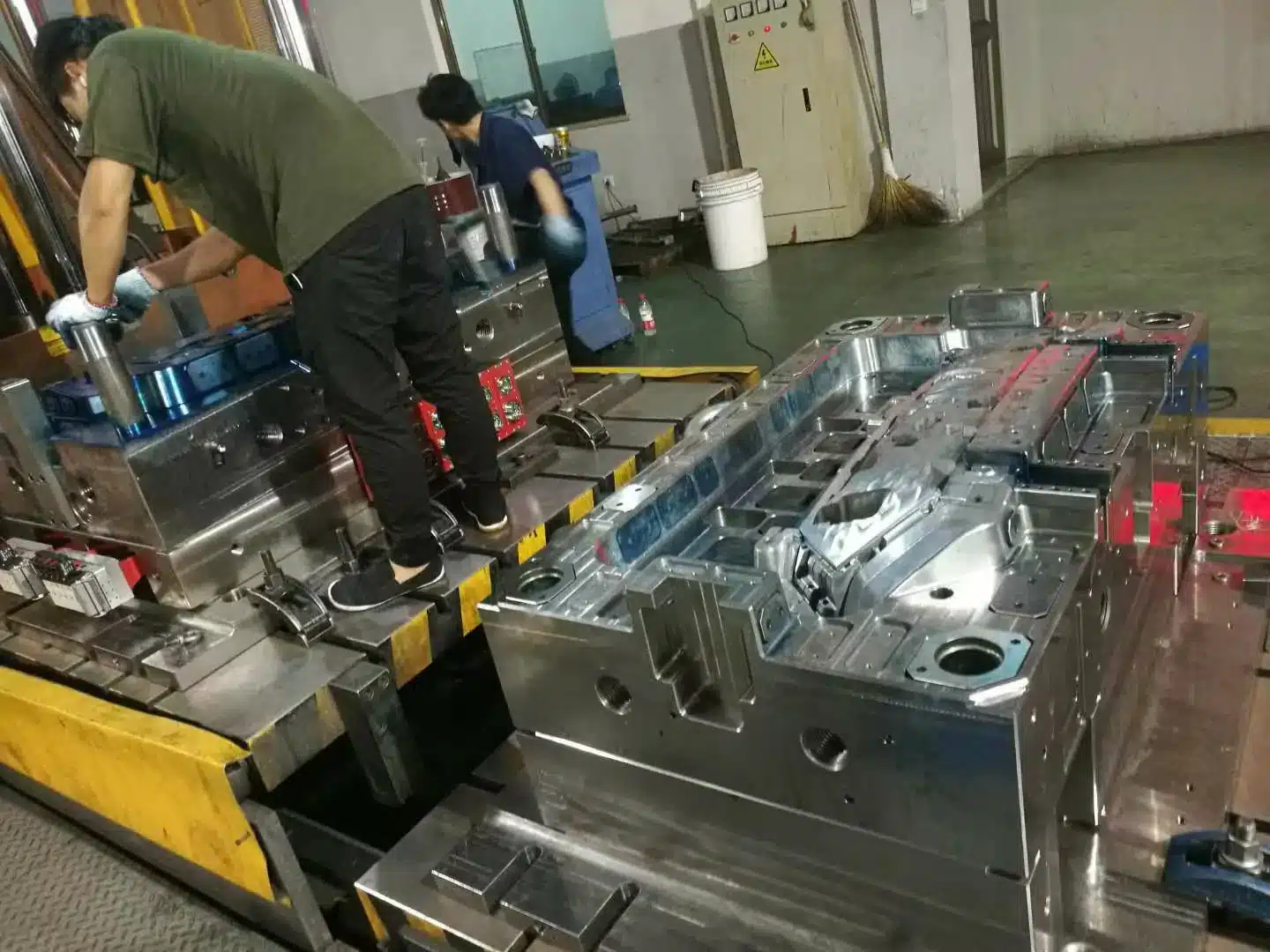

We went back and read 105 first emails from people who had never done injection molding before. The oldest was from 2010. The newest came in last week. No names, no company names, no product details, no prices — just the questions.
Fifteen years apart, the questions barely changed. Here’s what people ask, in order of how often:
| What they ask about | How often |
|---|---|
| Price — what does a mold cost, what does a part cost | 75% |
| “I only have a photo / sketch / sample / idea — can we start?” | 45% |
| Minimum order quantity | 30% |
| “Can this part even be molded?” | 27% |
| Lead time | 25% |
| Material choice | 23% |
| The overall process — who does what | 20% |
| Prototyping before cutting steel | 18% |
| Shipping and Incoterms | 14% |
| NDA and copying | 10% |
| Who owns the mold, what’s the warranty | 7% |
| “I have no idea what to budget” | 6% |
| Payment terms | 3% |
If you’re about to send your first email to a Chinese mold shop, you’ll probably ask four or five of these at once. That’s normal. They come as a bundle.
This page answers all of them, then walks the whole job from your first email to the container leaving Ningbo.
1. Two numbers, not one: tooling and unit price
Three out of four first emails ask “how much does a mold cost?” Most of them really mean “how much does this whole thing cost?”
Those are separate numbers. They behave differently.
The mold is a one-time cost
You pay for it once. It’s a block of steel we cut, polish and fit to make your exact part. What moves the price:
- Part size. Bigger part, bigger steel, bigger press.
- Complexity. Undercuts, side actions, threads and sliders all add work.
- Cavity count. A 4-cavity mold costs more than a single cavity, but makes parts four times faster.
- Steel grade. Softer steel rated for 50,000 shots is cheaper than hardened steel built for 500,000.
- Surface finish. A mirror polish or a leather grain is real labor, not a setting.
Complexity is the one people underestimate. A simple box opens straight up and drops out. Put a clip on the side wall or a thread on the inside, and the mold needs a moving part to get the plastic out — a slider for outside undercuts, a lifter for inside ones. Each one adds steel, fitting time and cost.
Drag the model below to watch both of them work:
[tw_slider_lifter]A small, simple, single-cavity mold starts around $1,000–$1,500. A large multi-cavity mold with side actions runs many times that. Nobody can narrow that gap without seeing your part.
The unit price is what you pay every time
Material, machine time, labor, packing, margin. The big driver is quantity. Run 500 pieces and the setup is spread over 500 parts. Run 50,000 and it nearly disappears.
That’s why a quote with no quantity on it isn’t a quote. It’s a guess.
What a real quotation sheet shows
- Tooling cost, with cavity count and steel grade stated
- Unit price at two or three quantity breaks
- Material grade, and who supplies it
- Mold life in shots
- Lead time, split between mold and production
- Payment terms
- Incoterm and port
Get a single number with no breakdown? Ask for the breakdown. A shop that won’t tell you cavity count and steel grade is hiding something.
One assumption worth killing early: a quote doesn’t start production. Between the quote and your first good part there’s design sign-off, mold design approval and sample approval. Section 7 lays out every step.
2. What we need from you to quote
Here’s the honest version. Not all of it is required.
Must have
1. A 3D file. STEP (.stp/.step) is best. IGES, Parasolid (.x_t) and native SolidWorks or Creo files all work. This is the one thing that turns a conversation into a quote.
2. Quantity — two numbers. How many in the first order, and how many per year after that. Those lead to different molds. If you don’t know the annual figure, guess out loud. “Maybe 2,000 the first year, 10,000 if it sells” is useful. “TBD” is not.
3. What the part has to survive. Not the material name. The job. Outdoor sun? Hot water? Food contact? Skin contact? Dropped on concrete? We’ll suggest the material. Section 5 covers this.
4. Where it’s going. Destination country. It drives compliance (FDA, LFGB, REACH, RoHS) and freight.
Helps a lot
5. A 2D drawing marking the dimensions that actually matter, with tolerances. You don’t need to dimension everything. Mark the three or four features that have to fit something else.
6. Appearance. Color (Pantone if you have it), gloss or matte, texture, logo, printing.
7. Target price. People hate giving this. It saves a week. If your target is far from reality we’ll say so, and usually we can tell you what to change to get closer.
8. Your deadline. Trade show? Crowdfunding delivery date? Put it in the first email.
Don’t need yet
Business license, incorporation papers, a finished brand, a warehouse. People apologize for not having these. None of it is needed to get a quote.
If you want to see how we handle a project once those files land, we’ve written it up here: how we manage injection mold projects, from DFM to shipment.
3. You don’t have a 3D file. Now what?
Forty-five percent of first emails start with something other than CAD. A photo. A sketch on paper. A sample part in a drawer. A link to a similar product. A paragraph of text.
All of these go somewhere. They go to different places.
A sample part in hand. The strongest non-CAD start. We measure it, scan it if needed, and rebuild a 3D model. Mail it over and tell us what you want changed. One catch: reverse-engineering gives you a part that works like the sample. It doesn’t tell us which dimensions are critical and which were accidents of the old tooling. You still have to say.
A dimensioned sketch or paper drawing. Usable. We can model from it. Expect questions about wall thickness and radii.
A photo or rough sketch with no dimensions. We can tell you whether the idea is moldable and give a rough cost range. We can’t give a firm quote. The next step is a model — either you hire a designer, or we build it for you. Price depends on how complex the part is, and the design fee is credited back against your tooling if you order the mold with us.
A product you want to copy. Careful. If it’s someone else’s patented product, we won’t build the mold. If it’s a generic item and you want your own version, that’s ordinary work.
An idea in your head and nothing else. Then you need a designer before you need a mold shop. Molding is the last step in product development, not the first.
Say it plainly: a sketch is not a drawing, and a photo is not a model. Nobody can reverse-engineer intent from a picture. Somewhere between your idea and cut steel, every dimension has to be decided. You decide, your designer decides, or we decide and you approve. There is no fourth option.
Not sure what to tell us? Start here
This walks you through the questions in the right order and emails you a spec sheet at the end. Four paths — idea only, photo or sample, you have files, or already in production — so it skips what doesn’t apply to you. Nothing is sent to us until you hit submit.
What do you need from us today?
Pick the one that fits. We'll ask different questions based on your choice.
What do you have, and what should we quote?
The more we know up front, the faster and more accurate the price.
What are you worried about in the design?
Pick all that apply. Not sure? Choose "Full review".
What would you like back from us?
DFM review is free for serious projects.
What do you have of the sample?
We can 3D-scan a physical part and rebuild the CAD.
Exact copy, or with changes?
Pick all that apply.
Tell us about your idea
Plain words are fine. What is it, who uses it, what does it do?
What do you need us to do?
Pick all that apply. Design work is quoted separately from the mold.
What kind of part is it?
Pick the closest one. If nothing fits, choose "Something else".
How big is your part?
Just pick a size close to yours. Exact numbers below (optional).
How should the plastic feel and behave?
Pick all that apply. Don't worry about material names.
What should the surface look like?
Pick more than one if needed.
How many parts do you need?
One of the biggest cost drivers. Rough number is fine.
Special features?
Optional. Skip if none apply.
Last step — how do we reach you?
We reply within 24 hours.
Your request is ready
Review below. Click Send to submit to us.
Thank you!
Your request # has been received.
Our team will reply to your email within 24 hours (Beijing business hours).
4. Minimum order quantity, and the “I only need 200 pieces” problem
Thirty percent of first-time buyers ask about MOQ. Most are worried the answer disqualifies them.
MOQ isn’t a rule invented to annoy small customers. It comes from setup. Mounting a mold in a press, dialing in the process and running until parts are stable takes the same hours whether you then run 300 pieces or 30,000. Below a certain run size, setup dominates and the per-part price looks ugly.
Our working range is 200–500 pieces. Below that, molding usually isn’t the right answer yet — we’ll tell you so instead of selling you tooling you don’t need.
Three things people get wrong:
“Can I skip the mold for a small order?” No. No mold, no molded part. Under a couple of hundred pieces, 3D printing or CNC machining is often cheaper and faster.
“Can I just buy the mold and run it myself?” Yes. We build mold-only. You pay for tooling, we ship you the steel, you run it at home. Ask for both quotes if you’re weighing it.
“My first order is small but I’ll reorder.” Say this in the first email. It changes what we recommend. For most startups in that position the answer is a single-cavity production mold — real steel, real production parts, lower tooling cost, and you add cavities later when volume justifies it.
5. Material: describe the job, not the plastic
Twenty-three percent ask about material, almost always as “what should I use?”
Good. That’s the right way round. Tell us:
- What it touches — food, drink, skin, chemicals, nothing
- Temperature range, including a hot car or a dishwasher
- Indoor or outdoor (UV kills some plastics in a season)
- Does it flex, snap, hinge, or carry load
- Clear, opaque, or doesn’t matter
- Certifications your market requires
We’ll come back with two or three grades and the tradeoff. ABS molds easily and takes texture well. PP flexes forever and costs less. PC is tough and clear and more expensive. Nylon is strong and absorbs water. Each choice moves the unit price, and sometimes the mold design.
Two misunderstandings worth clearing:
“Food grade” is not a material. It’s a compliance status — FDA in the US, LFGB in Germany, something else elsewhere. Many materials have food-contact grades. Tell us the market and we’ll quote a resin with the right certificate and supply the paperwork. That paperwork costs money and takes time. It’s a line item, not a freebie.
The material is yours to approve. It affects price, feel, strength and whether you can legally sell the thing. We recommend. You confirm in writing.
6. Prototype first, or cut the production mold?
Eighteen percent ask about prototyping, usually because they’ve heard they should and don’t know what it costs.
Three different things get called prototyping. They aren’t interchangeable.
3D printed or CNC samples. No mold. Days, not weeks. Good for checking size, fit and whether it looks right in your hand. Not your real material, and it won’t behave like a molded part.
Prototype tooling (soft tooling). A simplified single-cavity mold in aluminum or soft steel. Real material, real molded parts, built fast and cheap. Rated around 2,000 shots. Right when the design may still change, or you need a few hundred real parts for testing or a crowdfunding campaign.
Production tooling. Rated 50,000 shots in standard steel, 500,000 shots in hardened steel. Multi-cavity if your volume justifies it. This is the one you run for years.
The expensive mistake is cutting a production mold before the design is settled. Changing steel means welding and re-cutting — possible, costs money, leaves a mark — or starting over. Adding material to a part is hard. Removing it is easy. If you’re not sure the design is final, say so. It changes what we recommend.
And to be blunt about something several people have assumed: the prototype mold is not the production mold. Its parts prove the design. They aren’t the start of your production run.
7. The whole process, start to shipped
This is the part nobody explains. Every stage, what happens, what you have to do, how long it takes.
Stage 1 — Feasibility and DFM review · 5–7 days
You send files and the information from section 2. An engineer checks moldability: wall thickness, draft angles, undercuts, where the gate goes, where the parting line falls, where ejector pins will leave marks.
You get: a written DFM review with marked-up images, problems and suggested fixes.
You do: read it, ask questions. Nothing to approve yet.
A real DFM review is engineering work on a real 3D file. “Can you make this?” with nothing attached gets you an opinion, not a review.
Stage 2 — Quotation · 3–5 days after the DFM is settled
You get: tooling cost, unit price at quantity breaks, mold life, cavity count, steel grade, lead times, payment terms, Incoterm.
You do: compare, negotiate, ask what would make it cheaper. Ask now. After the steel is cut it’s too late.
Stage 3 — Order and deposit
Purchase order or signed sales contract. NDA signed here if you want one. Tooling deposit paid — see section 10.
You do: confirm the final 3D file. Whatever you confirm here is what gets cut into steel.
Stage 4 — Mold design and your approval · 7–10 days
We design the mold itself: layout, cavity and core, cooling, ejection, gate type and location. Complicated or thin-walled parts get a mold flow simulation.
You get: the mold design package — gate location, parting line, ejector pin positions, and the shrinkage rate we’re applying.
You do: approve it in writing. Look hard at gate and ejector positions. They leave visible marks, and this is your only chance to say “not on that face.”
Stage 5 — Mold making · 4–8 weeks
Steel ordered and rough machined, CNC, EDM for sharp internal corners, polishing or texturing, then fitting and assembly. Simple single-cavity molds land at the short end. Multi-cavity molds with side actions take the full eight.
You get: progress photos every week.
You do: nothing. Watch the photos.
Stage 6 — T1 trial and first samples · 3 days after the mold is finished
The mold goes into a press for the first time. Parts come out. We measure them against your drawing and film the molding cycle.
You get: T1 samples by UPS or FedEx, freight on us, plus a dimensional report.
You do: the important part. Test them. Fit them to mating parts. Put them in the environment they’ll live in. Then approve, or list exactly what’s wrong.
Stage 7 — Modifications: T2, T3 · 7–10 days per round
Almost nothing is perfect at T1. Expect at least one round.
Three rounds are included. Small corrections are free — dimensions, finish, warpage, the usual tuning. If you change the design itself, that’s a new quotation. Fixing our mistake is on us. Changing your mind is a cost.
Stage 8 — Sample approval
You sign off a golden sample. From then on, that part is the standard every production part is measured against. Keep one yourself.
Stage 9 — Mass production · about 4 days per 1,000 pieces
Balance paid before shipment. Material bought, mold runs, QC inspects at two levels: first article off the first shot, then random sampling through the run.
You get: inspection report, dimensional report, material certificate, plus photos and video.
Stage 10 — Packing
Inner bags, cartons, carton markings, barcode labels if you’re going to retail or Amazon FBA. Tell us before production, not after. FBA labels applied afterwards cost more and delay shipment.
Stage 11 — Shipping
Section 8.
Stage 12 — After shipment
The mold is cleaned, rust-protected and stored at our factory, ready for your reorder. Storage is free for normal reorder cycles. If a mold sits idle long term, there’s a small storage charge.
Reorders skip stages 1 through 8 entirely. That’s why the second order is fast.
Add it up: roughly 8 weeks from frozen design to shipment. What stretches it: an unfinished design, slow approvals, and changes after T1. The mold shop is rarely the bottleneck. Waiting on the customer usually is.
Want to see this run end to end on a real job? Read the 20L paint bucket mold case study — same twelve stages, with the actual decisions.
8. Shipping and Incoterms
Fourteen percent asked about freight. The usual misunderstanding is assuming the quoted price includes delivery to your door. It doesn’t.
Three terms cover nearly everything:
EXW (Ex Works). Price is parts sitting in our factory. You arrange everything from there. Lowest headline number, most work for you.
FOB Ningbo or FOB Shanghai. We get the goods to the port, cleared for export, loaded. You pay the ocean or air freight and everything on your side. This is what we quote by default unless you say otherwise.
DDP (Delivered Duty Paid). To your door, duties and customs handled. Simplest for you, highest number. We do it, and it’s common for first-time importers who don’t have a customs broker yet.
Small urgent batches go by air — we arrange that too. What drives cost: volume more than weight (plastic parts are light and bulky, so packing design matters), air versus sea, destination port, and the season. A rush air shipment can cost more than the parts inside it.
To quote freight we need your destination city and port, your preferred term, and whether you already have a forwarder. If you don’t, say so.
One duty note: on EXW and FOB, import duty is yours. It’s calculated on the part’s HS code. Ask us for the code early so you can check your country’s rate before committing.
9. NDAs, copying, and who owns the mold
Ten percent asked about confidentiality, usually some version of “how do I know you won’t copy this?”
Fair question. Straight answers.
Signing an NDA is normal. Send yours, or use ours. We sign before you send detailed files.
But don’t hide so much that nobody can help you. Several first emails wouldn’t say what the product was at all before an NDA was signed. We can’t tell you whether we can make something we’re not allowed to know about. Describe it generally — “a snap-fit enclosure about the size of a deck of cards, with a clear window” — get the NDA signed, then send files.
An NDA is not an order. It protects information. It commits neither side to anything else.
The mold is yours. Once tooling is paid in full, the buyer owns the mold. It runs your parts and nobody else’s. We don’t use your tooling for another customer, and we don’t sell your part.
You can take it whenever you want. Ask, and we ship it. No holding period, no conditions beyond settling outstanding invoices.
Warranty matches the steel. A standard-steel mold is warranted for 50,000 shots. A hardened-steel mold is warranted for 100,000 shots. If the mold fails inside that, the repair is on us.
Storage after shipment is covered in stage 12.
10. Budget and payment
“I have no idea what to budget”
Six percent said it outright. More were thinking it. The useful way to think about it isn’t one number, it’s a structure:
- Design, if you don’t have a finished 3D file
- Prototypes, to check fit and look
- Tooling — the one-time big number, from around $1,000–$1,500 for something small and simple
- Parts — unit price times quantity
- Freight, duty, and certification if your market needs it
The range narrows fast once three things are known: part size, annual quantity, material. Pin those three down and anyone can give you a sane number.
Payment terms
Tooling: 30% / 30% / 40%, or 50% / 50%. The split depends on the size of the job and we’ll agree it before you order.
Production: balance before shipment.
Methods: T/T (bank transfer) or L/C.
Ask about terms while you’re still quoting, not after. And ask what triggers each payment — “before shipment” and “after sample approval” are very different risk profiles for you.
Just send us this
If you read nothing else on this page, copy this into your first email and fill in what you know. Blanks are fine. Tell us what you don’t know and we’ll tell you how to find out.
Part: [what it is and roughly what it does]
File attached: [STEP / drawing / photo / none yet]
Size: [rough dimensions, or “fits in a hand”]
Quantity: [first order] now, [annual] per year after
Material: [grade, or what it has to survive]
Appearance: [color, gloss or matte, texture, logo]
Destination: [city, country]
Deadline: [date, and what it’s for]
Done this before? [first time / done it elsewhere / currently molding elsewhere]
That last line matters more than people expect. First-time buyers and experienced buyers need different conversations, and there’s nothing embarrassing about being new. A hundred and five people before you weren’t sure either.
Frequently asked questions
How much does an injection mold cost?
A small, simple, single-cavity mold starts around $1,000–$1,500. Price rises with part size, complexity, cavity count, steel grade and surface finish. A large multi-cavity mold with side actions costs many times that. Nobody can narrow the range without seeing your part, so send a 3D file for a real number.
Why do you need my quantity before quoting?
Tooling and unit price are two separate numbers. Tooling is a one-time cost. The unit price depends heavily on how many parts you run, because setup time is spread across the batch. Quantity also decides cavity count and steel grade, which change the tooling price. A quote with no quantity attached is a guess, not a quote.
Is there a minimum order quantity for injection molding?
Our working range is 200–500 pieces. Below that, the setup cost dominates and the per-part price stops making sense. For genuinely small volumes we will usually recommend 3D printing or CNC machining instead of selling you tooling you don’t need.
Can I get molded parts without paying for a mold?
No. Injection molding requires a mold, so there is always tooling behind the first part. If you only need a couple of hundred pieces, 3D printing or CNC machining is usually faster and cheaper. If you want a cheap way into real molded parts, prototype tooling rated for about 2,000 shots is the normal route.
What is the difference between a prototype mold and a production mold?
A prototype mold, also called soft tooling, is a simplified single-cavity mold in aluminum or soft steel, rated for about 2,000 shots. It produces real molded parts in your real material, cheaply and quickly, while the design may still change. A production mold is built for 50,000 shots in standard steel or 500,000 shots in hardened steel, often with multiple cavities. Prototype parts prove the design. They are not the start of your production run.
How long does a mold last?
Prototype tooling is rated for about 2,000 shots. A production mold in standard steel is rated for 50,000 shots. A hardened-steel production mold is rated for 500,000 shots. The right choice depends on your annual volume, and the rated mold life is stated on every quotation we send.
Who owns the mold after I pay for it?
You do. Once tooling is paid in full, the buyer owns the mold. It runs your parts only, we never use it for another customer, and you can ask us to ship it to you at any time once outstanding invoices are settled. Between orders we clean it, rust-protect it and store it at our factory ready for your reorder.
Is there a warranty on the mold?
Yes, and it matches the steel. A standard-steel mold is warranted for 50,000 shots and a hardened-steel mold for 100,000 shots. If the mold fails within that, the repair is on us.
What are your payment terms?
Tooling is paid 30% / 30% / 40%, or 50% / 50%, agreed before you place the order depending on the size of the job. Production orders are balance before shipment. We accept T/T bank transfer and L/C.
Worth reading before you send it
- How we manage a mold project, DFM to shipment — the same twelve stages from our side, including what we check and when.
- 20L paint bucket mold, start to finish — a real job with the real decisions.
- All our interactive tools — clamp force, gate position, shrinkage, defect troubleshooting, DFM scoring.
- Injection Molding Learning Center — design, mold design, manufacturing, cost and sourcing, in order.
Ready when you are
Send the checklist and your files. You’ll get a DFM review in 5–7 working days and a quotation 3–5 days after that. No obligation, and we’ll tell you if molding isn’t the right process for your volume.

