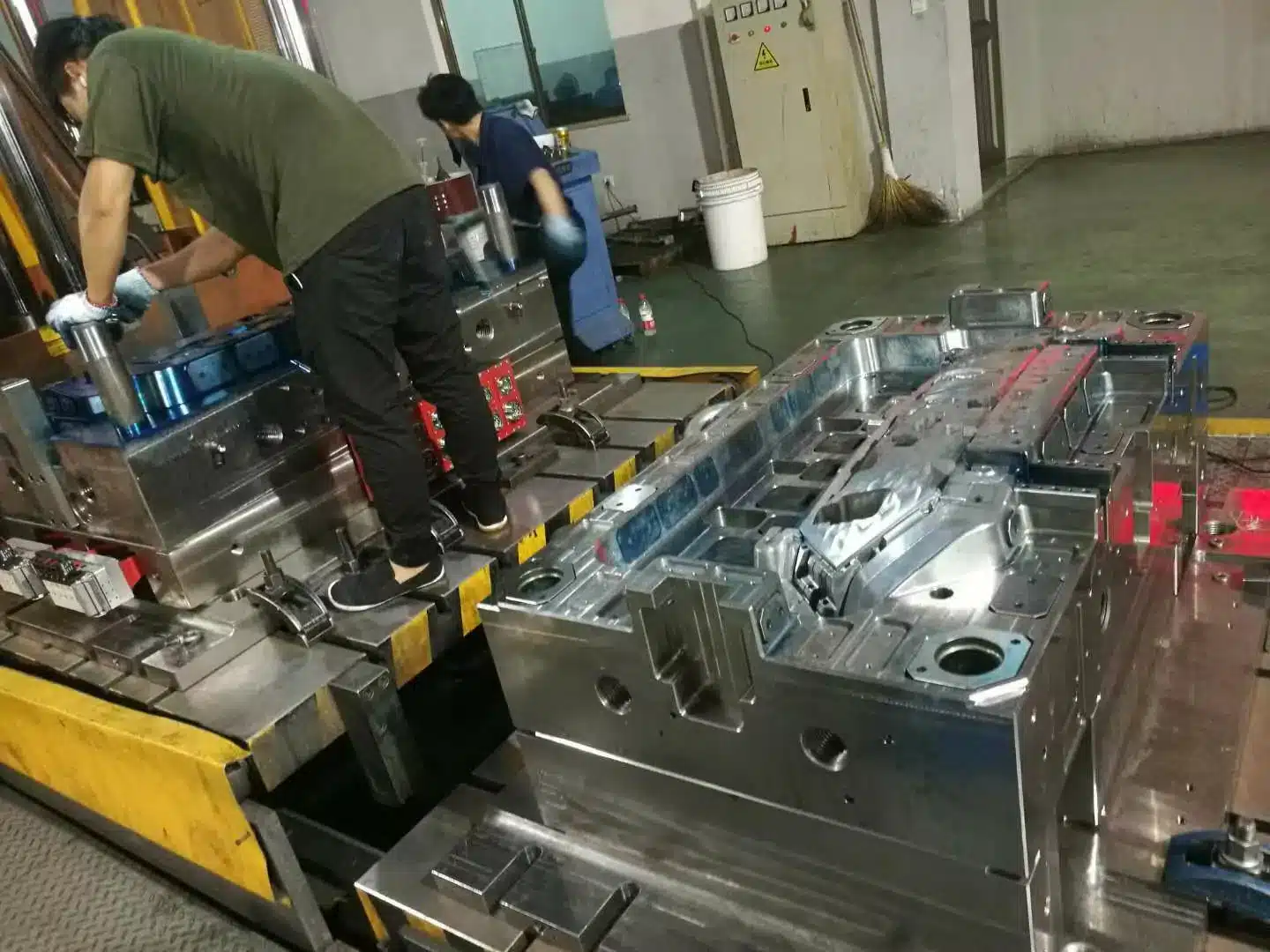

How We Manage Injection Mold Projects From DFM to Shipment in 9 controlled steps that protect timeline, budget, and part quality.
Sourcing a tool overseas should not feel like a gamble. Yet for many US buyers, the gap between a quote and a finished mold is a black box. This article opens that box. It explains, step by step, How We Manage Injection Mold Projects From DFM to Shipment at Topworks Plastic Mold, so you can see exactly where your money goes, where risk lives, and where good project control protects your launch date. You will learn what happens during DFM, how mold flow and deflection analysis prevent defects, how trials and inspection work, and what you should verify before you approve tooling.
The goal is simple. By the end, you should be able to evaluate any mold maker, not just us, with sharper questions and clearer expectations.
Design for Injection Molding
Eight checks that decide whether your part molds clean, or fights the tool for its whole life.
Wall thickness rules the whole job
Wall thickness sets cycle time, sink marks, warpage and fill pressure. Cooling time rises with the square of the wall. Double the wall and you roughly quadruple the time the part sits in the tool.
The second rule matters just as much: keep the wall uniform. Plastic shrinks as it cools. A thick zone cools last, keeps shrinking after the gate freezes, and pulls the surface in. That is a sink mark. If the skin is stiff enough to resist, the shrinkage tears a void inside instead.
Hold the nominal wall within ±10% across the part. Where a change is unavoidable, keep the step under 25% of the nominal wall and blend it over a length of at least 3× wall. Never step the wall with a square shoulder.
Cooling time is a first-order estimate from the one-dimensional plate solution. It ignores gate freeze-off, hot runner effects and mold cooling layout. Treat it as a comparison tool, not a quote.
Stiffness comes from ribs, not from thicker walls
Bending stiffness scales with height cubed. A rib 3× the wall height adds far more stiffness than doubling the wall, and it costs almost nothing in cycle time. This is the single highest-value move in plastic part design.
The catch is the rib root. Where the rib meets the wall, material mass builds up. That local thick spot cools last and pulls a sink mark onto the show surface directly opposite the rib.
Base thickness 0.5–0.6× wall for amorphous resins, 0.4–0.5× for high-shrink semi-crystallines. Height up to 3× wall. Draft 0.5–1.5° per side. Root radius 0.25–0.5× wall. Spacing at least 2× wall so the steel between ribs still cools.
Three fixes, in order of cost: move the rib off the show face, break the opposite face with a texture or a styling groove, or core out the wall behind the rib so the mass balances. Adding hold pressure only hides small sinks and often adds stress instead.
Draft is what lets the part leave the steel
A molded part shrinks onto the core. Ejector pins then push it off. With no taper, the part drags the full depth of the core and picks up scuff lines, stress whitening or a torn wall. Draft turns that sliding contact into an instant release.
Texture makes it worse. A grained surface is a field of tiny undercuts. Every 0.025 mm of texture depth needs roughly 1.5° of extra draft on top of the base requirement.
0.5° is the practical floor for a polished vertical face. 1–2° is the normal default. 3° suits a light grain, 5° and up a coarse one. Deep ribs and tall cores want at least 0.5° per side even when the drawing says the face is critical. Shut-off faces and sealing surfaces are the exception, and they need a written agreement before steel is cut.
Sharp inside corners are stress risers
A sharp internal corner concentrates stress, blocks flow and creates a local hot spot in the steel. It is also the place parts break first in drop tests. Adding a radius is free at the design stage and expensive after the tool is cut.
The chart below is the classic stress-concentration curve. Below R/T = 0.3 the factor climbs steeply. Above R/T = 0.6 you gain almost nothing, and you start adding mass that sinks.
Outside radius = inside radius + wall thickness. Do that and the material thickness through the corner stays equal to the nominal wall. Use the same inside radius everywhere so the polisher runs one ball cutter, not five.
Bosses: strong enough to hold a screw, thin enough not to sink
A boss is a rib rolled into a tube. Every rib rule still applies, plus two more. The wall of the boss has to stay thin relative to the nominal wall, and the boss must not sit directly against a side wall, or the two masses merge into one thick lump.
Core the boss from the parting line so the wall stays even. Give the core 0.25–0.5° draft, or it will not release. Stand the boss off the side wall by at least one wall thickness and tie it back with a gusset. Keep thread engagement at 2–2.5× the screw diameter, and add a counterbore at the mouth so the screw starts straight and the top of the boss does not split.
Every undercut buys a moving part in the tool
The cheapest mold opens in one direction and the part falls out. Anything that traps the part needs a slide, a lifter, a collapsible core or an unscrewing unit. Each one adds cost, adds cycle time, adds a witness line on the part, and adds something that can fail at 200,000 shots.
Pick the features your part actually needs. The panel adds up what they do to the tool.
Many undercuts disappear with a small change. Add a pass-through hole in the opposite face so a core pin can form the feature on straight pull. Move the parting line onto a styling break. Split one part into two and weld or clip them. Turn a rigid snap into a shallow bump-off that a flexible resin can strip over. Each of these is worth an hour of CAD work before the RFQ.
The gate decides where the weak lines land
Melt enters at the gate and races outward. Where two flow fronts meet, they form a weld line. That line can be 20–60% weaker than the bulk material, and on a glass-filled resin it is worse, because the fibers lie parallel to the line instead of across it.
Click anywhere in the plate to move the gate and watch the fill pattern change. Openings split the flow and put a weld line downstream of every hole.
Click the plate to place the gate.
Choosing a gate type
| Gate | Auto de-gate | Vestige | Best for | Watch out for |
|---|---|---|---|---|
| Edge / side | No | Trimmed nub | Flat parts, most tooling | Manual trim adds labor |
| Submarine (tunnel) | Yes | Pin mark, hidden | Small to medium parts | High shear, not for filled or brittle resins |
| Hot tip / valve gate | Yes | Small dimple or flat | Cosmetic parts, no runner scrap | Highest tool cost, needs controller |
| Direct sprue | No | Large scar | Thick single-cavity parts | Sink under the gate, long cooling |
| Fan | No | Wide trimmed edge | Wide flat panels, low warp | Needs trim fixture |
| Diaphragm | No | Ring on the bore | Round parts needing concentricity | Secondary machining |
Where can a gate vestige be accepted? Which surface is cosmetic, so the weld line must be moved off it? Is the longest flow path within reach for this resin at this wall? Answer those and the filling analysis usually confirms what you already chose.
Shrinkage first, tolerance second
The cavity is cut larger than the part. How much larger depends on the resin, the wall, the hold pressure and the direction of flow. Semi-crystalline resins shrink two to four times more than amorphous ones, and glass fiber makes shrinkage directional.
That is why a tolerance that is routine in aluminum can be impossible in PP. Ask for tight numbers only where the function needs them, and say which datum they are measured from.
Hold pressure and hold time change shrinkage more than any other setting. Mold temperature comes next, then wall thickness. A part measured hot off the press is not the part you get 48 hours later, especially in PA and POM. Set your inspection window and write it on the drawing.
Values shown follow the general shape of the SPI and DIN 16742 guidance for standard and fine tolerance grades. Use them to sanity-check a drawing early. A final capability statement comes from the mold flow study and the first-article report.
Self-check
Eight questions from the sections above. Answers explain themselves as you go.
What Does It Take to Manage an Injection Mold Project Well?
Strong project management causes predictable outcomes. A mold is a long-lead capital asset, often built thousands of miles from your desk, so small misunderstandings early can become expensive scrap later.
Good management of an injection mold project includes four things working together:
- Engineering discipline — catching design problems before steel is cut
- Process transparency — knowing the build stage at any moment
- Quality gates — formal checkpoints that must pass before work continues
- Clear communication — one accountable point of contact across time zones
When these four elements are missing, buyers feel it as missed dates, surprise costs, and parts that fail at the worst possible time. When they are present, the project moves quietly and on schedule.
How We Manage Injection Mold Projects From DFM to Shipment
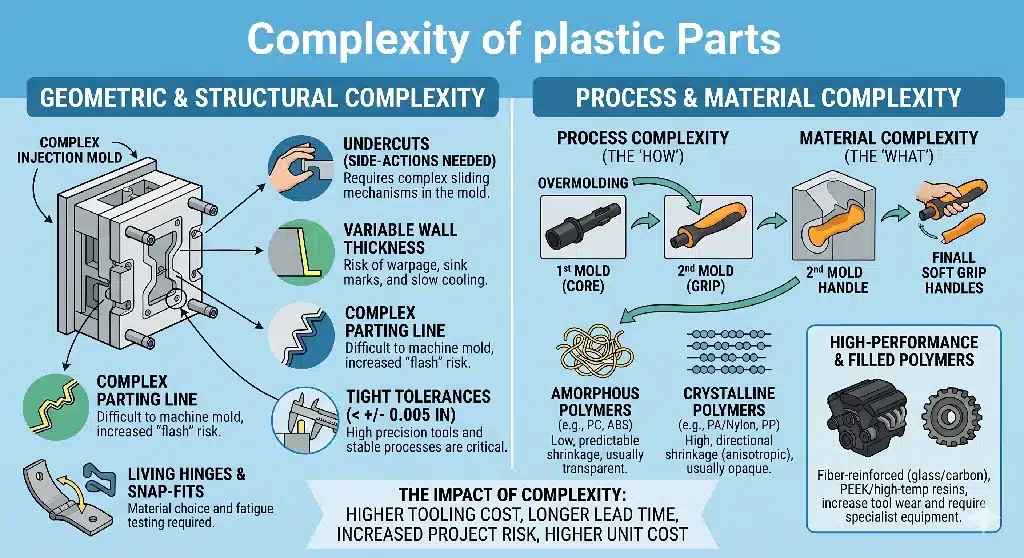
How We Manage Injection Mold Projects From DFM to Shipment follows nine controlled steps, each with a checkpoint that must close before the next begins. Topworks has run this workflow as an ISO 9001 certified, factory-direct manufacturer since 2006. There is no trading company between you and the shop floor, which means decisions reach engineers without translation loss.
Here is the full sequence.
Step 1 — Project Intake and Feasibility Review
Every project starts with a feasibility review, not a price. When you send a 3D file (STEP, IGES, or native), we confirm the part can be molded, the wall thickness is sound, and the resin choice fits the application. We flag anything that looks risky before quoting. This step prevents the classic problem of pricing a part that cannot actually be made as drawn.
Step 2 — Free DFM Analysis
We perform a free DFM analysis on every part. DFM, or Design for Manufacturability, examines the part through the lens of how it will be tooled and molded. We check draft angles, undercuts, gate locations, ejection, parting lines, and sink risk. You receive a written DFM report with annotated images and specific recommendations. Nothing moves to design until you sign off on the DFM outcome.
Step 3 — Mold Flow and Deflection Simulation
For complex or tight-tolerance parts, we run mold flow simulation and deflection analysis. Mold flow predicts how molten plastic fills the cavity, where it knits, and where it may trap air or burn. Deflection analysis is just as important: it predicts how the core, cavity, and mold plates may bend under injection and clamping pressure. Uncontrolled deflection causes flash, dimensional drift, and uneven wall sections. By modeling it first, we size the steel and support pillars to keep deflection within safe limits.
Step 4 — Mold Design and Customer Approval
Our tooling engineers then produce the full 2D and 3D mold design. This covers cavity layout, runner and gate system, cooling channels, ejection, and the mold base specification. We send the design package for your approval and hold a design review if needed. Approval here is a hard gate. We do not order steel until you confirm the design.
Step 5 — Steel Selection and Procurement
Steel selection matches the resin, the cycle count, and your budget. A short-run prototype tool in P20 or pre-hardened steel costs less and builds faster. A high-volume production tool in hardened H13 or 718H lasts far longer and resists wear from glass-filled resins. We recommend the grade, you approve it, and procurement begins with traceable material certificates.
Step 6 — Machining, EDM, and Mold Assembly
Now the mold is built. CNC milling, turning, EDM, wire cutting, and grinding bring the cavities and cores to final geometry. Skilled mold makers then fit, polish, and assemble the components. Throughout this phase you receive scheduled progress updates with photos, so the build never goes dark.
Step 7 — T1 Trial and First Article Samples
The first trial, called T1, is where steel meets plastic. We mold the first samples on the correct tonnage press using your specified resin. T1 reveals real-world behavior that simulation cannot fully guarantee. We capture process data, short shots, and any visual defects, then ship T1 samples to you for hands-on evaluation.
Step 8 — Inspection, Measurement, and Iteration
We measure first article samples against your drawing and issue a dimensional report. Where features are out of tolerance, we adjust the tool and run T2, then T3 if required. Each iteration is documented. This loop continues until parts meet your specification and you approve them in writing. Sample approval is the gate that releases the tool for production or shipment.
Step 9 — Packaging, Documentation, and Shipment
Finally, we prepare the mold and any approved parts for export. Tooling is cleaned, rust-protected, and crated to survive ocean freight. You receive the full documentation set: mold drawings, steel certificates, the trial report, the measurement report, and recommended maintenance intervals. We then arrange or coordinate shipment to your facility.
The table below summarizes the nine steps and what closes each one.
| Step | Stage | Gate to Pass |
|---|---|---|
| 1 | Intake & feasibility | Part confirmed moldable |
| 2 | Free DFM analysis | Buyer signs off DFM report |
| 3 | Flow & deflection simulation | Risks modeled and accepted |
| 4 | Mold design | Buyer approves design package |
| 5 | Steel selection | Grade approved, certs in hand |
| 6 | Machining & assembly | Build complete, photos shared |
| 7 | T1 trial | Samples molded and shipped |
| 8 | Inspection & iteration | Dimensions approved in writing |
| 9 | Packaging & shipment | Docs delivered, tool crated |
What Is DFM and Why Does It Come First?
DFM comes first because it prevents the most expensive mistakes. Design for Manufacturability reviews a part before any steel is cut, when changes cost almost nothing.
A DFM review improves a project in concrete ways:
- It identifies insufficient draft that would cause drag marks or ejection failure.
- It relocates gates to reduce visible blemishes and weld lines.
- It corrects uneven wall thickness that causes sink and warpage.
- It flags undercuts that may need side actions or lifters, which affect cost.
Skipping DFM does not save time. It moves the discovery of problems from the design stage to the trial stage, where fixing them means re-cutting hardened steel. For US buyers managing a product launch, that shift can mean weeks of delay. DFM front-loads the thinking so the back end stays calm.
How Does Mold Deflection Affect Part Quality?
Mold deflection directly degrades part quality and tool life. Injection happens under enormous pressure, and steel, though stiff, is not perfectly rigid. Cores and cavity walls can bend slightly, and mold plates can flex if they lack support.
The consequences of uncontrolled deflection include:
- Flash — plastic escaping where plates separate under pressure
- Dimensional variation — features drifting outside tolerance shot to shot
- Core shift — a thin core bending sideways, causing uneven wall thickness
- Premature wear — repeated flexing fatiguing the steel over time
We control deflection by analyzing it during simulation, then adding support pillars, increasing plate thickness, or selecting stiffer steel where the model shows risk. Managing deflection early is far cheaper than chasing flash and tolerance problems during trials. For demanding parts, deflection analysis is one of the highest-value steps in the entire workflow.
How Long Does an Injection Mold Project Take?
Lead time depends on complexity, but most molds follow a predictable range. A simple single-cavity tool may take a few weeks, while a complex multi-cavity production mold with side actions takes longer. The honest answer is that timelines vary by source and should be verified for your specific part.
What matters more than a single number is schedule control. Because each of our nine steps has a gate, delays are visible early rather than discovered at the end. Typical drivers of lead time include cavity count, surface finish requirements, the number of slides or lifters, and how quickly design and sample approvals come back from your side. Fast buyer approvals shorten the project; slow approvals extend it.
How Do We Control Quality Across the Project?
Quality control runs through every stage, not just final inspection. As an ISO 9001 certified shop, we treat quality as a process, not an inspection at the end.
Our quality system includes:
- Material certificates that trace steel and resin to their source
- In-process inspection during machining and assembly
- Documented T1, T2, and T3 trial records
- A dimensional measurement report against your drawing
- Written approval gates before any major step proceeds
This layered approach means a defect has many chances to be caught before it ever reaches your dock. It also gives you a paper trail, which matters for regulated industries and for any buyer who must justify a supplier decision internally.
Which Mold Type Fits Your Project?
Choosing the right tool type controls both cost and risk. The best choice depends on your annual volume, budget, and how final your design is. The comparison below helps you decide.
| Criteria | Prototype / Bridge Tool | Production Tool |
|---|---|---|
| Typical steel | Aluminum or P20 | Hardened H13 / 718H |
| Volume suited | Low, validation runs | Medium to high volume |
| Upfront cost | Lower | Higher |
| Lead time | Shorter | Longer |
| Tool life | Limited cycles | Long, durable |
| Best when | Design may still change | Design is locked |
A prototype tool improves speed to market when you still expect changes. A production tool lowers your long-term cost per part when volume is committed. Many US buyers start with a bridge tool, validate the design and market, then invest in a production tool once the design is frozen.
What Should US Buyers Verify Before Approving a Mold?
Smart verification before approval prevents costly regret. Before you sign off on a design or sample, confirm these points:
- The DFM report addresses every cosmetic and functional concern.
- The steel grade matches your expected production volume.
- The dimensional report covers all critical-to-function features.
- Gate location and witness marks are acceptable on visible surfaces.
- The cooling design supports a realistic cycle time.
- You have received material certificates and trial documentation.
Asking for these before approval is normal and welcomed by serious mold makers. A supplier who resists transparency is a supplier worth questioning. The strength of How We Manage Injection Mold Projects From DFM to Shipment lies precisely in making each of these points visible at the right gate.
Frequently Asked Questions
Do you charge for DFM analysis? No. Topworks provides free DFM analysis on every project before quoting moves forward. You receive a written report with annotated images and recommendations. This lets you evaluate manufacturability without upfront commitment.
What file formats do you accept for the part design? We accept STEP, IGES, and most native CAD formats, along with 2D drawings for tolerances and notes. The more complete your data, the more accurate the DFM and quote. If you only have a sketch or a sample part, we can still help scope the project.
Can I get samples before committing to production? Yes. Our workflow includes T1 trial samples shipped for your hands-on evaluation, followed by a dimensional measurement report. You approve parts in writing before the tool is released for production or shipment. This protects you from approving a tool you have not physically validated.
How do you handle design changes during the build? Changes are easiest and cheapest before steel is cut, which is why DFM and design approval are hard gates. If a change is needed later, we assess its impact on cost and schedule and document it before proceeding. Transparency about change cost is part of how we manage projects.
Do you ship the mold, the parts, or both? We can ship the tool, validated parts, or both, depending on your agreement. Tooling is cleaned, rust-protected, and crated for ocean freight. You also receive the full documentation set so the mold can be maintained or moved later.
What happens if parts are out of tolerance after the first trial? We measure samples against your drawing and adjust the tool, then run additional trials such as T2 or T3 as needed. Each iteration is documented until parts meet specification and you approve them. This corrective loop is included in the normal project flow, not treated as an afterthought.
Conclusion
Managing an injection mold project well is about control, not luck. How We Manage Injection Mold Projects From DFM to Shipment turns a long, distant build into a sequence of visible, gated steps: feasibility, free DFM, flow and deflection analysis, design approval, steel selection, machining, T1 trials, inspection, and documented shipment. Each gate protects your timeline, your budget, and your part quality.
For US buyers, the practical takeaway is to demand this kind of transparency from any supplier. Ask about DFM. Ask how deflection is controlled. Ask for trial and measurement documentation before approval. When a mold maker can answer clearly at every stage, you are no longer gambling on a black box. You are managing a known process toward a predictable result.

