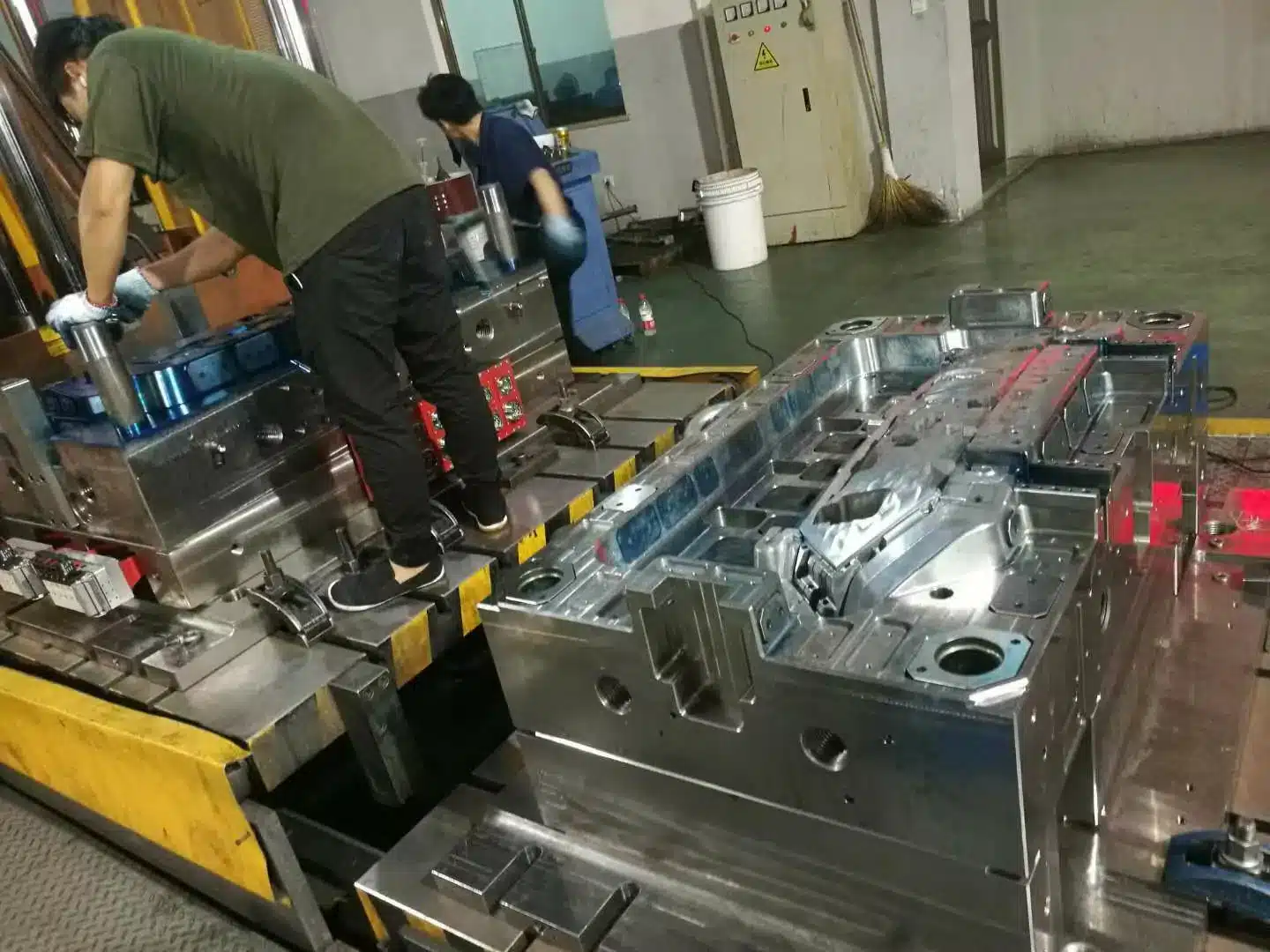

What Is PEEK Injection Molding?
PEEK injection molding melts polyether ether ketone at 350–400°C and shoots it into a hot steel cavity at 160–200°C. The result is a part that survives where nylon, PC, or even some metals quit.
Most plastic shops can’t run it. The barrel, the dryer, the mold heater — all of it has to be built for the temperature. That’s the short answer for why your PEEK quote looks the way it does.
If you source for aerospace, medical, oil and gas, or semiconductor, you’ll hit PEEK injection molding eventually. Knowing how it actually runs on the floor changes how you read a quote and how you push back on lead times.
What Makes PEEK Different From Other Plastics?
PEEK keeps its mechanical strength up to 250°C continuous. Nylon taps out at 80–150°C depending on grade. Polycarbonate softens around 120–130°C. That gap is the whole reason PEEK exists.
The other properties stack on top:
- Resists jet fuel, hydraulic fluid, and steam — the things that destroy commodity resins on a service rig or in a hydraulic line
- Biocompatible grades meet ISO 10993, which opens the door to spinal cages and dental work
- UL 94 V-0 with low smoke and low toxic gas, important on aircraft interiors
- Takes repeated steam and gamma sterilization without losing properties
- Density around 1.3 g/cm³ — about a sixth of steel
These aren’t bullet points for a brochure. They’re the reasons a buyer pays $80/kg instead of $3/kg.
How Does the PEEK Injection Molding Process Work?
PEEK injection molding follows the same five steps as standard injection molding. Every number is pushed to extremes.
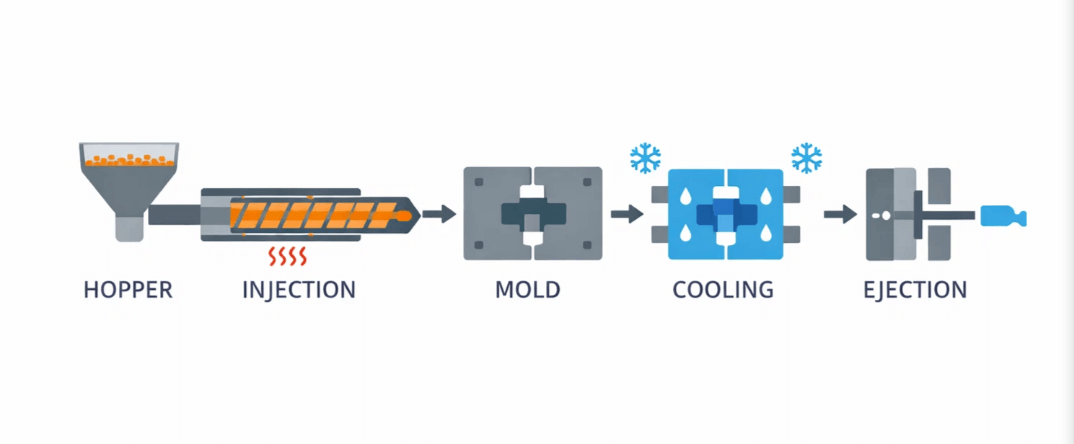
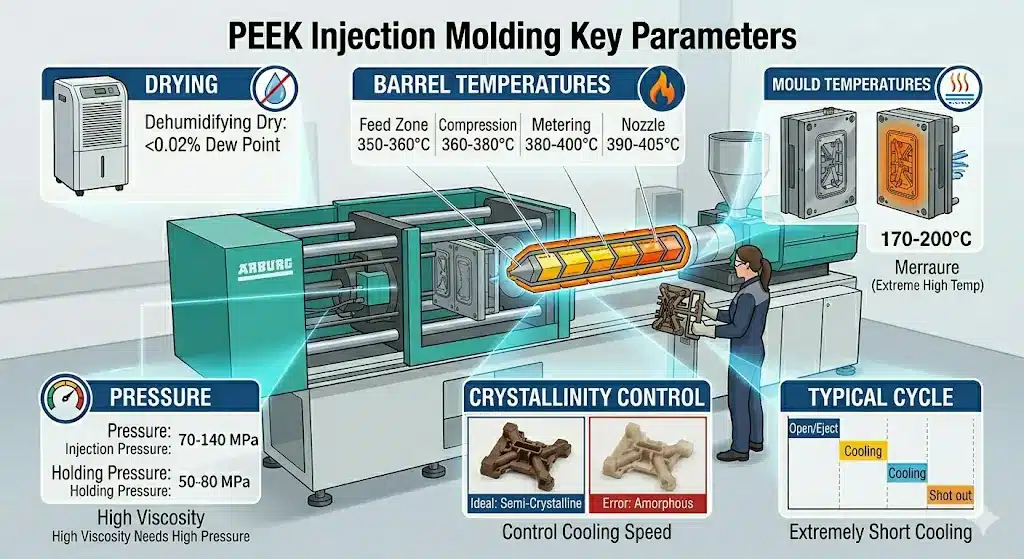
Step 1: Drying. Dry the resin at 150–160°C for 3–6 hours in a desiccant dryer. Target moisture below 0.02%. Miss this and PEEK hydrolyzes in the barrel. You get silver streaks, bubbles, and parts that snap under load.
For context, ABS dries at 80°C for 90 minutes. PEEK is a different animal.
Step 2: Melting. Barrel temperature climbs from 350°C at the rear to 380–400°C at the nozzle. PEEK melts around 343°C. Stay above that. Cross 400°C and you start degrading the polymer in the barrel — black specks and a brown haze in the part.
A standard machine sitting under 300°C cannot do this. The heater bands, thermocouples, and screw all need to be rated for sustained 400°C.
Step 3: Injection. Inject at 80–120 MPa cavity pressure. Speed runs 30–80 mm/s. Hold pressure sits at 60–80% of injection pressure. PEEK shrinks more than amorphous resins, so pack hard or you get sink and dimensional drift.
Step 4: Mold temperature. This is where most shops fail. Mold surface has to hit 160–200°C — Victrex recommends 170–200°C. Run the mold cold and the part comes out amorphous: dark brown, opaque, weak in chemicals and weak in load. It looks burnt. It’s actually just under-crystallized.
Getting 200°C uniformly across the cavity needs oil heaters or electric cartridges, plus insulation boards between the mold and the platen. Water units don’t go that high.
Step 5: Cooling and ejection. Cool slow and controlled. Many parts then go to a post-mold anneal — typically 200°C for several hours — to relieve internal stress and lock in dimensions.
What Equipment Does a Shop Need to Run PEEK?
Short list of what separates a PEEK-capable shop from a regular molder:
- A machine rated above 400°C at the barrel and nozzle. Ceramic heater bands and barrel blankets keep the temperature stable and the bill manageable. The screw is low compression, around 2:1, with no non-return valve. L/D should be 20–30.
- Hardened tool steel. H13 heat-treated to 44–50 HRC, or S136 stainless at 48–54 HRC. H13 wins for glass-filled or carbon-filled PEEK — the wear is brutal. S136 wins when you need a mirror polish or full corrosion resistance for medical work.
- Oil or electric mold temperature controllers. The unit has to hold 200°C across the cavity without a 20°C swing from gate to far wall.
- Corrosion-resistant barrel surfaces. Filled PEEK eats screws. Highly polished, hard-faced surfaces. No copper, no copper alloys anywhere the melt touches — they corrode at PEEK temperatures and contaminate the part.
- A real desiccant dryer with a dew point below −40°C.
Three things on shot sizing:
- Use 30–70% of the machine’s shot capacity. Under 30% and the resin sits in the barrel too long — it degrades. Over 70% and the cushion gets unreliable.
- Keep a cushion of 5–10% of shot stroke
- Estimate clamp force from melt pressure × projected area × 1.1–1.3 safety factor
If your supplier can’t walk you through these numbers, they probably can’t run your part.
Mold Design Rules for PEEK
PEEK breaks a lot of mold design habits carried over from ABS or PC. The most common ones we re-cut on a tryout:
Gates run bigger. Victrex’s 2/3 rule: gate thickness at least two-thirds of the maximum wall. Minimum gate is 1.0 mm for unfilled PEEK and 2.0 mm for filled. Tab gates, side gates, and fan gates do most of the work. Submarines can work on small thin walls. On larger parts they freeze off early and you get a short shot.
For reference, here’s standard gate sizing — read this as a floor, not a target, for PEEK:
| Part Wall Thickness (mm) | Side Gate Depth h (mm) | Side Gate Width b (mm) | Pin Gate Diameter d (mm) |
|---|---|---|---|
| < 0.8 | ≈ 0.5 | ≈ 1.0 | 0.8–1.3 |
| 0.8–1.5 | 0.6–0.8 | 1.0–1.5 | 0.8–1.5 |
| 1.5–2.5 | 0.8–1.2 | 1.5–2.5 | 1.0–1.8 |
| 2.5–4.0 | 1.2–2.0 | 2.5–4.0 | 1.5–2.2 |
| > 4.0 | 2.0+ | 4.0+ | 2.0–2.8 |
For glass-filled PEEK, bump gate cross sections about 10% larger than unfilled. High shear shreds the fibers and you lose the reinforcement you paid for.
Runners. Main runner diameter at least 4.06 mm (0.16 in). Keep them short. Cold slug wells at the end of every runner segment — skip them and a cold front blocks the flow path. Typical main runners sit at 4–8 mm for small to medium parts and 6–10 mm for larger ones. Sub-runners slightly smaller.
Draft. Minimum 2°. Not 0.5°. Not 1°. The hot mold and high shrinkage make ejection nasty if you skimp here.
Venting. This is where shops with no PEEK experience get burn marks. At 380°C melt, any trapped gas torches the part. Vent depth 0.02–0.05 mm. Vent width 3–12 mm. Vent land about 1.5 mm. Put vents opposite the gate, at flow ends, and on every weld line.
Cooling channels. The mold runs hot, but it has to run hot uniformly. Use oil channels sized like this:
| Part Wall Thickness (mm) | Channel Diameter (mm) | Channel-to-Cavity Distance (mm) | Channel Spacing (mm) |
|---|---|---|---|
| 1–2 | 6–8 | 10–15 | 30–40 |
| 2–4 | 8–10 | 15–20 | 40–60 |
| 4–6 | 10–12 | 18–25 | 50–70 |
| > 6 | 12–14 | 20–30 | 60–80 |
Keep channels at least 5 mm from ejector pins and other holes. Leave 8–10 mm of steel between a channel and the mold edge.
Part Design Guidelines for PEEK Components
The fundamentals don’t change. The penalty for breaking them does.
Wall thickness. 1.0–3.0 mm is the sweet spot. Hold variation inside ±25% of nominal. Bigger swings and the part warps as different sections crystallize at different rates.
Ribs. Rib thickness 40–60% of the adjoining wall. Height no more than 2.5–3× the wall. Spacing at least 2× wall. Root radius around 0.25–0.4× wall.
Bosses. Outer wall 40–60% of the surrounding wall. Hole depth no more than 2.5–3× hole diameter without a gusset.
Radii. Internal corners at minimum R ≥ 0.25–0.5× wall. For parts under cyclic load or chemical attack, go bigger. Sharp internal corners are where PEEK parts crack first.
Why Is PEEK Injection Molding So Expensive?
Material is the headline. Everything else stacks on top.
| Cost Factor | Impact |
|---|---|
| Raw resin | Standard grades $40–$100+/kg [VERIFY]. Implant grade is much higher. Commodity plastics sit at $2–$5/kg. |
| Energy | 400°C barrel and 200°C mold burn far more electricity than a standard run at sub-300°C barrel and 60°C mold. |
| Equipment | High-temp machine, hardened steel (H13 at 44–50 HRC or S136 at 48–54 HRC), oil heater, desiccant dryer. Higher capex, fewer shops to amortize across. |
| Cycle time | Cooling time scales with the square of wall thickness. Double the wall, roughly quadruple the cool. Parts per hour drop. |
| QC | Tolerances of ±0.05–0.25 mm and qualification testing add real inspection hours. |
| Supplier scarcity | Fewer qualified molders means less price pressure on you. |
| Contamination control | Any leftover ABS or PC in a barrel will char at PEEK temperatures. Dedicated machines or full purge cycles are normal — both cost money. |
Don’t compare PEEK to nylon on a per-kg basis. Compare it on cost per year of service. A PEEK valve seat that lasts five years beats a steel one that needs replacement every twelve months — counting downtime, that math usually isn’t close.
PEEK vs. Other High-Performance Polymers
You’ll get asked why PEEK and not PPS, PEI, or PAI. This is the short answer:
| Property | PEEK | PPS | PEI (Ultem) | PAI (Torlon) |
|---|---|---|---|---|
| Max continuous temp | 250°C | 220°C | 170°C | 275°C |
| Chemical resistance | Excellent | Good | Moderate | Good |
| Biocompatibility | Yes (select grades) | No | Limited | No |
| Processability | Moderate | Good | Good | Difficult |
| Relative cost | High | Moderate | Moderate | Very high |
| Metal replacement | Excellent | Good | Moderate | Excellent |
PEEK sits in a sweet spot. Near-Torlon performance, better processability, and the regulatory paperwork already exists for medical and food contact. PAI runs hotter but is genuinely hard to mold.
Which Industries Use PEEK Injection Molded Parts?
PEEK shows up wherever a failed part means a shut-down line, a grounded plane, or a recalled implant.
- Aerospace: brackets, cable clamps, cabin interior parts. Flame rating and weight savings drive the spec.
- Medical devices: spinal cages, dental abutments, surgical instrument handles. Biocompatibility and repeat sterilization.
- Oil and gas: downhole seals, valve seats, backup rings. The fluids and the heat would kill almost anything else.
- Automotive: transmission parts, turbocharger components, sensor housings around the manifold.
- Semiconductor: wafer handling. Plasma chambers and aggressive cleaning chemicals.
- Industrial: bearings, gears, and wear parts replacing lubricated metal — runs dry, runs longer.
Key Benefits of PEEK Injection Molding
- 60–70% weight savings over steel or titanium parts. PEEK density is about 1.3 g/cm³. Steel is 7.8. Titanium is 4.5.
- Part consolidation — one molded PEEK piece can swallow three or four machined metal subcomponents
- Tolerances of ±0.05–0.25 mm at full production rates
- X-ray transparent. Useful when an implant has to disappear on a CT scan so the surgeon can see the bone
- Water absorption under 0.1%, so dimensions hold under sustained load and thermal cycling
- Less secondary machining than the metal part it replaces
Every claim above needs to land against a specific buyer outcome. “Lighter” doesn’t sell. “Five kilograms off a fuel pump bracket, multiplied by 200 brackets per aircraft” — that sells.
Limitations You Should Know Going In
- Entry cost is high. If the application can tolerate nylon or PPS, use them. PEEK is not a default.
- Color is limited. Natural PEEK is beige-brown. Custom colors are possible but compromise properties.
- Tight processing window. Barrel 350–400°C, mold 160–200°C. Drift outside and you get amorphous parts, burn marks, or hydrolyzed resin.
- Gate sensitivity. Minimum 1 mm gate unfilled, 2 mm filled. Complex parts with multiple flow fronts need careful runner balance. Cheap mold design shows up as weld line failures.
- Contamination kills yields. Black specks from prior material residue. Dedicated machines or full purge protocols are the only fixes.
- Tooling cost vs. volume. Below a few hundred parts, machining from PEEK rod usually wins on total cost.
- High shrinkage. Semi-crystalline behavior demands careful mold compensation and even cooling. Get this wrong and the first article doesn’t match the print.
Tell buyers this upfront. You shorten the qualification cycle and you sound like someone who’s actually run the material.
How Should Marketers Position PEEK Products?
Lead with what fails. Not with what PEEK is.
- Open on the failure mode. Corroded steel, cracked nylon, rejected implant. Then bring in PEEK.
- Talk total cost of ownership. Service life, maintenance intervals, downtime. Per-kg comparisons lose.
- Layer the content. Engineers want the data sheet and the cycle parameters. Procurement wants unit economics and a stable supply story. Executives want risk reduction and regulatory cover.
- Show the certifications first, not last. In regulated work, no cert means no conversation.
- Use case studies with numbers. A documented steel-to-PEEK conversion with measured weight, lifespan, and savings beats any property table.
What Certifications Apply to PEEK Parts?
Standards that come up most often:
- ISO 10993 — biocompatibility for medical parts
- FDA 21 CFR — food contact
- AS9100 — aerospace quality management
- IATF 16949 — automotive quality systems
- UL 94 V-0 — flammability
- REACH and RoHS — chemical substance compliance in Europe
Cite the certifications your supplier actually holds. “PEEK is REACH-compliant in principle” is not a certification — it’s a press release.
Is PEEK Injection Molding Sustainable?
It’s complicated. The honest version:
- Parts last longer. Fewer replacements. Less waste over a product’s life.
- PEEK is recyclable in principle. Regrind needs extended drying — 6 to 8 hours — and tight QC to keep properties.
- Lightweight parts cut fuel burn in aircraft and vehicles, which lowers lifecycle CO₂
The other side: synthesizing PEEK is energy-intensive. Running it at 400°C barrel and 200°C mold is also energy-intensive. Don’t make blanket green claims. Frame it as lifecycle, with the upfront energy cost counted honestly.
Process Parameter Quick Reference: PEEK vs. Standard Plastics
| Parameter | PEEK | ABS (typical) | PC (typical) |
|---|---|---|---|
| Drying temp / time | 150–160°C / 3–6 h | 80°C / 1.5–2 h | 90–110°C / ≥ 2 h |
| Target moisture | < 0.02% | < 0.05% | < 0.02% |
| Barrel temperature | 350–400°C | 190–235°C | 280–320°C |
| Mold temperature | 160–200°C | 45–80°C | 80–110°C |
| Back pressure | 5–10 MPa | 9–18 MPa | 6–15 MPa |
| Injection speed | 30–80 mm/s | > 100 mm/s possible | Moderate |
| Melting point | ~343°C | ~105°C (amorphous) | ~267°C (amorphous) |
| Min. draft angle | 2° | 0.5–1° | 0.5–1° |
| Mold steel | H13 (44–50 HRC) or S136 (48–54 HRC) | P20 (28–32 HRC) | NAK80 (38–42 HRC) or S136 |
| Shot utilization | 30–70% | 20–80% | 30–50% |
Frequently Asked Questions
What temperature is required to mold PEEK? Barrel 350–400°C, mold 160–200°C. PEEK melts at about 343°C. Cross 400°C and the polymer degrades. These ranges are well above what a standard machine and a standard water-cooled mold can handle, which is why most molders cannot run it.
Can PEEK replace metal in structural applications? Yes. PEEK routinely replaces stainless, aluminum, and titanium when weight, corrosion, or radiolucency matter. Every conversion still needs engineering validation against load, temperature, and environment.
How long do PEEK injection molded parts last? Often longer than the metal parts they replace, especially in corrosive or high-cycle service. Actual lifespan depends on load, chemistry, and temperature — test the part, don’t trust a brochure.
Is PEEK safe for medical implants? Select grades are biocompatible and meet ISO 10993. PEEK-OPTIMA from Victrex is the most common implant grade for spinal and orthopedic work. Implant applications need implant-grade resin with full traceability and documentation.
What is the minimum order quantity for PEEK injection molding? No universal MOQ, but tooling and setup costs make molding viable from a few hundred parts up. Below that, CNC machining from PEEK rod or plate is usually cheaper.
Does PEEK injection molding require special mold design? Yes. The mold has to hold 160–200°C uniformly, the gates must be larger (1 mm unfilled, 2 mm filled minimum), venting must be shallow at 0.02–0.05 mm, and runners need cold slug wells. A standard ABS mold will not run PEEK without extensive rework.
What mold steels are best for PEEK? H13 at 44–50 HRC or S136 at 48–54 HRC. H13 holds up to filled grades — glass and carbon fiber are abrasive. S136 polishes to a mirror and resists corrosion, which is what you want for medical and optical parts. P20 at 28–32 HRC is not enough for sustained PEEK temperatures.

