
Injection Molding Material Guide
PP Injection Molding: Grades, Shrinkage, Processing Specs and Real Part Costs
Your first articles land and the 120mm dimension measures 118.3mm. The drawing says ±0.3mm. Before you email the mold shop about bad steel, check the resin you specced. In PP injection molding, a gap that size is usually shrink doing exactly what PP does.
PP shrinks 1.2–2.0% between melt and room temperature. That 1.7mm gap is what unmanaged shrink looks like on a real part.
This page covers what PP does inside a mold and the tolerances you can realistically hold. It also covers the processing window your supplier should run, and what a PP part costs line by line. Written for the person issuing the PO, not the one running the press.
What PP Injection Molding Is, and the One Number That Changes Everything
PP injection molding melts polypropylene at 200–250°C and forces it into a steel cavity, where it cools into a finished part. PP is the cheapest and lightest commodity molding resin in common use. Resin runs roughly $1.10–1.40/kg at a density of 0.90–0.91 g/cm³.
That low density is why PP beats HDPE on cost when resin prices are nearly identical. Same part volume, 5% less weight, 5% less material in every shot.
Shrinkage matters more than any of it. PP is semi-crystalline, so the molecules pack into ordered regions as they cool and the part gets noticeably smaller. Amorphous resins like ABS and other molding materials do not do this to anything like the same degree.
| Property | PP (unfilled) | ABS | HDPE |
|---|---|---|---|
| Mold shrinkage | 1.2–2.0% | 0.4–0.7% | 1.5–2.5% |
| Density (g/cm³) | 0.90–0.91 | 1.04–1.06 | 0.95 |
| Resin cost (USD/kg) | $1.10–1.40 | $1.80–2.20 | $1.05–1.35 |
| Melt temperature | 200–250°C | 220–250°C | 200–260°C |
Three to four times the shrink of ABS. Every downstream decision on your project traces back to that line.
The Three PP Families, and Which One Your Part Needs
PP comes in three families: homopolymer, random copolymer, and impact copolymer. Picking the wrong one is the most common material mistake we see on incoming RFQs. It usually shows up as a part that cracks in cold weather.
Homopolymer is pure propylene. It is the stiffest and the cheapest of the three, and the most widely used. It also turns brittle below about 0°C. That matters if your product ships through a Chicago winter or sits in a freezer. Pails, crates and 20L paint bucket tooling are nearly all homopolymer.
Random copolymer adds a small amount of ethylene into the chain. You give up stiffness and gain clarity plus low-temperature toughness. Clarified random copolymer is what clear caps and food containers are molded from.
Impact copolymer, also called block copolymer, carries a rubber phase inside the PP matrix. It stays tough down to −20°C and costs roughly 8–15% more than homopolymer. Automotive bumper trim and tool cases are the typical jobs.
Then there are filled grades. Talc at 10–40% raises stiffness and cuts shrinkage. Glass fiber at 20–30% roughly doubles tensile strength. Both are abrasive, and both change what steel your mold needs.
| Family | Stiffness | Toughness at −20°C | Clarity | Typical MFI (g/10min) | Relative resin cost | Typical parts |
|---|---|---|---|---|---|---|
| Homopolymer | Highest | Poor | Translucent | 0.7–55 | Baseline | Crates, housings, closures, furniture |
| Random copolymer | Medium | Fair | Good to clear | 1.5–100 | +4–8% | Food containers, clear caps, medical |
| Impact copolymer | Medium-high | Good | Opaque | 0.4–100 | +8–15% | Automotive trim, tool cases, bins |
| PP + 20% talc | Very high | Fair | Opaque | 8–30 | +5–10% | Appliance parts, thin-wall structural |
| PP + 30% glass | Highest | Good | Opaque | 3–20 | +40–70% | Pump bodies, brackets, under-hood |
What MFI to Specify Before You Send the RFQ
Melt flow index tells a molder how easily the resin flows. It is the spec most often missing from a PP RFQ. MFI is measured at 230°C under a 2.16 kg load, reported in grams per 10 minutes. High MFI means low molecular weight and easy filling. Low MFI means a tougher part that takes more pressure to fill.
Send three suppliers an RFQ that says only “PP” and you get quotes built on three different grades. They are not comparable. The cheapest one is usually quoting the highest-MFI resin on the shelf, which is also the most brittle.
Thinnest wall → longest flow length from the gate → MFI → resin grade
Work in that order. Do not start with a target MFI and shop for a resin to match it.
MFI of 8–25 covers most general molding. Thin-wall parts under 1.2mm push you into 30–100, as does any flow length over 150× the wall. Structural parts with walls above 3mm do better at 2–8, where impact strength is highest.
| MFI (g/10min) | Wall thickness | Flow length / wall ratio | Example parts |
|---|---|---|---|
| 2–8 | 3.0mm and up | Under 100:1 | Pallets, crates, structural housings |
| 8–25 | 1.5–3.0mm | 100–150:1 | Caps, bins, appliance covers, toys |
| 25–50 | 1.0–1.5mm | 150–250:1 | Food containers, thin-wall lids |
| 50–100 | Under 1.0mm | Over 250:1 | Thin-wall packaging, deli tubs |
One warning on the high end. Reaching for a 60 MFI grade to cure a short shot treats a mold problem with a material change. Fix the gate size or the venting first.
PP Shrinkage, Warpage, and the Tolerance You Can Actually Hold
Unfilled PP shrinks 1.2–2.0%. Talc-filled PP at 20% shrinks 0.8–1.4%. The shrink is not uniform in all directions either. PP shrinks more across the flow direction than along it, which is what turns a flat lid into a potato chip.
Most buyers never need to calculate this. They need to know what it costs them in tolerance.
A PP part will not hold the tolerances an ABS part of the same geometry holds. Anyone who tells you otherwise comes back during T1 with bad news. Realistic PP tolerances sit around DIN 16901 Series 4 to 5, which in millimeters looks like this.
| Nominal dimension | PP unfilled | PP + 20% talc | ABS |
|---|---|---|---|
| 0–30mm | ±0.15–0.25mm | ±0.12–0.20mm | ±0.08–0.12mm |
| 30–100mm | ±0.25–0.40mm | ±0.20–0.32mm | ±0.12–0.20mm |
| 100–200mm | ±0.40–0.70mm | ±0.32–0.55mm | ±0.20–0.35mm |
| Over 200mm | ±0.3% of dimension | ±0.25% of dimension | ±0.15% of dimension |
Tighter than this is possible on specific features. It costs money, and it needs a steel-safe first article plus a second cut. Negotiate it feature by feature instead of writing one blanket note on the drawing.
Which brings up the practical move. Flag your three or four truly critical dimensions on the print and mark the rest reference. A mold shop that knows which dimensions matter can compensate shrink correctly on those and leave steel for adjustment. A shop staring at 40 dimensions all toleranced ±0.1mm will price in a disaster premium or quietly ignore the drawing.
Hold time drives warpage more than any other process variable. Longer hold under pressure gives less shrink and a flatter part. The limit is gate freeze. Once the gate solidifies, extra hold time only burns cycle.
The PP Processing Window Your Supplier Should Be Running
Below is the starting window we run unfilled PP to. Ask your supplier for their own process sheet and compare it line by line. If they cannot produce one, that tells you how the shop runs. Trade publications like Plastics Technology publish the same ranges if you want a second reference.
| Parameter | Range | Why it matters |
|---|---|---|
| Melt temperature | 200–250°C (400–470°F) | Below 200°C risks short shots and poor weld lines; above 250°C starts degrading the polymer chain |
| Barrel rear zone | 199–227°C | Too hot here and the pellets bridge in the feed throat |
| Barrel front zone | 199–250°C | Sets final melt uniformity before the nozzle |
| Mold temperature | 15–50°C (60–120°F) | Low end = fast cycle, more internal stress; high end = better surface and flatter parts |
| Screw speed | 50–125 rpm | High speed adds shear heat and can degrade high-MFI grades |
| Back pressure | 50–200 psi | Too low leaves unmelted pellets; too high adds shear and cycle time |
| Injection pressure | Up to 180 MPa | PP fills easily; most parts run well below the ceiling |
| Drying | Normally not required | PP absorbs under 0.02% moisture — see note below |
That last line has a commercial edge to it. PP does not need drying the way nylon or PC does, so no dryer energy and no pre-heat time in the cycle. It also means that when a supplier blames splay on wet resin in a PP job, something else is going on. Usually contamination or a worn screw.
What PP Does to Your Mold
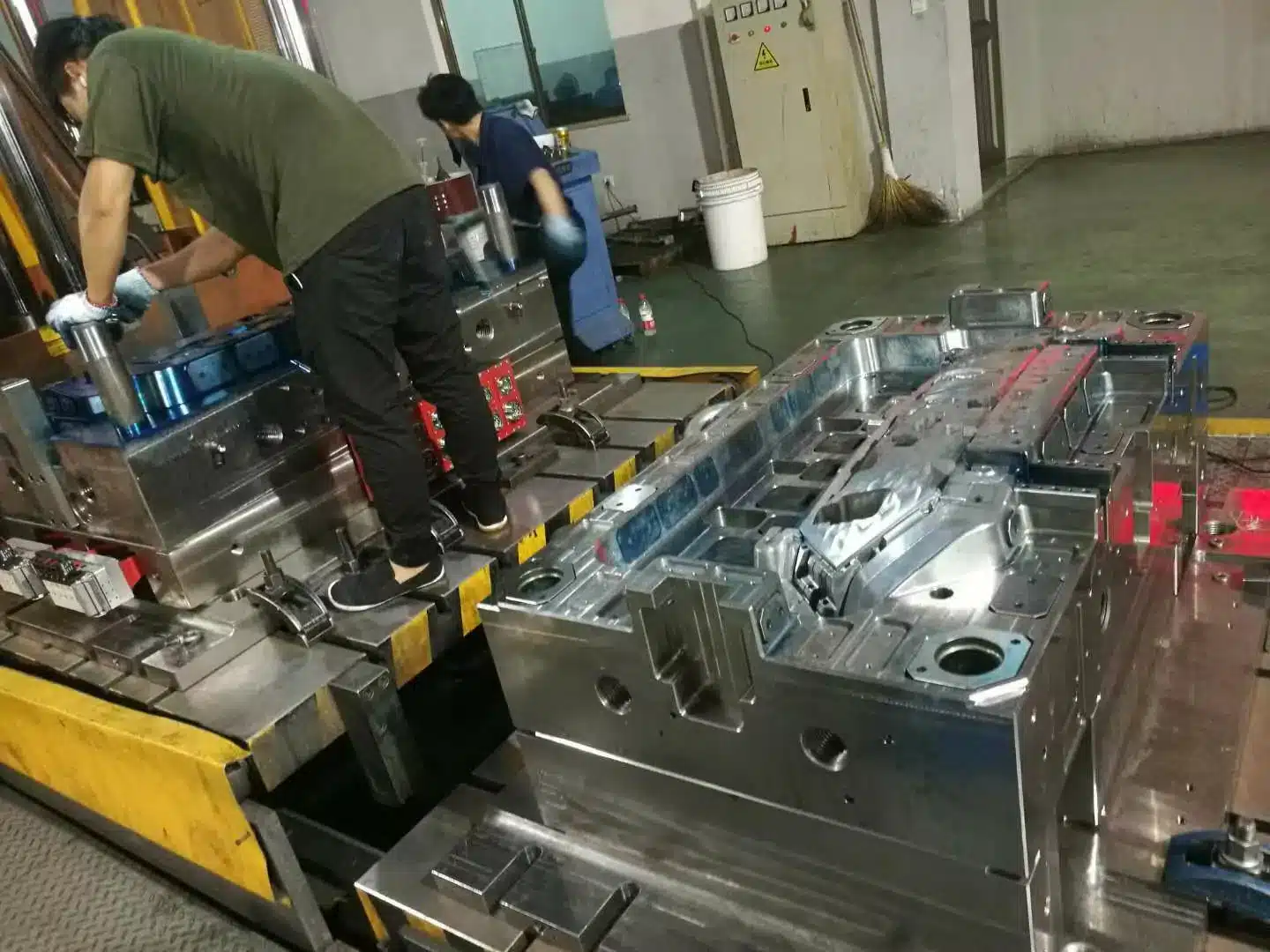
PP’s low melt viscosity makes it the easiest commodity resin to fill and the easiest one to flash. That trade-off drives several mold decisions, and cheap tooling quotes hide their problems right here.
Vent depth is the clearest example. In our shop, PP tools get vents cut at 0.010–0.020mm. ABS tools run 0.020–0.038mm. Put an ABS vent depth on a PP tool and flash shows up along the parting line within the first few thousand shots. That turns into a deflashing labor cost nobody quoted. MoldMaking Technology runs venting case studies worth reading before you approve a tooling drawing.
Steel selection is more forgiving than buyers expect. Unfilled PP is not abrasive. P20 pre-hardened steel will carry an unfilled PP tool to 300,000–500,000 shots without meaningful wear. Switch to 30% glass-filled PP and that same P20 cavity starts washing out at the gate by 50,000 shots. Glass-filled PP needs hardened H13 or S136, plus a carbide or hardened gate insert.
Shrink compensation has to be applied per dimension, not as one global scale factor. A 1.6% uniform scale-up on a ribbed part lands some dimensions dead on. Others come out half a millimeter off. Ask your mold shop how they compensate. If the answer is a 1.6% scale on the CAD model, push back.
Cavity count is a cost question, not a technical one, and PP’s fast cycle makes multi-cavity pay off early. A 4-cavity PP tool typically costs 2.2–2.6× a single-cavity version of the same part, not 4×. Above 50,000 pieces a year, the math almost always favors more cavities. Our clamp force and mold cost calculators will run the comparison before you ask for a quote.
Why PP Living Hinges Fail
A properly molded PP living hinge survives over a million flex cycles. A badly gated one cracks within a few hundred. The difference is how the plastic flowed through the hinge, not the resin itself.
The hinge web should be 0.25–0.40mm thick, with generous radii blending into the thicker sections either side. Thinner than 0.25mm and it tears. Thicker than 0.40mm and it behaves like a crease that wants to whiten and fail.
Gate placement decides everything. The melt has to cross the hinge perpendicular to the hinge axis, so the polymer chains orient across the bend. Gate it so the flow runs parallel to the hinge and you have built a tear line.
The third requirement surprises buyers because it is not a design item at all. The hinge has to be flexed within a few seconds of ejection, while the part is still warm. That first flex orients the crystalline structure and gives the hinge its fatigue life. On production tools it belongs in the robot program or the operator’s standard work. Ask whether it is written on the process sheet. We have seen correct hinge designs fail because nobody wrote that one step down.
The Defects You’ll See on PP Specifically
Generic defect guides treat every resin the same. PP has its own short list, and warpage sits at the top of it because of the shrink behavior already covered.
| Defect | What it looks like | Root cause | Fix |
|---|---|---|---|
| Warpage | Twisted, bowed, or rocking part | Differential shrink from uneven wall or uneven cooling | Design: even out wall thickness. Process: raise hold time, balance mold temp zones |
| Sink marks | Dimples over ribs and bosses | Rib thicker than 60% of the adjoining wall | Design: thin the rib. Process: raise hold pressure and time |
| Tiger striping | Alternating dull and glossy bands | Rubber phase in impact copolymer slipping at the flow front | Process: raise melt and mold temperature, slow injection. Mold: relocate or enlarge gate |
| Flash | Thin film along parting line | Low viscosity plus excess vent depth or low clamp | Mold: reduce vent depth to 0.010–0.020mm. Process: check clamp tonnage |
| Gate blush | Cloudy halo around the gate | Melt fracture from too-fast fill at the gate | Process: slow the first stage. Mold: enlarge gate |
| Short shot | Incomplete fill in the last area | Insufficient venting, undersized gate, or MFI too low | Mold: vent the last-fill area. Material: move up one MFI step |
Notice how many of these carry both a design fix and a process fix. A wall thickness problem cannot be processed away permanently. When somebody offers to dial in a sink mark caused by a 4mm rib on a 2mm wall, they are buying time. On a sink complaint I check the rib-to-wall ratio before anyone touches the process sheet.
What a PP Part Actually Costs
A worked example beats a range. Take a 60g PP housing on a 4-cavity cold runner tool, 28-second cycle, 160-ton press, molded in China at 100,000 pieces a year.
| Cost element | Per part | Basis |
|---|---|---|
| Resin | $0.085 | 65g shot weight incl. runner share, at $1.30/kg |
| Machine time | $0.043 | 160T press at $22/hr, 514 parts/hr across 4 cavities |
| Labor and packing | $0.030 | Operator coverage, inspection, carton |
| Scrap allowance | $0.003 | 2% of material and machine |
| Factory cost | $0.161 | |
| Quoted piece price | $0.19 | At 15% margin |
| Tooling amortized | +$0.095 | $9,500 mold over 100,000 parts |
| Landed program cost | $0.285/part | Before freight and duty |
Run the same mold to 500,000 parts and tooling drops to $0.019 per part. The piece price does not move. That is why the tooling quote and the part quote have to be read together at your real volume. A cheap tool with a high piece price can cost more over the program than an expensive tool with a low one.
China tooling typically lands 40–60% below US or European equivalents at the same cavity count. The gap is real. Freight, duty, travel, and the cost of a four-week delay all come off the top. Run the comparison at landed cost per part, at two different annual volumes, before you decide.
One more note on quotes that come in suspiciously low. There are four places the money can hide: lighter mold base and fewer guide components, softer steel, fewer cavities than quoted, or regrind in the resin. The first three show up in the tooling drawing. The fourth does not show up anywhere.
How Much Regrind Is in Your PP Parts
PP tolerates reprocessed material better than most resins. That is exactly why it gets abused, and it is the most common hidden variable in a low PP quote.
Some regrind is normal and reasonable. Runners and sprues off a cold runner tool are 15–25% of every shot. Grinding that back into the same job is standard practice and it is fine. The problem starts when outside material enters the blend.
At 10–15% in-house regrind you will not measure a difference. Above 25–30%, notched impact strength drops measurably and color shifts between lots. MFI drifts upward as the polymer chains break down from repeated heat history. Parts get more brittle and less consistent, and it happens gradually enough that the first failures look like a fluke. The Society of Plastics Engineers publishes degradation work on exactly this.
Four ways to control it:
- Put a numeric cap in the PO, not a vague quality clause
- Require the virgin resin certificate of analysis for every production lot
- Spot-check MFI on retained samples from month one against month six
- Watch for color drift and black specks in natural or light-colored parts
“Maximum regrind content shall not exceed 15% by weight, limited to in-house runners and sprues from the same virgin grade. No post-consumer or externally sourced reprocessed material is permitted. Supplier shall retain resin certificates of analysis for each production lot for 24 months and provide them on request.”
A supplier who pushes back on that clause is telling you something useful.
Your PP RFQ Checklist
Send these nine items and every quote comes back comparable. Leave them out and you are comparing three different projects.
- PP family — homopolymer, random copolymer, or impact copolymer
- Target MFI, or your thinnest wall and longest flow length so the supplier can propose one
- Filler type and percentage, if any
- Color, and whether masterbatch is supplier-sourced or customer-specified
- Maximum regrind percentage
- Certifications required, such as FDA food contact, UV stabilization, flame rating
- Annual volume and the ramp schedule for year one
- Critical dimensions flagged on the drawing, with everything else marked reference
- Mold ownership, storage terms, and what happens to the tool if you change suppliers
That last one has no technical content. It settles more disputes than the other eight combined.
FAQ
Is PP stronger than ABS?
No. ABS has higher tensile strength and higher stiffness. PP wins on chemical resistance, fatigue life, moisture resistance, and cost. A part that flexes repeatedly, or that sees cleaning chemicals, outlasts its ABS equivalent in PP. For a rigid cosmetic housing that has to hold tight dimensions, ABS is the better pick. Match the resin to the duty, not to a strength number on a datasheet.
How much does polypropylene shrink in injection molding?
Unfilled PP shrinks 1.2–2.0%. Adding 20% talc brings it down to 0.8–1.4%, and 30% glass fiber brings it under 0.5%. Shrink is also directional. PP shrinks more across the flow direction than along it, which is the main cause of warped flat parts. Gate position and hold time both move the final number, so the mold has to be compensated dimension by dimension.
Is PP food safe?
Most PP grades meet FDA requirements for direct food contact, and PP carries recycling code #5. Compliance belongs to the specific grade and its additive package, not to PP as a material. Ask for the grade’s food contact statement, and ask for the colorant’s compliance documentation separately. Masterbatch is where food contact claims most often fall apart on a finished part.
Can PP be molded clear?
Not fully. Standard PP runs translucent to opaque. Clarified random copolymer grades reach good optical clarity, enough for food containers and clear caps, but they will not match polycarbonate or acrylic. Wall thickness matters too, since clarity drops as the section gets thicker. If you need true optical transparency, PP is the wrong resin for that part.
Does PP need to be dried before molding?
Usually not. PP absorbs under 0.02% moisture, so most grades mold straight from the bag. Filled and compounded grades sometimes want 2–3 hours at 80°C, and the resin datasheet will say so. If a supplier blames a surface defect on wet PP resin, ask what else they checked. Contamination and a worn screw are the more likely causes.
What tolerance can you hold on a PP part?
Plan on ±0.25–0.40mm for dimensions between 30 and 100mm in unfilled PP. Talc-filled grades hold roughly 20% tighter because they shrink less. Tighter numbers are achievable on specific features with a steel-safe first article and a second cut, and they cost money. Flag only your genuinely critical dimensions and mark the rest reference.
How does PP hold up outdoors?
Unstabilized PP degrades under UV. It chalks and fades, and it gets brittle, typically within one to two years of direct sun. UV-stabilized grades with HALS additives extend that to five years or more. Specify UV stabilization explicitly on any outdoor part, because it will not be added by default. Color matters too, since carbon black carries useful UV protection on its own.
Got a PP part out for quote? Send the drawing, your annual volume, and your critical dimensions. We come back with a DFM review covering grade selection, shrink compensation, cavity count, and tolerance risk before anybody cuts steel.
Start here
