
Mold Engineering
Injection Mold Tool Life and How Long a Mold Really Lasts
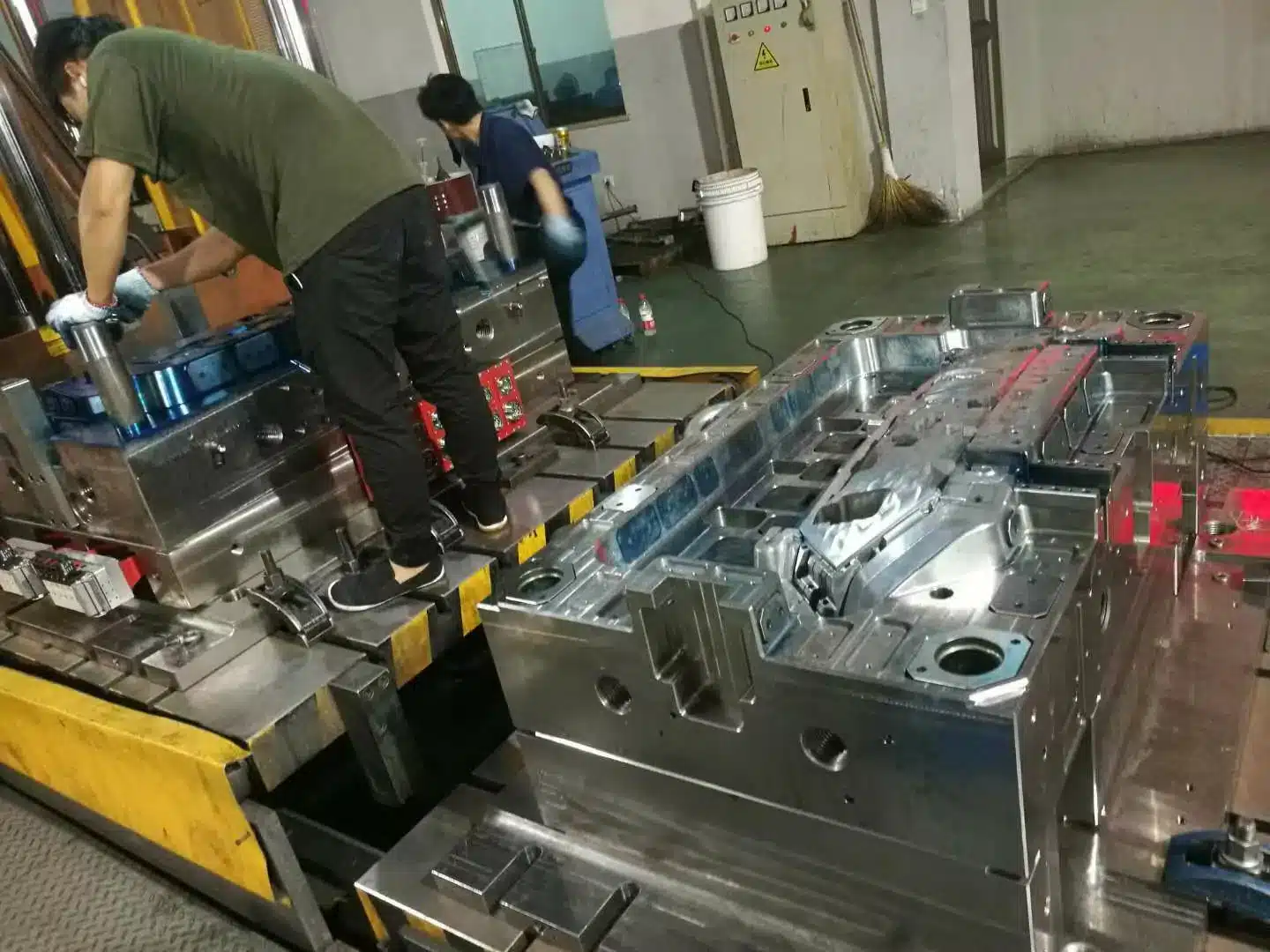
Injection mold tool life is the number of good shots a mold makes before it needs major repair. Most buyers hear one number from a supplier and file it as a promise. It isn’t one. An aluminum prototype mold may last 8,000 shots, while a hardened S136 production tool can pass one million. Steel sets the ceiling. What you run through the mold, and how the shop looks after it, decides how close you get.
Injection Mold Structure – Cross-Section
Two-plate mold, closed position, 2 cavities. Hover or tap any part or number.
Typical ranges are aluminum 5,000–10,000 shots [VERIFY], P20 100,000–250,000 [VERIFY], H13 500,000–1,000,000 [VERIFY] and S136 1,000,000+. Glass-filled or corrosive resins pull every one of these numbers down hard. Before you sign, ask which steel is in the quote and how many shots the warranty covers.
Injection Mold Tool Life by Steel Grade
Steel grade moves tool life more than any other choice you make. Harder steel wears slower, but it costs more and takes longer to machine. Most of the buying decision sits inside that trade-off.
| Steel | Typical shots [VERIFY] | Best for |
|---|---|---|
| Aluminum (QC-10, 7075) | 5,000–10,000 | Prototypes, bridge production |
| P20 (pre-hardened) | 100,000–250,000 | Medium-volume production |
| NAK80 | 100,000–300,000 | Mirror-polish cosmetic parts |
| H13 (hardened) | 500,000–1,000,000 | High-volume production |
| S136 (stainless) | 1,000,000+ | Corrosive resins, very high volume |
These are industry-typical ranges, not guarantees. A P20 tool running clean polypropylene in a well-kept shop can outlive an H13 tool nobody looks after. The steel number is a ceiling, and plenty of molds never reach it.
One quote pattern I see often is P20 offered for a 400,000-part program. In practice P20 tops out around 250,000 shots. So the buyer is really paying for one mold plus a rebuild, or a second mold later. The low quote ends up as the expensive one. If a supplier won’t name the steel grade at all, treat that as a warning.
A mirror-polish cosmetic part pushes you toward NAK80 or S136, because P20 won’t hold that polish across high shot counts. Wall thickness and texture choices interact with steel too, so read our injection mold design guide before locking the grade.
What Actually Ends a Mold’s Life
Flash at shot 200,000, on a part that ran clean for months, usually means the parting line has worn. It rarely means the press lost tonnage. Molds seldom fail all at once. They wear in specific spots, and each spot shows up as a part defect before anyone opens the tool.
The parting line goes first on most tools. The two halves close on each other every cycle, and over hundreds of thousands of closes the shut-off edges round over. Flash starts where the edge has worn most.
Gates erode next. Hot melt forced through a small opening wears the steel slowly, the way water cuts rock. The vestige gets bigger. On a multi-cavity tool the fill balance shifts, and one cavity starts flashing while the others still run fine.
Cooling channels scale up from the inside. Water deposits cut heat transfer, so cycle time creeps longer without anyone changing a setting. Nobody notices until output drops 10%.
Leader pins and bushings wear too, and the mold stops closing dead true. Cores shift a fraction of a millimeter and dimensions start to drift. It helps to know the structure of an injection mold, so you can match each worn component to the defect it causes on the part.
Resin Choices That Eat Tool Life
Buyers often pick steel first and resin later. That order is backwards, because some resins wear a tool faster than any steel downgrade would. Abrasive grades grind the steel away, and corrosive grades eat it.
Glass-filled grades are the classic tool killers. Glass fiber is hard and sharp, and it erodes gates and runners first, then cavity surfaces. A 30% glass-filled PA66 can halve the life of a P20 tool versus unfilled PA66 [VERIFY]. If the part needs glass fill, I’d quote hardened steel from day one. Plastics Technology covers gate wear data for filled resins in its molding coverage.
PVC is the corrosive one. Left too long in a hot barrel, it degrades and releases hydrogen chloride, which attacks steel. That is why PVC tools run in stainless or plated steel. It is also why hot runner makers warn against PVC.
Some flame-retardant packages are corrosive at melt temperature as well. Give your mold maker the exact resin grade, FR package included, before steel is ordered. Finding out after the cavity is cut is an expensive way to learn.
Gate and runner size feed into all of this. An undersized gate raises shear and speeds up erosion. Our notes on sprue, runner and gate design go through the trade-offs.
Maintenance That Buys Extra Shots
Maintenance alone can make a 2x difference in life between two identical molds. Nothing about it is exotic. It is scheduled, boring care that someone actually writes down.
A real preventive program runs on four intervals. Every run gets a wipe-down and a visual check. At fixed shot counts, the shop inspects the parting line and cleans the vents. Cooling channels get descaled on a calendar, before cycle time drifts. Leader pins get lubricated and clamps checked before wear reaches the parts.
Before you place the order, ask the supplier three things. What is your preventive maintenance interval in shots? Do you log shots per mold, and can I see the log? Where is the line between a warranty failure and normal wear? A shop with a shot-counter log answers in seconds. A shop without one is guessing. MoldMaking Technology publishes maintenance checklists that show what a serious program looks like.
Storage counts too. A mold pulled from production and parked damp will pit before its next run. Rust on a parting line is damage, so ask how idle tools are dried and protected between runs.
Matching Steel to Your Order Quantity
Running 40,000 parts a year for three years means 120,000 shots. P20 covers that with margin, and H13 would buy life you never use. Tool cost spreads across every part you make, so the math is plain division. The one twist is that a rebuild counts as a second purchase.
At 300,000 parts a year for five years, you need 1.5 million shots. On P20 that means six tools or five rebuilds. H13 or S136 costs more upfront and ends up cheaper over the program.
When volume is uncertain, I usually recommend a bridge tool. Cut aluminum for the first 8,000 parts, see whether the market holds, then cut production steel. You pay for two tools, but you aren’t betting the whole program on a forecast. Our injection molding cost guide runs the full tooling-versus-part-cost math.
Warranty Questions to Ask Before You Pay
Get the warranty definitions in writing before anyone cuts steel. A shot count means little if “failure” is never defined.
Start with the exact steel grade and hardness. “Tool steel” is not an answer. P20 at 30 HRC and P20 at 36 HRC are different tools.
Then ask how many shots are covered and what counts as a covered failure. Normal wear is never covered. Premature cracking or a machining defect should be.
Ask who pays for scheduled maintenance and who owns the mold after final payment. At Topworks, the mold belongs to you once the mold invoice is paid in full. Get the same commitment in writing from any supplier. Ownership disputes are among the hardest problems to fix once parts are already shipping.
Last, check for a shot counter on the mold and ask whether the supplier will share the count. Without a counter, every warranty claim turns into an argument about memory.
Planning a program and unsure which steel fits your volume? Send your part drawings for a DFM review and a steel recommendation with the quote.
FAQ
How many shots does a P20 injection mold last?
A P20 mold typically lasts 100,000 to 250,000 shots [VERIFY]. Unfilled commodity resins in a well-maintained tool reach the high end. Glass-filled or corrosive resins land at the low end or below it. P20 is pre-hardened to about 30–36 HRC. That handles medium volumes well, but it can’t match hardened H13 on long runs.
Can you extend injection mold tool life?
Yes, up to the ceiling the steel allows. Scheduled maintenance does most of the work. That means vent cleaning, parting-line checks, cooling-channel descaling and leader-pin lubrication at fixed shot intervals. Resin choice matters too. Keeping glass-filled grades out of P20 tools, or moving to hardened steel when fill is required, prevents the fastest wear.
Does glass-filled nylon damage molds?
Yes. Glass fiber is abrasive, and it wears the gates and runners first, then the cavity steel. A 30% glass-filled PA66 can roughly halve P20 tool life compared with unfilled PA66 [VERIFY]. For glass-filled programs, quote hardened H13 or S136 from the start and oversize the gates to cut shear. The steel upcharge is smaller than a rebuild halfway through production.
Who owns the mold after the project ends?
Ownership follows the contract, not possession. At reputable builders, the mold becomes your property once the mold invoice is paid in full. Get that in writing before production starts, along with storage terms and transfer rights. At Topworks, molds belong to the client after final mold payment.

