
China Sourcing Guide
How to Choose a Custom Injection Molding Manufacturer in China (2026 Buyer’s Guide)
You’ve got a STEP file, a target piece price, and a launch date. Three suppliers in China quoted the same mold at $4,200, $9,800, and $16,500. At least one of them doesn’t own a single press. This guide shows you how to find that out in ten minutes, what the part actually costs once it lands in Ohio, and what to put in writing before a dollar leaves your account.
Factory or trading company? Decide this before anything else
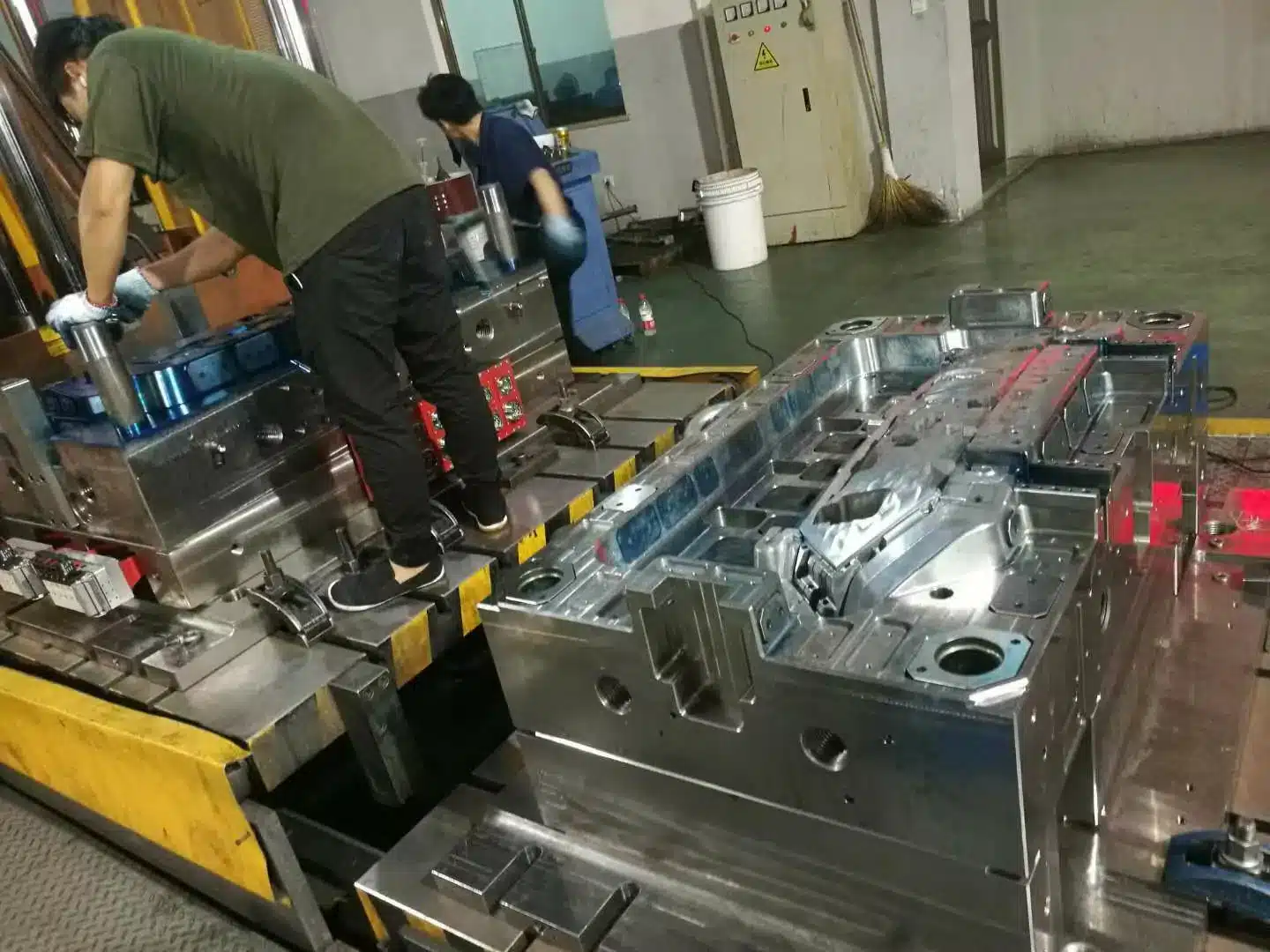
A custom injection molding manufacturer in China is a company that owns its molding machines, employs its own toolmakers, and runs your parts under its own quality system. A trading company owns none of that. It takes your deposit and subcontracts the job to a factory you’ll never talk to.
Some trading companies are honest sourcing agents and say so. That’s fine. The problem is the ones that call themselves factories.
Here’s how that plays out. You approve the DFM with one engineer over email. A different shop cuts the steel. T1 samples come back with sink marks, and now three companies are pointing at each other. Your deposit is sitting somewhere in Dongguan, and your launch date is gone.
In our shop, we get a call like this about twice a month. The buyer paid 50% down to a “factory” and can’t find out where the mold physically is.
Trading companies outnumber real factories on Alibaba, and the listings look identical. The “Verified Supplier” badge confirms that someone paid for a membership and passed a paperwork check. It does not confirm that the company owns a press. Use the table below instead.
| Signal | Real factory | Trading company |
|---|---|---|
| Business license scope | Lists manufacturing (生产) | Lists import/export or trade only |
| Machine list | Specific tonnages, brands, count | “100+ machines,” no list |
| Live shop-floor video | Same day, on request | Delayed, or a polished clip |
| Who answers technical questions | An engineer, sometimes slowly | Sales, fast and vague |
| Address | Industrial park | Office tower |
| Quote turnaround | 2–5 days, with DFM comments | Same day, no questions asked |
| “Which press runs my part?” | Answers in one line | Deflects |
One quick tell. A factory quote that shows up in three hours with zero DFM questions is a trading company forwarding someone else’s number.
What custom injection molding from China costs in 2026
A custom injection mold from a Chinese manufacturer costs $1,500 to $30,000 in 2026 for most parts under 500 tons. The same mold from a US shop runs $5,000 to $100,000 and up. Piece prices on commodity resins land around $0.15 to $0.80 FOB at 100,000 units, before tariffs and freight.
The gap comes from labor, not steel. A skilled toolmaker in Shenzhen earns $10 to $20 an hour. The same toolmaker in Michigan costs the shop $50 to $100. P20 and H13 steel cost roughly the same everywhere, and LKM mold bases run cheaper than DME or HASCO but hit the same spec.
Resin is where the China advantage gets thin. Commodity PP and ABS price near parity with US Gulf Coast resin. Imported engineering grades like PEEK or PPSU can cost more in China than in the US, because the factory is importing them too. If your part is 40% resin cost by weight, the tooling savings may be all you get.
| Tooling tier | Typical life | China quote | US quote | China lead time |
|---|---|---|---|---|
| Aluminum prototype (SPI Class 105) | 50–2,000 shots | $1,500–5,000 | $3,000–8,000 | 2–3 weeks |
| P20 steel, single cavity (Class 103) | 50k–500k shots | $4,000–12,000 | $12,000–35,000 | 4–6 weeks |
| Hardened H13/S136, multi-cavity (Class 101) | 1M+ shots | $12,000–30,000+ | $40,000–120,000+ | 6–10 weeks |
The lead times above are from PO to T1 samples. Add 3–5 weeks of ocean transit if the mold or parts are shipping to the US. Air freight on a 300 kg mold runs $1,500 to $3,000 and cuts that to a week.
Landed cost: the number that kills most China deals
Total landed cost for injection molded parts from China in 2026 equals the FOB price plus 25% to 50% in combined US duties, plus ocean freight, plus customs fees, plus the cost of carrying six to ten weeks of inventory. On a typical consumer part, that adds 45% to 60% to the quote you were excited about.
Most buyers do this math after the first shipment. Do it before.
Take a $1.00 FOB part, 10,000 units, shipping LCL from Ningbo to Los Angeles.
| Line item | Per part | Notes |
|---|---|---|
| FOB piece price | $1.00 | Supplier quote |
| Section 301 + baseline duty | $0.47 | ~47% combined on many HTS 3926.90 parts in 2026; confirm your code with a broker |
| Ocean freight, LCL, allocated | $0.06 | Varies with cube, not weight |
| Merchandise Processing Fee + Harbor Maintenance Fee | $0.005 | 0.3464% + 0.125% of value |
| Third-party inspection, allocated | $0.03 | One man-day, ~$300 |
| Inventory carry, 8 weeks | $0.02 | At 12% annual cost of capital |
| Landed cost | $1.59 |
That $1.00 part is a $1.59 part. If your US molder quoted $1.45, China just lost.
The mold itself carries duty too. Injection molds classified under HTS 8480.71 take a 3.1% base rate plus the 25% Section 301 tariff, and Section 232 steel derivative rules now reach some mold categories on top of that. Budget 30% to 40% over the mold quote for duties and freight, and verify the exact stack with a licensed broker before you sign.
One more comparison buyers ask about. For programs between 100,000 and 2 million annual parts, Mexico now beats China on landed cost in many cases, because USMCA parts enter duty-free. China still wins at 5 million-plus annual parts on locked designs where cycle time and cavitation dominate.
Where the factories are, and why the region changes your quote
Export-grade custom injection molding manufacturers in China sit in three clusters: the Pearl River Delta (Shenzhen, Dongguan, Huizhou), the Yangtze Delta (Ningbo, Taizhou, Suzhou), and Shanghai. Each cluster prices and performs differently, and most buyers never ask which one they’re quoting from.
| Region | Known for | Best fit | Price level |
|---|---|---|---|
| Shenzhen / Dongguan | Precision tooling, electronics housings, fast iteration | Small parts, tight cosmetics, under 500T | Higher labor, fastest turnaround |
| Ningbo / Taizhou | High tonnage, appliance and auto parts, mold-base supply chain | Large parts, 800–2,000T, high volume | Lowest |
| Shanghai / Suzhou | Medical, ISO 13485, export documentation, English-speaking PMs | Regulated products, audit-heavy programs | Highest |
If a supplier claims Shenzhen precision at Taizhou prices, something’s off. Ask for the factory address and drop it into a map. An industrial park in Songgang tells you one thing. A 22nd-floor office in Futian tells you another.
The 10-minute vetting routine before you send a deposit
You can confirm whether a Chinese injection molding supplier owns a factory in about ten minutes with six checks that cost nothing. Run all six. A real factory passes every one without friction.
- Ask for the business license (营业执照). Read the business scope line. It should include manufacturing or production of plastic products, not just “trade” or “technology consulting.”
- Ask for the machine list. Tonnages, brands, quantity. Haitian, Chen Hsong, Yizumi, and JSW are common. “Over 100 machines” with no list is a no.
- Request a live video call from the shop floor today. Not a recorded tour. Ask them to walk to a press and show you the controller screen.
- Reverse-image-search their factory photos. Stock photos and photos lifted from other suppliers’ sites show up in seconds.
- Ask which press will run your part and its tonnage. A factory engineer answers in one sentence. A trading company says they’ll check.
- Verify certificate numbers. Copy the ISO 9001 or 13485 certificate number into the certifier’s public lookup. Fake certs are common. Real ones take 30 seconds to confirm.
Then send your RFQ and watch the response. A real factory comes back in two to five days with DFM notes, questions about draft angles, and maybe a gate-location suggestion. That slowness is the good sign.
Mold ownership and IP: get it in writing or lose it
In China, the buyer owns the injection mold only if the purchase order says so in plain language. The default assumption on the factory floor is that the tool stays where it was built. Verbal promises and email confirmations don’t move a 400 kg block of steel.
We’ve watched buyers pay $18,000 for a mold, switch suppliers two years later, and discover they can’t take it with them. No clause, no mold. Or worse, the mold ships but the design files don’t, and no other shop can maintain it.
Paste this into your PO, in English and Chinese, and get it stamped with the company chop.
Mold Ownership. Buyer owns the injection mold(s) described in this Purchase Order, including all steel, mold base, hot runner system, inserts, and slides, upon payment of the tooling invoice. Supplier holds the mold solely as custodian for Buyer’s exclusive use. Supplier shall not run the mold for any third party, modify it, or move it off the named factory site without Buyer’s written consent. Supplier shall release and ship the mold to Buyer or Buyer’s designee within 15 business days of written request, at Buyer’s freight cost, together with complete 2D and 3D mold design files, steel certificates, and last-shot samples. Supplier shall engrave “PROPERTY OF [BUYER]” and the mold number on the mold base.
Three details most buyers miss. Get the mold design files at T1 approval, not “later.” Sign an NNN agreement (non-use, non-disclosure, non-circumvention) written in Chinese and governed by Chinese law, because an English NDA under Delaware law is close to worthless in a Shenzhen court. And put a mold number on the PO so there’s no argument about which tool you own.
Don’t pay the balance until the parts pass inspection
Pay the tooling balance only after T1 samples pass your dimensional check. Pay the production balance only after a third-party inspection passes at the factory, before the container doors close. Once the balance is wired and the parts are on the water, your leverage is gone.
A standard payment split is 50% tooling deposit, 50% after T1 sample approval. For production runs, 30% deposit and 70% against a passed pre-shipment inspection is reasonable. A supplier who insists on 100% before inspection has told you something.
Third-party inspection from QIMA, SGS, or Intertek costs $250 to $350 per man-day. Use AQL 2.5 for major defects and 4.0 for minor on consumer parts. Medical and automotive go tighter. Write the AQL level into the PO so “acceptable” isn’t a debate later.
| Problem | Who pays | What to write into the PO |
|---|---|---|
| Dimensions out of tolerance at T1 | Factory | Mold rework at Supplier cost; T2 samples within 10 business days |
| Short shots, flash, sink in production | Factory | Replace or credit; sorting labor at Supplier expense |
| Cosmetic defects above agreed AQL | Factory | Re-sort before shipment; rejects replaced at no charge |
| Wrong resin grade or regrind substitution | Factory | Full lot replacement; resin lot certificate with every shipment |
| Defects found after balance paid and shipped | Buyer, in practice | This is why you inspect first |
Resin substitution deserves its own line. Swapping virgin PC for a regrind blend, or a branded ABS for a local grade, is one of the oldest cost-cutting moves in the business. Ask for the resin certificate of analysis and a photo of the bag label with each production run. Reasonable factories do this without complaint.
When China is the wrong call
China is usually the wrong choice for injection molding when annual volume is under about 1,000 pieces, when tolerances sit at ±0.001″ or tighter with active design changes, or when regulatory documentation makes tariff and audit exposure expensive. The tooling savings don’t cover the friction in those cases.
Fast iteration is the real weak spot. If you expect three design revisions in six months, each one costs a week of email and two weeks of transit. A US molder does the same revision in three days. Chinese factories can hit tight tolerances. They just can’t fix them as fast from 7,000 miles away.
There’s a middle path that works for a lot of US buyers. Build the mold in China and run it on a US press. You save 60% to 70% on tooling, pay zero per-part tariff, and keep production oversight local. One buyer we know took a $52,000 US tooling quote, built the same mold in China for $24,500 landed, and ran it in a Cleveland molder’s press with no changes. The requirement is non-negotiable: the mold must be built on a DME, HASCO, or LKM standard base, with full 2D/3D documentation, so any US molder can hang it and run.
How to send an RFQ that gets a real quote
A usable RFQ to a Chinese injection molding manufacturer includes a STEP file, a 2D drawing with toleranced dimensions and material spec, the annual volume, the target piece price, and the cosmetic requirements. Leave out any one and the number you get back means nothing.
Copy the block below and fill in the brackets.
RFQ – [Part name / number]
Files: STEP (3D) + PDF drawing (2D) attached
Material: [Resin brand and grade, e.g., SABIC Cycolac MG47 ABS] – substitution requires written approval
Color: [Pantone / RAL / natural]
Annual volume: [X] pcs, [Y] releases per year
Tooling life target: [500k shots] – quote SPI Class [103]
Cavitation: [1x1 / 1x2 / 1x4] – propose alternatives if cost-effective
Critical dimensions: see drawing, ±[0.05] mm on flagged features
Surface finish: [SPI A2 on Face A, VDI 27 texture on Face B]
Secondary ops: [Pad print / ultrasonic insert / none]
Mold base standard: LKM / DME / HASCO – state which
Please quote: mold cost, T1 lead time, piece price at [X] and [2X] volume, FOB port
Please include: DFM review, proposed gate location, machine tonnage
Terms: mold ownership per attached clause; 50/50 tooling; 30/70 production against PSI
Watch the quote that comes back. Red flags: no tonnage stated, no gate location, “material as customer request” instead of a named grade, and a mold cost that’s 40% below the other quotes with no explanation of why. Green flags: a marked-up drawing with draft angle questions, a cavitation recommendation you didn’t ask for, and a T1 date instead of a vague “about 5 weeks.”
FAQ
How much does a custom injection mold cost in China in 2026?
A custom injection mold from a Chinese manufacturer costs $1,500 to $30,000 in 2026 for most parts. Aluminum prototype tooling starts around $1,500. Single-cavity P20 steel runs $4,000 to $12,000. Hardened multi-cavity production molds land at $12,000 to $30,000 or more. Add 30% to 40% for US duties and freight if the mold ships.
How do I tell a real factory from a trading company?
Ask for the business license and check that the scope includes manufacturing. Ask for a machine list with tonnages. Request a live video call from the shop floor the same day. Ask which press will run your part. A factory answers all four in one email. A trading company stalls on at least two.
What tariffs apply to injection molded parts from China?
Most plastic parts from China under HTS 3926 carry combined US duties of roughly 47% in 2026, including the 10% baseline and Section 301 tariffs. Molds under HTS 8480.71 take a 3.1% base rate plus 25% Section 301. Exact rates depend on your HTS code, so confirm with a licensed customs broker.
Who owns the mold, me or the factory?
You own the mold only if the purchase order says so. Without a written ownership clause, the factory treats the tool as its own. Put the clause in the PO in English and Chinese, get it chopped, and collect the 2D/3D mold files at T1 approval. Paying for the mold is not the same as owning it.
How long does tooling take from a Chinese manufacturer?
Tooling from a Chinese injection molding manufacturer takes 2 to 3 weeks for aluminum prototype molds and 4 to 10 weeks for steel production molds, measured from PO to T1 samples. Add 3 to 5 weeks of ocean transit for the mold or parts to reach the US, or about one week by air.
Is it safe to source injection molding from China?
It’s safe if you verify the factory, pay against milestones, and inspect before the balance. The risks are known and manageable: trading companies posing as factories, resin substitution, and mold ownership disputes. Buyers who skip the vetting and pay 100% upfront are the ones who get burned. The process protects you, not the supplier’s promises.
Can I build the mold in China and run it in the US?
Yes, and it’s often the best deal for US buyers. Build the mold in China on a DME, HASCO, or LKM standard base with full documentation, ship it, and run it at a domestic molder. You save 60% to 70% on tooling, pay no per-part tariff, and keep production oversight local.
What minimum order is worth sending to China?
Around 1,000 pieces a year is the floor where China tooling savings outweigh freight, duties, and communication cost. Below that, a US prototype molder or aluminum tooling at home is usually cheaper once everything’s counted. Above 5,000 pieces a year on a stable design, China wins on total cost for most parts.
Your next step
Pick your top two suppliers and run the six-check routine on both this week. It takes ten minutes each. Then send the RFQ template above and see which one comes back with DFM questions.
If you’d rather skip the guessing, send us your STEP file and drawing. You’ll get a DFM review and a real quote from the factory that will actually run your part, within 24 hours.

