
By Steven Cheng — 20 years in injection molding, tooling, and production sourcing
The bracket that cracked at 40 grams
A drone startup sent us a motor-arm bracket two years ago. The drawing had one instruction: “minimize mass.” Their previous supplier hit the 40-gram target. The part looked beautiful.
It cracked at the arm root after a few hundred flights. The break sat where the rib met the main wall. The wall was only 1.2 mm. The glass fibers ran straight across the load path.
We ended up at 46 grams. Six grams heavier. Nobody has cracked one since.
That story sums up lightweight structural parts. They are a load-path problem first. Material choice and weight reduction come after that. Most quotes I review get this backwards.
What a lightweight structural part actually is
A lightweight structural part carries a real mechanical load. That includes bending, vibration, impact, or clamping force. The part also has a mass budget. It often replaces aluminum or steel.
That distinction matters. A display bezel is light but not structural. A battery cradle is both.
E-bike components cover a long list. Battery trays and enclosures are common. So are controller housings and motor covers that locate bearings.
Rack and fender mounts also carry loads. Cable-management pieces can take repeated impacts during daily use.
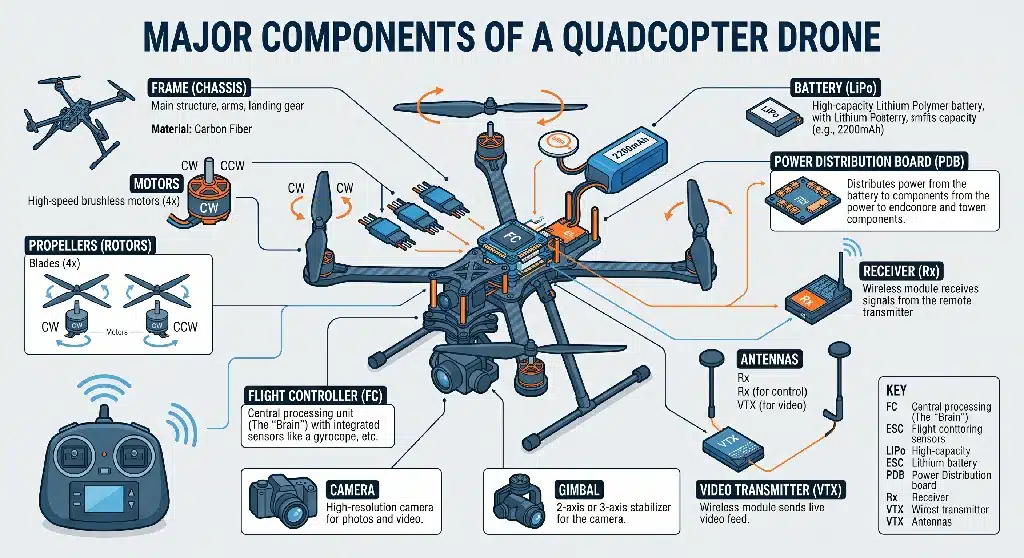
Drone components include arms, arm hinges, landing gear, and gimbal mounts. Frame plates, battery latches, and prop guards also count.
If the part gets dropped, vibrated, clamped, or ridden on, treat it as structural. If you’re unsure, treat it that way.
E-bike and drone components: lightweight structural parts start with the load case
To quote a lightweight structural part correctly, we need the load case first. Give us three things.
State the direction and size of the main force. State whether the load is static or cyclic. Give the operating temperature range.
Without those facts, material choice becomes a guess. The quote becomes fiction.
Filled thermoplastics are anisotropic. Glass fibers can make stiffness strongly dependent on fiber direction.
Fiber direction comes from flow. Flow comes from gate location. Gate location gets fixed when the mold is designed.
That makes the load case a tooling input. Miss it, and the part can come out strong in the wrong direction.
A one-line load statement is enough to start.
“Arm root sees 12 N·m bending in crash, cyclic vibration 80–200 Hz in flight, 60 °C max near the ESC.”
That sentence changes the material, the gate, and the steel. I’d rather receive it than a 40-page FEA report without a clear summary.
Drones and e-bikes push different limits. Drone parts face vibration fatigue and crash impact. Most are small enough that stiffness per gram matters.
E-bike parts are larger. They see road salt and UV for years. They also get clamped with real torque.
Parts touching the battery bring another issue. UL and flammability requirements can apply where a drone arm would not face them.
Which material? The short list
For these parts, the practical choice is six or seven compounds. The table gives the working shortlist.
| Material | Typical use | Stiffness per gram | Weakness | Relative part cost |
|---|---|---|---|---|
| PA6-GF30 | E-bike brackets, motor covers | Good | Absorbs moisture, dimensional drift | Low |
| PA66-GF30 | Drone arms, hinges, higher-temp mounts | Good, better at heat | Same moisture issue, harder to mold | Low–mid |
| PA12-GF | Parts near water, outdoor e-bike | Moderate | Pricier, lower stiffness than PA66 | Mid |
| PPA-GF (e.g., Zytel HTN, Grivory HT) | Motor housings, near-ESC parts | Excellent at heat | Cost, abrasive to tooling | Mid–high |
| PA66-CF20/30 | Drone frames, gimbal mounts | Best | Cost, brittle in impact, conductive | High |
| PC (unfilled) or PC-GF10 | Battery enclosures, prop guards | Moderate | Stress cracking, notch sensitivity | Low–mid |
| PP-LGF30 | Large e-bike covers, trays | Moderate | Creep at heat, poor cosmetics | Low |
For most e-bike structural brackets, PA6-GF30 is a practical starting point. It’s cheap. Every molder in Dongguan runs it daily.
Moisture pickup is manageable unless the part is a precision bearing seat.
For drone arms and parts seeing prop-frequency vibration, PA66-GF30 is often the better starting point. It retains modulus better as temperature rises.
One current PA66-GF30 grade, for example, lists 1.33 g/cm³ density and 1.3–1.7% equilibrium moisture absorption at 23°C and 50% RH. Its listed processing window is also grade-specific.
The grade matters.
Carbon-filled PA66 is stiffer than glass-filled PA66 per gram. The exact gain depends on the compound and fiber loading.
But it is more brittle in a crash. It also costs more per kilogram.
That trade makes sense for some frame plates. It rarely makes sense for a simple bracket.
For an e-bike battery enclosure, forget stiffness for a moment. Start with the applicable flammability and certification requirements.
UL 2271 covers battery systems for light electric vehicle applications. UL 2849 covers the electrical system of e-bikes. The exact requirement depends on the product and certification scope.
Usually, the plastic choice starts with a recognized V-0 grade when the certification program requires it. Pick the resin before tooling.
FR grades can shrink differently. A V-0 glass-filled nylon exists. It may also bring molding and cosmetic tradeoffs.
PP-LGF30 is the sleeper. It works well for large, low-cosmetic e-bike trays and undercovers.
You get useful stiffness at lower density and resin cost. Its problem is creep.
Don’t use it where a bolt stays torqued at 70 °C unless the compound data supports that load.
Is carbon fiber worth the price over glass?
Carbon fiber pays off when the part is stiffness-limited and mass-critical. Drone frame plates and gimbal mounts fit that description.
Almost nothing on an e-bike does. For brackets, hinges, and enclosures, glass-filled nylon is often enough.
Carbon fiber’s advantage is specific modulus. That means stiffness divided by density.
A PA66-CF30 part can run thinner than a GF30 part at the same deflection. That can save grams.
Three issues eat into that advantage.
First, carbon-filled nylon is electrically conductive. On a drone, that matters around antennas and ESC leads.
Some teams like that property for EMI reasons. Others get bitten by it.
Second, carbon-filled nylon fails differently. Glass-filled nylon can yield before breaking.
Carbon-filled nylon can fail more abruptly. A drone arm that bends during a crash can beat one that breaks in two.
Pick the failure mode you want. Don’t let the molder pick it for you.
Third, carbon compound is abrasive. It wears gates and cavities faster than glass does.
That becomes a tooling-life question. It shows up in the quote.
You either accept a shorter guaranteed shot count or specify harder steel.
My default advice is simple. Prototype in glass.
Move to carbon only if the glass part misses the stiffness target. Fix the ribs before changing the compound.
Where the weight really hides
Buyers often save weight by thinning walls. That’s the last place I look. It can also be the most dangerous.
Weight comes from three areas. The nominal wall is one. Ribs and bosses are another.
The third is extra material around fastener points. Designers often leave it there “just in case.”
A good glass-filled bracket runs a 2.0–2.5 mm nominal wall. Ribs sit at 50–60% of that thickness.
Go below 1.5 mm on a filled compound and trouble starts. Short shots become more likely.
Fiber-poor skins can develop. Hesitation cracks can also appear at weak flow areas.
Ribs are where the easy weight savings are. Their effectiveness depends on geometry, position, and load direction.
Matching stiffness by simply thickening the wall can cost more resin. It can also increase cycle time and sink risk.
If your DFM report shows a 4 mm structural wall, look for missing ribbing.
Bosses are another offender. A screw boss with a 4 mm wall around an M4 thread invites sink.
It’s also dead mass. Core the boss, add a gusset, and keep the boss wall at 60–70% of nominal.
Thinner walls do not automatically produce better structural parts.
Ribs can save weight while increasing section stiffness.
Metal inserts and overmolding
E-bike structural parts almost always bolt to something. A bolt torqued into bare nylon can become a warranty claim.
Threaded brass inserts are standard. They can be heat-staked after molding or molded in.
Molded-in inserts are stronger. They add a few seconds of cycle plus an operator.
Heat-staked inserts are cheaper per part. They are also easier to fix when a boss is off-nominal.
Replacing an aluminum casting? Consider an overmolded steel or aluminum stamping inside the nylon.
A battery-tray latch we tooled last year used a 1.5 mm stamped steel plate overmolded in PA6-GF30.
The nylon handled the shape. The steel handled the pull-out load.
Total part mass came in 35% under the die-cast aluminum it replaced. The tool also cost less than the casting die.
Drone parts more often use press-fit bearings and carbon tubes. Ask about bore tolerance.
Glass-filled nylon shrinks differently along and across the flow direction. The exact value depends on the grade and molding conditions.
One current PA66-GF30 grade lists 0.93% normal molding shrinkage and 0.38% parallel shrinkage.
A round bore in CAD can therefore come out oval. The fix starts with gate placement.
Place the gate to keep the flow as symmetric as practical. Any molder quoting a GF nylon bearing seat should address gate placement.
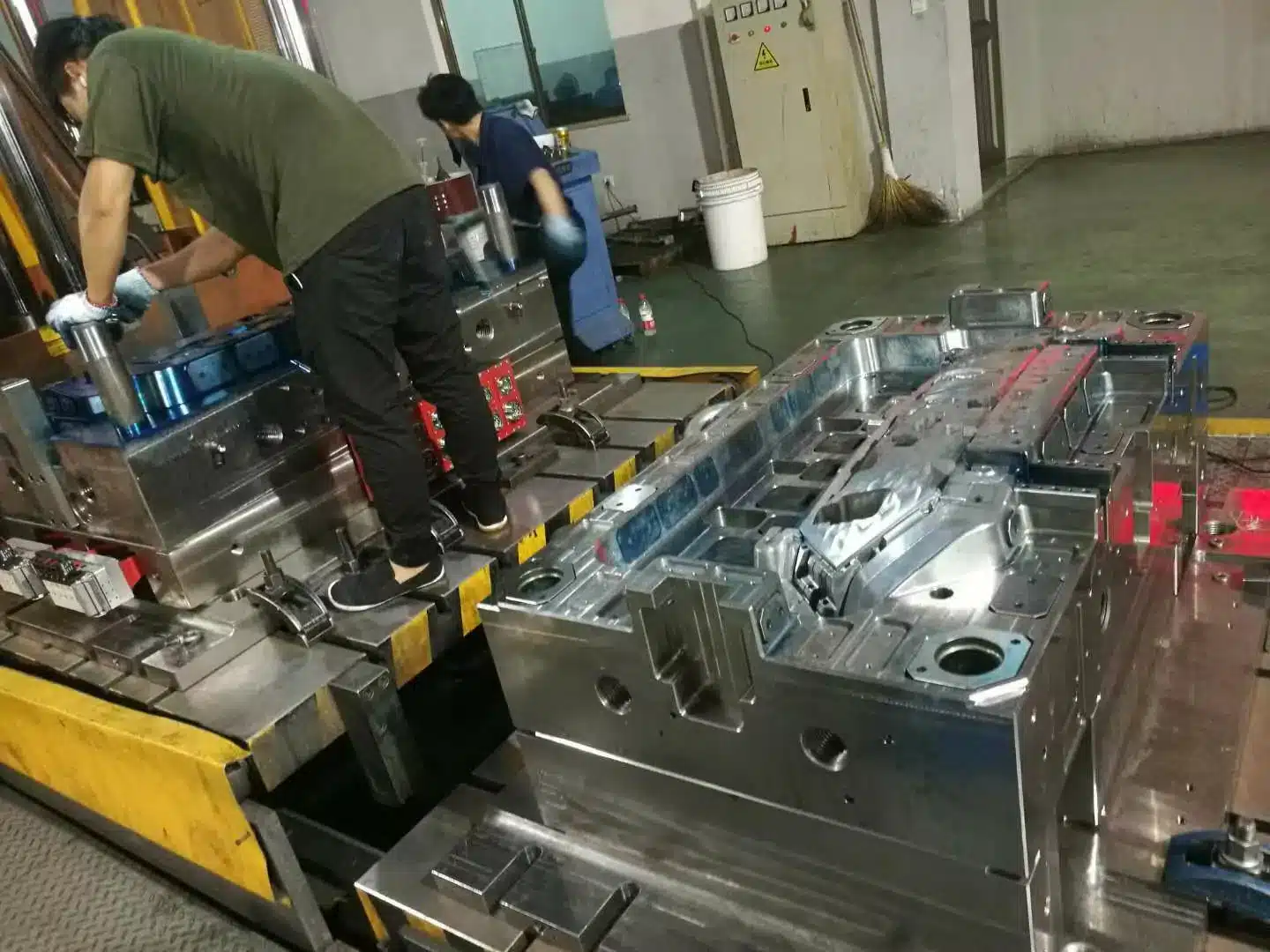
What filled nylon does to your mold
Glass fiber is sand. Carbon fiber is harder sand.
Run either through a mold and it grinds gates, wears core pins, and erodes cavity edges. That changes what you pay for tooling.
Steel grade goes up. For an unfilled ABS bracket, P20-class pre-hardened steel is fine.
That means 1.2311/1.2738. For PA-GF30 at production volumes, we spec H13 or 1.2344.
Harden it to 48–52 HRC. Go to S136/1.2083 stainless if the part needs polish.
Stainless also makes sense when the shop is humid. For carbon-filled compounds, add hardened gate inserts.
Those inserts can be replaced without re-cutting the cavity. The 15–30% tooling-price increase needs to come from your actual quotation history.
Gates get bigger. Filled compounds often need larger gates.
That reduces fiber breakage and can reduce gate erosion. Think tunnel gates in the 1.0–1.5 mm range.
A fan gate works if cosmetics allow it. A quote showing pin-point gates on a GF30 structural part needs another look.
Warp control also gets real. Filled parts warp in ways unfilled parts don’t because shrinkage is anisotropic.
A competent molder will show mold-flow results before cutting steel. A very competent one will explain the gate location.
If neither happens, budget for one mold-correction round after T1 sampling.
Draft angles need more room too. Figure 1.5° minimum on filled nylon versus 1° for ABS.
Use 2°–3° on textured faces. A drawing with 0.5° draft on a GF part will scuff during ejection.
Then you’re polishing the tool every few thousand shots.
That tooling difference also changes the part-cost curve.
Tonnage, briefly
Glass-filled nylon needs 3–5 tons of clamp force per square inch of projected area. ABS needs 2–3.
The filled melt is stiffer and can require higher injection pressure. The actual press requirement depends on part geometry and process conditions.
A 40 mm × 120 mm drone arm with shallow depth is nothing. An 80-ton press covers it.
An e-bike battery tray at 100 mm × 400 mm, in a 2-cavity layout, pushes 300 tons.
That machine costs more per hour. It also sits in fewer shops.
Ask the quote to state the press size. Some molders squeeze a large filled part into a small press.
They do that to protect their hourly rate. Flash and short shots usually show up in the first sample.
What this costs landed in the US
These ranges come from projects we’ve quoted in the last two years. Tooling was built in Guangdong.
Parts were shipped by sea to the US West Coast. These are typical numbers, not promises.
| Part | Material | Tool (single or 2-cavity) | Part price at 5,000 pcs | Part price at 50,000 pcs |
|---|---|---|---|---|
| Drone arm, ~120 mm | PA66-GF30 | $6,000–$12,000 | $1.80–$3.00 | $0.90–$1.40 |
| Drone frame plate | PA66-CF30 | $10,000–$18,000 | $6.00–$11.00 | $3.50–$6.00 |
| E-bike rack bracket, with inserts | PA6-GF30 | $9,000–$16,000 | $2.50–$4.50 | $1.30–$2.20 |
| E-bike battery tray, ~400 mm | PC/ABS FR V-0 | $25,000–$45,000 | $9.00–$16.00 | $5.00–$8.00 |
| Motor cover, bearing seat | PPA-GF35 | $18,000–$30,000 | $7.00–$12.00 | $4.00–$6.50 |
Three things drive the spread. Volume is obvious.
Steel grade for filled compounds is the second. It’s the one a low bidder quietly drops.
Inserts and secondary operations are the third. Every heat-staked insert adds a few cents plus labor.
A bearing seat needing post-mold machining adds a dollar or more.
Tariffs on plastic parts from China have moved several times lately. HTS Chapter 39 covers the parts.
Code 8480.71 covers molds for rubber or plastics. Check the current HTS treatment before building a landed-cost model.
Anything I print here can go stale quickly.
Testing before you commit to 10,000 pieces
New-tool samples can look fine. The same parts can look different after six weeks in Arizona sun.
They can also change after 500 landings. Validate before the production PO.
For drone arms and mounts, two tests matter. First, run vibration fatigue at prop frequency.
Use a shaker table. A cheaper option is a few hundred real flights on an instrumented airframe.
Second, run a drop or crash test at the impact energy you actually expect. Watch the rib roots.
For e-bike parts, run three tests.
Check bolt torque retention after a 24-hour soak at 80 °C. Nylon creeps, so the joint can loosen.
Run accelerated UV exposure with the applicable plastics test method. ASTM D4329-26 is the current ASTM practice for fluorescent UV exposure of plastics, with G154 operating requirements.
Also test the actual outdoor environment when that environment drives the failure mode. UV, heat, moisture, and salt are separate stresses.
Run salt spray if the part sits near the road.
Anything in the battery system pulls in more requirements. UL 2271 covers battery systems for light electric vehicle applications.
UL 2849 addresses the e-bike electrical system, including the battery and charger system combinations.
Your molder doesn’t certify the complete e-bike system. Your certification program and product integrator determine the applicable scope.
The plastic still needs to meet the applicable material requirements. Put the required resin grade and traceability on the drawing.
Moisture conditioning is the test buyers often forget. Nylon as molded is dry and brittle.
After exposure to humid air, nylon absorbs moisture and its properties change. The amount depends on grade and conditioning.
One current PA66-GF30 grade lists 1.3–1.7% equilibrium moisture absorption at 23°C and 50% RH.
Test the conditioned part. That’s the part your customer receives.
In our shop, we condition PA samples at 50% RH for at least 48 hours. We do that before mechanical testing.
Red flags in the quote
- No press tonnage is stated for a filled part.
- Steel grade is listed as “P20” or “718” for GF or CF nylon at volumes over 20,000.
- No mold-flow or gate-location discussion appears on a part with a bearing bore or long unsupported arm.
- Pin-point gates are specified on a filled structural part.
- A “V-0” battery enclosure is quoted without a specific resin grade and supplier.
- The weight target is met by thinning walls below 1.5 mm instead of adding ribs.
- The molder agrees to everything on your drawing without asking a single question.
That last one gets my attention first. A molder with real filled-nylon experience will push back.
They’ll question draft, gates, or wall thickness during the first call. Silence means they’ll find the problems at T1.
Then you’ll get the bill for the fix.
FAQ
Can injection-molded nylon replace aluminum in an e-bike frame component?
For brackets, mounts, and covers, yes. It can reduce mass and machining compared with aluminum. For the main frame, or anything carrying rider weight in bending, the answer depends on fatigue and load requirements. Long-fiber composites or metal may still win there. The dividing line is fatigue under high cyclic load. Filled thermoplastics do not automatically match 6061-T6.
How thin can a glass-filled nylon drone part be molded?
The practical minimum wall is 1.5 mm for PA-GF30. You can hit 1.2 mm over short flow lengths with a generous gate. Below that, fiber distribution and filling become harder to control. The skin can become resin-rich and weaker. Need thinner sections? Use ribs instead. Keep the load path in mind.
Does glass-filled nylon need to be dried before molding?
Yes, but the drying recipe depends on the resin grade. The supplier’s datasheet should set the target moisture level, temperature, and time. One PA66-GF30 grade, for example, lists specific processing conditions rather than one universal drying rule. Wet nylon can produce splay and lose properties. Ask for the actual dryer settings on the process sheet.
Why did my nylon part change size after a few weeks?
Nylon absorbs moisture from the air and its dimensions can change. Glass fill reduces the effect but does not remove it. The amount depends on grade, fiber direction, geometry, and conditioning. Design bearing seats and mating features around the required moisture condition. State on the drawing whether dimensions are checked dry-as-molded or after conditioning.
Is long-glass-fiber PP a good choice for drone parts?
Rarely. PP-LGF can offer useful stiffness at low density. Sustained heat and load can still create creep. That makes the material less attractive for a motor arm carrying a constant structural load. It can work well for large e-bike undercovers and trays. Cost and mass can matter more there than tight bearing alignment.
What surface finish should I specify on a lightweight structural part?
For hidden or functional parts, use an SPI B-3 or light texture at VDI 24–27. It hides fiber read-through and keeps the tool requirement reasonable. Glass-filled nylon can show fiber at the surface after polishing. Don’t specify SPI A-grade on a GF part unless you plan to paint it.
How many shots can a mold for carbon-filled nylon run?
A 200,000–500,000-shot range should come from your toolmaker’s documented production history. Hardened H13 cavities and replaceable gate inserts can extend service life. Actual life depends on compound, fiber loading, geometry, cooling, gate design, maintenance, and steel treatment. The quote should state the guaranteed shot count in writing. CF should not be assumed to match GF tool life.
Do I need UL-listed plastic for a drone battery housing?
The answer depends on the drone, market, and certification program. UL 2271 covers batteries and energy-storage assemblies for light electric vehicle applications, including unmanned aerial vehicles within its scope. It is not a blanket requirement for every consumer drone housing. Check the applicable product standard before specifying a resin.
The one rule
State the load case before the tool is designed. Choose the material second.
Every lightweight structural part that’s failed on me failed in the same basic way. Someone picked a weight target or resin first.
For production pricing and mold options, see our drone parts injection molding service.
Then they let the load path sort itself out. It doesn’t.
Six grams heavier and no returns beats forty grams and a crack at the rib root. Your molder should tell you that first.
If they don’t, keep looking.

