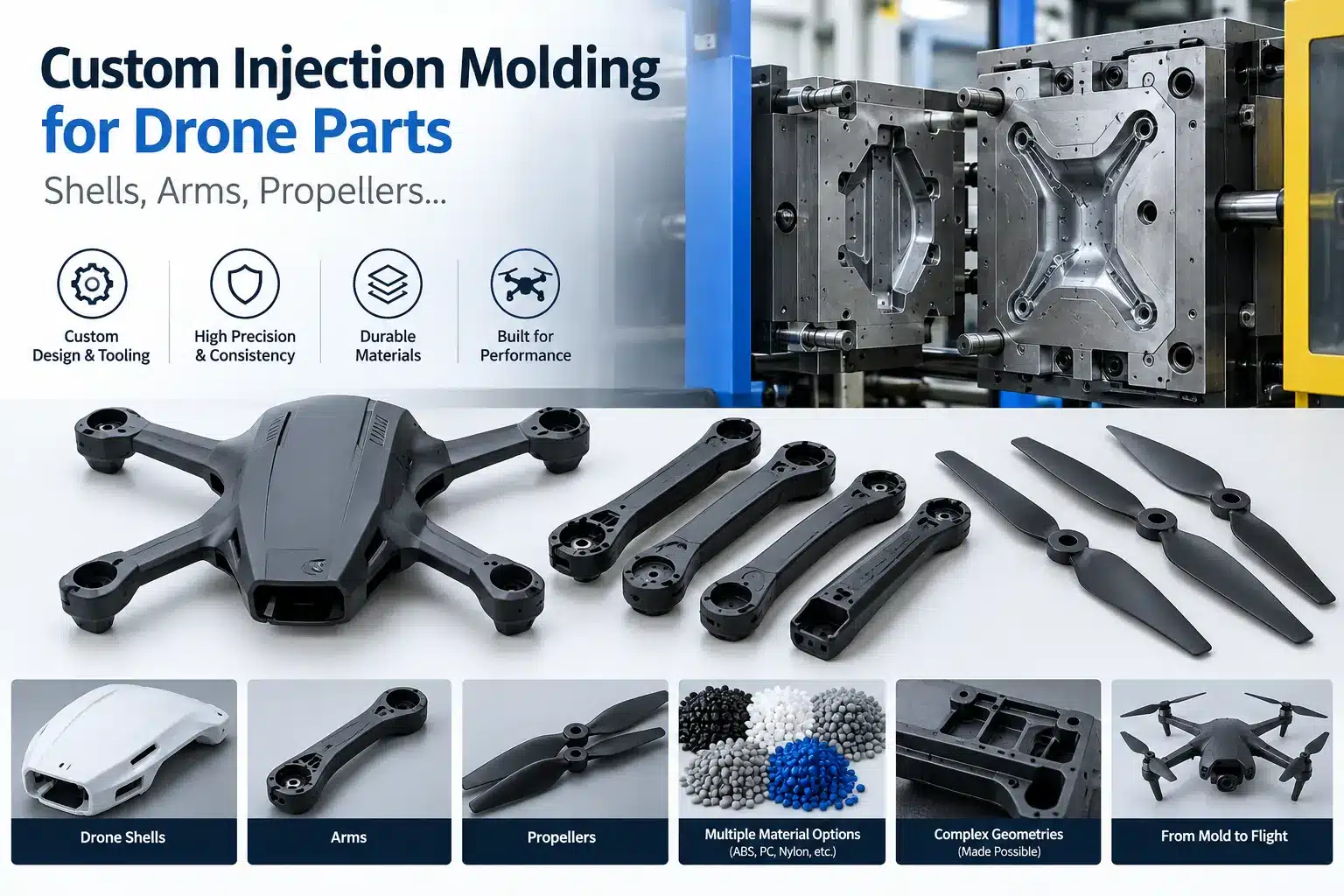
Drone parts, molded to a weight budget
Arm shells, canopies, gimbal housings, propellers and battery bays. We design the mold, cut it in our own tool room, and run the parts. Grams and fit stay one shop’s responsibility.
Start with what you fly
A spray drone and an FPV frame share almost nothing except the word “drone”. Material, tolerance, volume and cost pressure all differ. Find the row that matches your program.
FPV and consumer
Hobby brands, camera drones, indoor platforms
- Parts we usually mold
- Canopies, arm covers, prop guards, camera mounts, gimbal shells, controller housings
- Typical materials
- PC/ABS and ABS for shells, TPU for guards and feet, unfilled PC for lens covers
- What usually bites
- Cost per unit and cosmetics. Thin walls, no sink marks, and a texture that hides gate blush
Survey and inspection
Mapping, utility, public safety fleets
- Parts we usually mold
- Arm shells, motor mounts, gimbal yokes, antenna and GPS covers, sealed body halves
- Typical materials
- PA6-GF20 and PA12 for structure, ASA outside for UV, unfilled PC or PBT at the antenna
- What usually bites
- Warp on long glass-filled arms, and keeping glass fiber away from the RF window
Agricultural spraying
Crop protection and seeding platforms
- Parts we usually mold
- Nozzle bodies, manifolds, pump housings, tank lids and fittings, arm and boom covers
- Typical materials
- PP and PA for chemical contact, ASA outside, TPE seals molded onto the part
- What usually bites
- Orifice consistency across cavities, and resin that survives daily agrochemical wash-down
Delivery and cargo
Logistics UAV, VTOL, heavy lift
- Parts we usually mold
- Fairings, cargo bay panels, latch mechanisms, battery bays, landing gear parts
- Typical materials
- PA6-GF30 for load paths, FR grades in the battery bay, PC for covers
- What usually bites
- Structural parts with a real safety case, and low volumes that still need production tooling
Two processes we do not run. EPP and EPS foam bodies need bead-foam machines. Carbon plate arms are cut and layered, not molded. We will name a better route rather than force the part into our press.
The weight budget, and what each gram costs
Airtime comes out of mass. Every saving on this list is real, and every one has a price. We put these choices in the DFM report so you decide, not us.
| Design or molding decision | Typical effect | What it costs you |
|---|---|---|
| Thin the wall from 2.5 mm to 1.8 mm | −25% mass | Higher injection pressure, shorter flow length, stiffness must come back through ribs |
| Rib instead of thicken | −10 to 20% | Rib at 50–60% of wall or a sink mark shows on the visible face |
| PA6-GF20 instead of GF30 | −2 to 3% | Lower stiffness, better impact behaviour, less warp on long arms |
| Mold in bosses, clips and cable channels | Removes screws and brackets | More complex tool, harder to change later |
| Two-shot seal instead of a fitted gasket | Removes a part and its assembly | Higher tooling cost, second-shot design has to be right first time |
| Chemical foaming on internal parts | −5 to 10% | Swirl on the surface, so cosmetic faces are out |
| Cut the runner mass with a hot runner | Material cost, not part mass | Pays back only at volume; adds tooling cost up front |
How we report it. The DFM reply carries an estimated part mass. At T1 we weigh real parts, cavity by cavity, and send the numbers with the samples.
Tooling that matches this year, not next year
100 – 2,000Flight testing, first customers
- Aluminium bridge tool, or a single-cavity prototype steel tool
- Changing features built as removable inserts
- Lowest tooling spend while the airframe still moves
- Limited life with glass-filled resins
2,000 – 50,000Committed production
- P20 or 718H steel, single or two cavity
- Roughly 300,000 shots of life
- Texture, FR grades and two-shot seals all viable here
- The right call for most survey and ag programs
50,000 +Consumer volume
- Hardened H13 or S136, multi-cavity, hot runner
- Lowest unit price, longest build time
- Needed anyway for abrasive glass-filled propellers
- Only worth it once the design is frozen
Moving up a rung. Bridge tooling is not wasted money. It buys flight data while a production tool is cut in parallel, which is usually the shortest path to shipping.
Five things that decide a UAV part
- The antenna window has to let RF through
- Glass fiber and metallic pigment interfere. Use unfilled PC or PBT at the GPS and antenna cover, even when the surrounding shell is glass-filled. This gets missed more often than any other detail.
- Sealing is cheaper molded than fitted
- An IP-rated joint made from a two-shot TPE or LSR lip has no gasket to source, fit or glue. It costs more in tooling and removes a leak path plus an assembly step.
- Sunlight destroys the wrong plastic in one season
- ABS chalks and fades outdoors. ASA holds colour under sustained UV, which matters for ag and survey aircraft that live on a truck bed.
- Battery bays need a rated grade, not a claim
- Flame retardance depends on grade and wall thickness together. Specify the UL yellow card grade at your actual thickness, and we will keep the traceability with the run.
- A propeller is only as good as cavity-to-cavity consistency
- Half a gram of difference between blades reaches the camera and the motor bearings. Balanced runner, cooling in the blade, weight checks by cavity. If a post-molding balance step is needed, we say so at quote stage.
What to put in the first email
Complete information turns a two-week back-and-forth into a two-day answer. Missing something? Send it anyway and we will ask.
- STEP or IGES fileParasolid or native CAD also fine
- Target mass per partOr the airframe budget you are working to
- Quantity this year and nextHonest numbers get honest tooling advice
- Material, or the missionPayload, temperature, sun and chemical exposure
- Critical dimensionsBearing bores, mating faces, motor patterns
- Cosmetic requirementPainted, textured, raw, or hidden inside
- Target date for first samplesAnd the flight test you are aiming at
- NDA, if you want one firstYours or ours, signed before files are opened
You get back a marked-up DFM report, an estimated part mass, tooling cost and unit price at your volumes. Usually within two business days. No account and no sales call to see the number.
Straight answers
What is the thinnest wall you can mold?
Around 0.8 mm on a flowable material such as PC/ABS over a short flow length. A long glass-filled arm shell needs more. Flow length against thickness decides it, not the number alone.
My airframe is not frozen. Should I wait?
Usually not. Molding constraints often change the design anyway, so an early review saves a revision. We build the unstable features as removable inserts to keep changes cheap.
Can I move the mold to another factory later?
Yes. You paid for it, so you own it. We crate it, record the shot count and ship it where you ask. Storage stays free while you keep ordering parts from us.
Do you mold propellers?
Yes, in PC-GF and PA-GF, with balanced runners and weight checks by cavity. Some geometries still need a balancing operation afterwards, and we flag that before you commit.
Can you mold structural parts for a certified aircraft?
We supply molded parts with material traceability and dimensional reports. Airworthiness qualification of your aircraft stays with you and your authority.
Who handles export paperwork?
We ship plastic components with commercial invoices and HS codes. Any export control applying to your finished aircraft is yours to confirm in your own country.
Send the CAD and the gram target
A DFM report, an estimated part mass, tooling cost and unit price come back within two business days. If your part belongs in CNC, foam or carbon instead, we will tell you that too.
For the engineering trade-offs behind lightweight frames and arms, read our field guide to e-bike and drone components.
