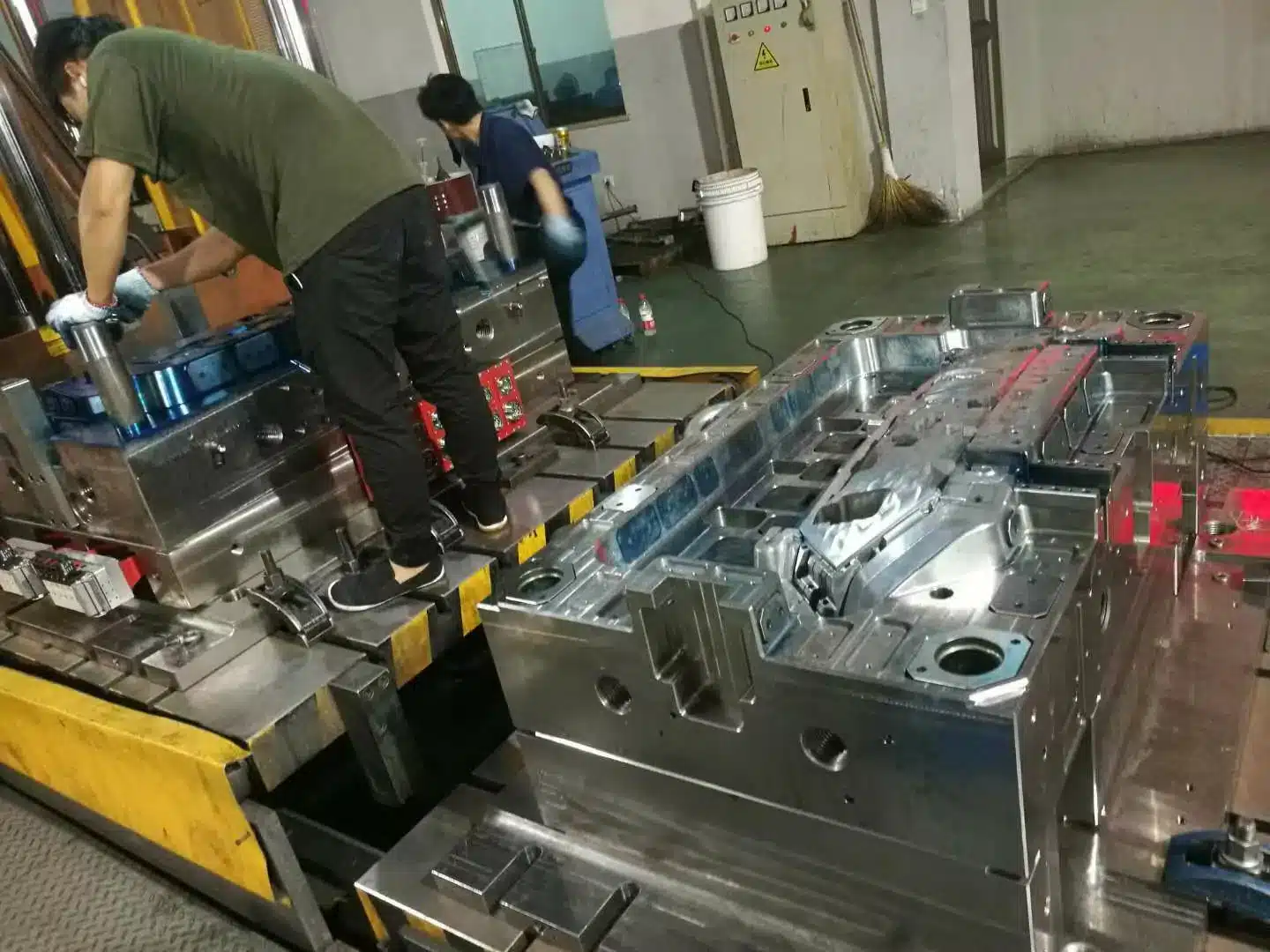

BATTERY ENCLOSURE TOOLING
Battery Case Mould Manufacturing
A buyer emailed us last month asking for a “battery case mould” quote, no other detail attached. Turned out he wanted a lead-acid car battery box, not a lithium power bank shell. Same words. Completely different tool. You might be sourcing lead-acid, lithium, EV, power bank, power tool, charger, or automotive enclosures. The material and tolerance stack changes every time. This breaks down all eight, so your RFQ lands on the right press tonnage the first time.
What Makes a Battery Case Mould Different From a Regular Enclosure Tool
Most enclosure moulds only worry about fit and finish. A battery case mould carries three extra jobs. It has to contain thermal runaway and resist the chemistry inside. It also needs to clear a certification body’s flame test. Miss one, and the part fails an audit — not just a QC check.
Wall thickness swings the hardest. A power bank shell might run 1.2mm walls for a slim profile. An EV module cover often needs 2.5mm or more, plus ribbing, for vibration testing. Get the thickness wrong, and you’re warping the part. Or wasting material and cycle time on a wall nobody asked for.
Then there’s the certification layer. UL94 V-0 flammability, IEC 62133 drop and crush testing, IATF 16949 for anything touching a vehicle. None of these show up as a mould design spec on paper. All three still decide wall thickness, gate placement, and resin choice before a single steel block gets cut.
Cell chemistry → thermal profile → material grade → wall thickness → certification test

Lead-Acid Battery Case Mould
Lead-acid is the oldest chemistry still in mass production. Mould requirements haven’t shifted much in twenty years. The case and cover usually run as separate cavities in one family mould, molded in polypropylene copolymer. PP resists sulfuric acid without cracking. It’s cheap too — cost stays sane on a $30 battery.
Wall thickness sits around 2.8mm to 3.5mm, thicker at the base where the plates rest. Ribbing on the container floor stops sag under acid weight over a five-year service life. Tonnage follows battery size. We’ve built these moulds from 350 tons for a motorcycle battery up to 650 for a forklift traction battery.
One detail buyers miss: vent-plug bosses need a tight fit. Loose ones let acid mist escape past the seal during charging. That’s a warranty claim, not a cosmetic issue.
Lithium Battery Case Mould
Lithium cases split into two jobs, based on pack size. Same chemistry, different scale. Small consumer packs mould in PC/ABS blend or glass-filled nylon. Think e-bike battery covers, vape batteries, handheld tool packs. Walls run thin — 1.5mm to 2mm — with snap-fit or ultrasonic-weld seams.
Larger lithium module housings move to PA66 with 30% glass fill. Think e-scooters or home energy storage units. That resin holds dimensional stability under charge-cycle heat, and clears UL94 V-0 without a separate flame-retardant coating.
Tolerance is where lithium moulds get strict. Cell holder pockets often need ±0.1mm tolerance — tight for a reason. Too loose, and the cells rattle. Too tight, and thermal expansion cracks the housing after 200 charge cycles. We run mold flow simulation on every lithium project before cutting steel, to catch warpage around those pockets. Skipping that step is the single most common reason a first-shot lithium case comes back for rework. That’s the whole game.
EV Battery Enclosure Mould (EV Battery Case Mould)
“EV battery case mould” gets searched constantly. But the full pack housing on a real vehicle is almost never plastic. It’s stamped aluminum or a sheet-molded composite, for crash and fire code reasons. What we actually build in steel are the components around that housing. Think module carriers, busbar covers, coolant plate lids, and battery management system enclosures.
These parts run in PPS or LCP near the busbars. Both resins hold shape past 200°C. They also resist corona discharge from high-voltage arcing. PA66-GF30 covers the cooler zones — module frames, sensor housings — where cost matters more than extreme heat resistance.
Tonnage runs big. A full module carrier tool can call for 1,200 to 2,500 tons. Part size drives that, and so do multi-cavity busbar cover inserts running alongside it. Sealing groove tolerance runs tighter here than on most plastic parts we quote. A loose IP67 seal on a coolant lid means a leak inside a live battery pack. Not a return. A fire report.
If your BOM lists “EV battery enclosure” as one line item, ask your shop to break it into components. Quoting it as a single part almost always means someone guessed the wrong resin for at least one zone. One wrong guess, one failed zone.
Power Bank Battery Case Mould
Power bank shells are a volume game, and the mould reflects it. Most run a two-shot process. A rigid PC or ABS shell gives structure. A soft-touch TPU overmold covers the grip zones. Wall thickness stays thin, often under 1.5mm, because every gram fights the product’s advertised weight-to-capacity ratio.
Cavitation is where the real cost lives. A 4-cavity or 8-cavity tool brings per-unit price down fast on a product that might sell for $15 retail. We’ve quoted power bank shells on 100-ton presses for single-cavity prototype runs. Once the order hit six figures, we rebuilt the same design into an 8-cavity, 250-ton production tool.
Surface finish matters here more than on almost any other battery enclosure. Buyers judging a $20 gadget go by hand feel. They’ll notice a flow line or a sink mark near the USB port. Nobody would flag that on an EV module cover. Budget for EDM texture or high-polish steel finishing, not just the base tool.
Power Tool Battery Pack Enclosure Mould
Power tool packs get dropped and thrown in truck beds. They also sit in freezing job-site trailers. The mould has to account for all of that before the first sample ships.
PA66 with 30% glass fill is the default here. It holds impact strength at low temperature. A plain ABS pack cracks in a -20°C drop test. A glass-filled nylon pack survives the same test without a mark. Ribbing around the cell bays does double duty. It gives structural support and a heat path away from the cells during fast charging.
We mould these on 300 to 500-ton presses. Closures run snap-latch or screw-boss, depending on the brand. Some brands want a tool-free swap. Others want the pack sealed. IEC 62133’s 1.5-meter drop test isn’t optional for most retail markets. Boss walls around every screw point need enough draft and thickness for that. They have to survive the shock without stress-whitening. Skip that detail at the DFM stage, and it fails at the certification lab, not on our press.


Battery Charger Shell Mould
Charger shells look simple next to a battery case. The tooling usually is simpler too. But the flammability rule stays, even with no cell inside. Anything on mains power needs UL94 V-0 rated PC/ABS, at minimum. Non-negotiable. Europe and Australia often demand straight flame-retardant PC instead, under stricter codes.
Most charger shells split into a top and bottom half, snap-fit or screwed together around a transformer or PCB. Ventilation slots need enough open area for heat dissipation. But they can’t let dust or a screwdriver tip reach a live circuit. That’s a safety standard, not a style choice.
Tooling runs modest, usually 120 to 250 tons for a typical wall or desktop charger shell. The detail that trips up new buyers is boss placement for the PCB standoffs. Small detail, big miss. Move a boss 2mm off the approved design and the board no longer clears the shell wall. We check that against the customer’s PCB file before cutting steel, every time.
Sourcing one of these eight enclosures? Tell us the chemistry and target capacity. Add your target market too. We’ll send back steel grade and tonnage. Lead time follows within two business days.
Material and Spec Comparison Across Battery Case Types
Rough numbers below, based on projects we’ve quoted. Every part still needs its own DFM review. Cell count and mounting method shift the final spec. So does target market.
| Battery Case Type | Typical Material | Wall Thickness | Flame Rating | Typical Tonnage |
|---|---|---|---|---|
| Lead-acid battery case | PP copolymer | 2.8–3.5mm | UL94 HB | 350–650T |
| Lithium battery case (consumer) | PC/ABS blend | 1.5–2.0mm | UL94 V-0 | 150–300T |
| Lithium battery case (pack/module) | PA66-GF30 | 2.0–2.8mm | UL94 V-0 | 400–700T |
| EV battery enclosure component | PPS / LCP / PA66-GF30 | 2.0–3.0mm | UL94 V-0 | 1,200–2,500T |
| Power bank battery case | PC or ABS + TPU overmold | 1.0–1.5mm | UL94 V-0 (shell) | 100–250T |
| Power tool battery pack enclosure | PA66-GF30 | 2.2–3.0mm | UL94 V-0 | 300–500T |
| Battery charger shell | PC/ABS (FR grade) | 1.8–2.5mm | UL94 V-0 | 120–250T |
| Automotive / car battery box | PP + talc, UV-stabilized | 3.0–4.0mm | UL94 HB | 500–800T |
Automotive Battery Box Mould and Car Battery Case Mould
“Automotive battery box mould” and “car battery case mould” usually mean the same part. It’s the tray or box holding a 12V lead-acid or AGM battery. You’ll find it under the hood or in the trunk. Material leans toward PP copolymer with talc filler, for stiffness and heat resistance. That’s for parts near the engine bay. Trunk-mounted boxes, with lower thermal load, use straight PP instead.
These moulds run bigger than a standalone lead-acid case — think 500 to 800 tons. The box often integrates a hold-down bracket boss. Some designs add a vent tube for hydrogen off-gassing during charging. That vent feature needs a core pull or a side-action slide, and that adds mould cost. Buyers don’t expect that from a “plain” box.
Corrosion resistance matters twice here. Once from battery acid inside. Once from road salt and underbody spray outside. We spec UV-stabilized PP for anything sunlight and road grime reach. That describes most under-hood boxes.
Frequently Asked Questions
What’s the difference between a lead-acid battery case mould and a lithium battery case mould?
Lead-acid cases mould in acid-resistant PP with thick, rib-supported walls. They hold weight over years of service. Lithium cases mould in glass-filled nylon or PC/ABS instead. Tolerances run tighter around cell pockets, and UL94 V-0 is mandatory.
What material works best for EV battery enclosure moulds?
True EV pack housings are usually aluminum, not plastic. The plastic parts around them — module carriers, busbar covers, coolant lids — mould in PPS, LCP, or PA66-GF30. Material choice depends on how close a part sits to the high-voltage busbars.
How much does a power bank battery case mould cost?
A single-cavity prototype tool can run under $5,000. Production-grade 8-cavity two-shot tools cost more — typically $18,000 to $35,000. Price depends on cosmetic finish and overmold complexity.
What wall thickness is standard for an automotive battery box mould?
Most automotive battery box moulds run 3.0mm to 4.0mm walls. That’s thicker than consumer battery enclosures. It handles vibration and heat. It also carries the weight of a filled lead-acid battery, over the vehicle’s service life.
Can one mould base produce both a power tool pack enclosure and a charger shell?
No. The two parts need different steel cavities and different gate locations. Press tonnage usually differs too. Some shops share a base plate size to cut cost on standard components. Cavity inserts always stay separate.
What lead time should I expect for a battery case mould?
Simple charger shell or power bank tools usually run 30 to 40 days from approved drawing to T1 sample. Bigger lithium pack or automotive box tools run longer. Side-action slides or lifters push that to 45 to 60 days.
Not sure which of these eight fits your part? Send us the chemistry and target certification. Tell us the rough volume too. We’ll tell you which path it belongs to — before we quote steel.

