
Robotics Sourcing Guide
Plastic Parts for Humanoid Robots: What to Tool, What to Machine
The math nobody in robotics wants to do
A humanoid robot startup called us last spring to quote 34 molds in one package. Their forecast for the year was 200 robots. I told them to tool six parts and machine the rest. They were annoyed for about a month. Then their frame geometry changed, and a third of that tool package would have been scrap steel. That call is the market for plastic parts for humanoid robots, compressed into one story.
The hype says millions of robots. The shipping data says something under 20,000 humanoid units moved globally in 2025. Most came from Chinese makers, and reported figures vary by source. Treat any precise number with suspicion. Tesla is converting Fremont lines for Optimus. Unitree is targeting five figures of units this year. Figure has robots working in BMW plants. It’s real. It’s also early.
For a sourcing team, the gap between those two curves is where money gets lost. Tool too early and you scrap steel every time the design iterates. Tool too late and you pay $180 per CNC’d cover on a robot you want to sell for $30,000.
Getting that timing right is most of the job. The rest is knowing how robot plastics differ from the consumer and industrial parts most molders quote every day.
What counts as a plastic part on a humanoid robot
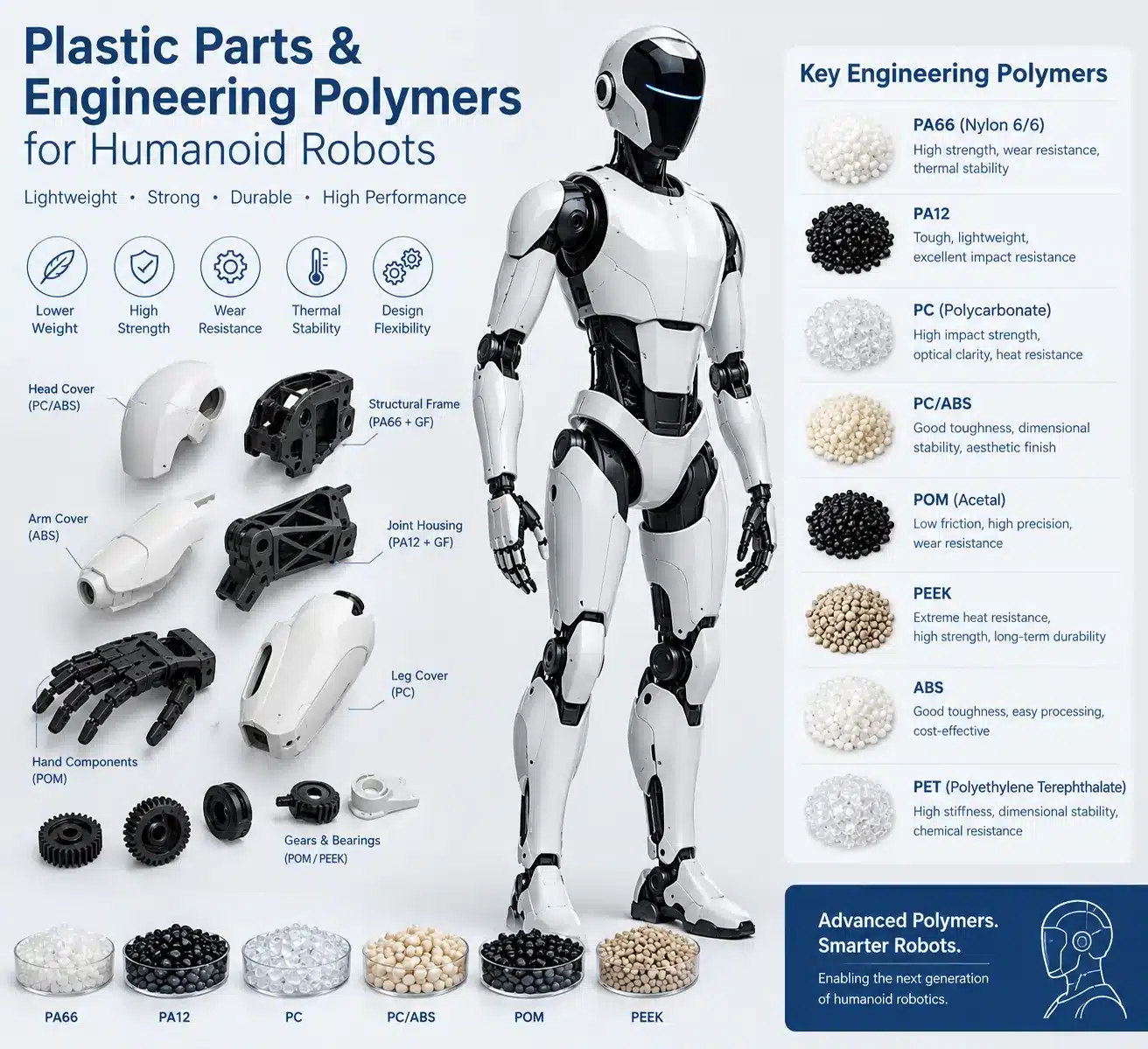
Plastic parts for humanoid robots cover exterior shells, structural brackets, cable management, sensor housings, and grip surfaces. Everything that isn’t a metal frame member, an actuator, or electronics. A typical humanoid carries 60 to 150 discrete plastic parts. The count keeps rising as designers swap machined aluminum for glass-filled nylon to cut weight and cost.
Weight is the quiet driver. Every gram on a limb segment gets swung thousands of times a day by an actuator. Actuators are the most expensive subsystem on the robot. Swap a machined aluminum forearm cover for molded PC/ABS and you cut part cost. You also buy back battery runtime. The logic matches our lightweight structural work for e-bikes and drones. Higher stakes here, and higher part counts.
The five part families
Not all robot plastics are the same job. When we review a humanoid BOM, the parts sort into five buckets. Each bucket has a different tooling answer.
Exterior shells and covers. Torso panels, limb covers, head shells. Large, thin-walled, cosmetic, usually painted. These are the parts everyone sees in the launch video. They’re also the hardest to mold well. Big projected areas, warp risk, and Class A expectations on a part that must survive the robot falling over.
Structural brackets and chassis parts. Actuator mounts, joint housings, internal frames. Glass-filled nylon territory. These carry load, hold tight tolerances at bolt patterns, and fail expensively when they creep.
Hands and fingers. Small, complex, often overmolded with TPU or TPE for grip. A dexterous hand can carry 20+ molded components. So these hit molding-friendly volumes long before the torso panels do.
Cable management and internal hardware. Clips, guides, grommets, connector housings. Boring, cheap, and the first parts you should tool. They never change, and every robot uses dozens.
Sensor and camera housings. Tolerance-critical, often with optical windows and EMI shielding needs. Zero allowance for warp around the lens seat.
That ordering isn’t decorative. It’s roughly the order in which molding makes sense as your volumes climb.
When does molding actually beat CNC and printing?
Mold a part when its design is frozen and you’ll use 500+ pieces before the next major revision. Below that, CNC machining or MJF/SLS printing almost always wins on total cost. Tooling amortization crushes you at prototype volumes. The exception is small multi-cavity parts. Clips and finger segments hit thousands of pieces even at 200 robots.
Typical numbers for a mid-size cover, roughly 250 × 150 mm.
| Route | Tooling | Piece price | Sensible volume | Design change cost |
|---|---|---|---|---|
| MJF / SLS print | $0 | $40–90 | 1–100 | Zero |
| CNC (ABS/PC block) | $0 | $120–250 | 1–200 | Zero |
| Aluminum bridge mold | $4k–9k | $6–15 | 200–5,000 | Lose the tool |
| Production steel (P20/718H) | $15k–35k | $3–8 | 5,000+ | Lose a lot more |
Notice the aluminum row. That 200-to-5,000 band is where the entire humanoid industry lives right now. Which brings us to the strategy that matters most.
Bridge tooling is the whole game right now
Stop asking for production tooling quotes. Ask for bridge tooling quotes instead. If I could give a robotics sourcing team one instruction, that’s it.
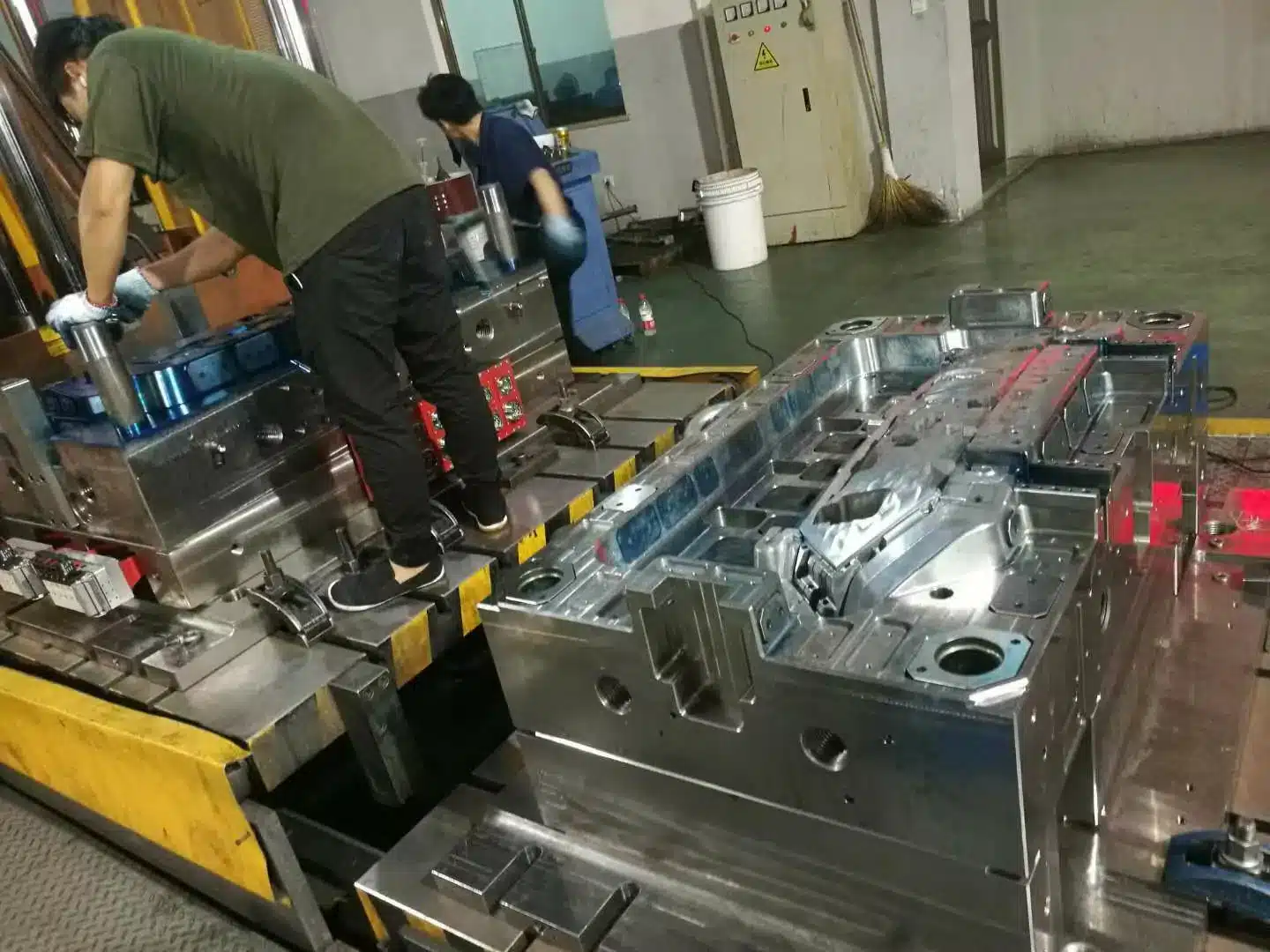
A bridge tool is an aluminum (7075 or QC-10) or soft-steel mold. It often runs as an insert set in a standard MUD or master frame. It costs a quarter to a third of a hardened production tool. Lead time drops to three or four weeks instead of eight to ten. And you get genuinely molded parts. Right material, right shrink behavior, right surface, real drop-test data. When your arm geometry changes in six months (it will), you’ve written off $6,000, not $28,000.
The counterargument I hear is “but we’ll just pay again for steel later.” Yes. That’s the point. You pay a known small amount now to avoid an unknown large amount of scrapped steel. And you get parts that behave like production parts during drop tests, thermal soak, and FCC pre-scans. Prototype prints lie to you about all three.
One caveat. Glass-filled nylons chew up aluminum cavities. A 30% glass-filled PA6 will visibly wear an aluminum gate land inside 3,000–5,000 shots. For GF-loaded structural brackets, have your toolmaker quote steel inserts in a standard mold base. 718H is fine. Costs a little more, saves the tool.
Plastic parts for humanoid robots: material choices that hold up
Most of the humanoid BOM comes down to four material decisions. None needs exotic resin.
PC/ABS for exterior shells. It paints beautifully, survives impact at room temperature, and molds thin. It’s the default for cosmetic covers, and it should stay the default. Don’t let anyone push straight PC for a large cover without a specific flammability or clarity reason. You’ll pay in molded-in stress and cracking at bosses.
PA6-GF30 or PA66-GF30 for structural brackets. Glass-filled nylon is the workhorse for actuator mounts and joint housings. Strong and cheap. Also hygroscopic. It drinks moisture, and moisture shifts both dimensions and toughness. If your supplier doesn’t condition GF-nylon parts before CMM inspection, the dimensional reports are fiction. I wrote a full article on nylon and moisture. The failure modes there apply doubled here, because robot brackets sit under sustained load.
TPU or TPE for grip and contact surfaces. Finger pads, palm surfaces, anything that touches objects or people. Usually overmolded onto a rigid PA or PC substrate. Shore hardness matters more than brand. 60A–80A covers most gripping tasks.
PPA or PPS where heat lives. Housings near motor drivers and dense actuator clusters can sit above 100 °C for hours. Standard PA6 creeps there. Glass-filled PPA holds up and still molds on conventional equipment. You rarely need PEEK. At $75+/kg for resin, treat “rarely need” as “don’t, until a thermal map proves otherwise.”
PC/ABS hesitates less in thin ribs than PP and paints better than PA. That’s most of why it owns the cosmetic shell category. Say that plainly to your supplier and you skip a week of material back-and-forth.
The shin cover that taught me about robot aesthetics
We molded shin covers for a legged-robot pilot a couple of years back. PC/ABS, about 380 mm long, gentle compound curve. Gated at one end, because the customer didn’t want a gate witness on the visible face. First shots looked great on the bench. Painted, assembled, shipped.
Three weeks later, photos arrived of robots with visibly bowed shins. The cover had warped a millimeter and a half along its length. Nothing structural. But next to a machined aluminum frame, 1.5 mm on a straight vertical face reads as a crooked robot. You see it from across the room.
The fix was ordinary. Two-drop hot tip, balanced fill, a shallow rib pattern inside. The lesson wasn’t. Humanoid robots get judged like consumer electronics and assembled like industrial machines. A bow that would pass on a power-tool housing looks defective on a robot. The human eye is brutal about anything shaped like a body. Budget cosmetic-grade tooling and inspection for every exterior part. Even the ones engineering calls non-critical.
Inserts, overmolding, and the stuff that touches humans
Three secondary processes show up on almost every humanoid program.
Brass threaded inserts at every serviceable joint, heat-staked or molded-in. Robots get opened far more often than consumer products. Self-tapping screws into bosses die by cycle ten. Molded-in inserts cost more per part but survive. Specify them for anything a field tech will open.
TPU overmolding on grippers, as above. Ask your supplier whether they’ve run bonded two-shot or insert-overmold with your exact rigid/soft pairing. Adhesion between TPU and glass-filled nylon is chemistry-dependent. “We do overmolding” is not “we’ve bonded 70A TPU to PA6-GF30.”
Conductive coatings or filled resins for EMI. A robot is a walking bundle of motor drivers. Some housings will need shielding. Usually that means conductive paint or plating on standard resin, not exotic conductive compounds. Scope it early, because it changes which surfaces can carry texture.
What a realistic quote looks like
Take a program tooling its first ten parts. Say two covers, four brackets, four small internals. Expect a bridge-tooling package in the $35,000–70,000 range from a capable Chinese shop. T1 samples land in four to six weeks. Piece prices sit mostly in single-digit dollars. A comparable hardened-steel package runs 2.5–3× that, with roughly double the lead time.
If a quote comes in far under those ranges, look closer. Check the mold base spec (LKM standard or better). Check the steel callouts and whether DFM review is included. The cheapest number on a robot program usually assumes your CAD is final. It isn’t.
Sourcing from China for a robot program
The tooling economics that favor China for drones and e-bikes apply here unchanged. Mold in China, land parts or tools in the US, keep final assembly wherever your engineers sit. Two robot-specific wrinkles.
Iteration speed matters more than piece price. At 500 robots a year, saving $0.80 per part is noise. Getting a revised cavity insert cut in eight days instead of four weeks is not. Weight your supplier scoring toward engineering-change turnaround, not unit cost.
Tariffs and export-control exposure are moving targets. Molds from China enter under HTS 8480.71, most parts under Chapter 39. Both carry Section 301 exposure on top of base rates. Robotics as a category is attracting fresh policy attention in both directions. I’m deliberately not printing rates here. They’ve changed multiple times and will again. Check the current USITC HTS database and CBP before you build a landed-cost model. Rerun it quarterly.
Questions that expose a weak supplier
Ask these on the first call. The answers tell you more than the quote does.
- “How do you condition glass-filled nylon parts before dimensional inspection?” A blank pause means your CMM reports will measure moisture, not molding.
- “Show me a painted PC/ABS part over 300 mm you’ve shipped. What was your warp spec, and how did you hold it?”
- “What’s your turnaround on a cavity insert change, in days, with the PO already open?”
- “Which mold base standard do you build on?” DME, HASCO, or LKM are all fine answers. “Our own” is not. It marries you to that shop for the life of the tool.
- “Have you bonded TPU to glass-filled nylon? Which grades?”
A supplier who answers all five specifically is worth a premium. A supplier who answers with certifications and factory-tour photos hasn’t done this work.
Where this market actually is (and isn’t)
I’ll commit to a position. Humanoid robots will become a major injection molding market, and it hasn’t happened yet.
Right now the volumes are bridge-tool volumes. The programs shipping hundreds of units still machine and print half their plastics. They’re right to. The picture changes when any single program crosses roughly 10,000 units a year. At that point its part families flip to hardened multi-cavity tooling. Its resin buys start moving PA-GF pricing regionally. Its suppliers get pulled into automotive-style PPAP discipline. Several companies claim they’ll cross that line within two years. Claimed and shipped are different numbers. So far the shipped ones are small.
The practical read for a buyer is simple. Build supplier relationships and bridge-tool discipline now, while the market is loose. Then you’re not learning your molder’s weaknesses during the ramp.
The one decision rule
Tool the parts that won’t change. Machine the parts that will. Use aluminum bridge molds for everything in between. Cable clips and finger segments go to steel early. Torso shells stay in aluminum until your industrial designer stops touching them. Sourcing a humanoid program well is downstream of being honest about which parts sit in which bucket. Revisit that answer every quarter. In this market, the buckets move.
FAQ
How many plastic parts are in a typical humanoid robot?
Most current humanoid platforms use between 60 and 150 discrete plastic components. These span exterior covers, structural brackets, hand components, cable management, and sensor housings. The count is rising as designers convert machined aluminum parts to glass-filled nylon, cutting both weight and cost per unit.
What is the best plastic for humanoid robot exterior covers?
PC/ABS is the standard choice for humanoid robot exterior shells. It molds thin, takes paint well, and resists impact from falls at room temperature. Straight polycarbonate or painted PA shows up in specific cases. PC/ABS covers the large majority of cosmetic cover applications.
Can humanoid robot structural parts be injection molded instead of machined?
Yes. Glass-filled nylons such as PA6-GF30 and PA66-GF30 replace machined aluminum in many bracket and housing applications. They come in at a fraction of the piece cost and weight. The limits are sustained temperature above roughly 100 °C and creep under constant load. There, PPA or a metal part is the safer call.
How much does a mold for a robot part cost?
An aluminum bridge mold for a mid-size robot part typically runs $4,000–9,000 from a Chinese toolmaker. A hardened-steel production mold for the same part runs $15,000–35,000. Small multi-cavity molds for clips and finger segments sit below those ranges. Compare quotes on the same mold base standard and steel callouts.
When should a robotics startup switch from 3D printing to injection molding?
Switch a part to molding when its design is frozen and you expect at least 500 pieces before the next revision. Small high-count parts like clips and finger segments justify tooling earlier. Large cosmetic covers justify it later, usually through an aluminum bridge tool first.
Do injection molded robot parts need EMI shielding?
Housings near motor drivers and controller boards often do. The common approach is conductive paint or plating on a standard PC/ABS or PA housing. Molding with conductive-filled resin is rarer. Scope shielding at the DFM stage, because coated surfaces constrain texture and gate placement.
Is PEEK necessary for humanoid robot parts?
Rarely. PEEK solves sustained high-temperature and wear problems. But at resin prices many times those of glass-filled PPA, it belongs only where a thermal map proves standard engineering resins fail. Most humanoid programs ship with no PEEK parts at all.
Are molds for robot parts subject to US tariffs when built in China?
Molds imported from China classify under HTS 8480.71, and most molded plastic parts under HTS Chapter 39. Both carry Section 301 exposure on top of base duty rates. Rates have changed repeatedly. Verify current figures in the USITC HTS database and with CBP before building a landed-cost model.

