
For buyers new to injection molding
How to Ask for an Injection Molding Quote (Without Knowing the Jargon)
You have a plastic part in mind. Maybe a housing for a small device. Maybe a lid for a jar you sell. You email three factories. Two never reply. The third sends back a wall of questions you don’t understand.
What is “draft angle”? Which “grade” of PP? Do you need SPI-A2 finish? At this point most first-time buyers give up. Or worse, they guess. And a wrong guess at this stage can cost thousands of dollars later.
We built a tool to fix that. It’s a simple visual wizard. You click pictures. We get everything we need to quote you. No jargon required.
Why traditional RFQ forms fail small buyers
A typical quote form asks for material grade, tolerance class, surface finish code, gate type, and cavity count. If you know these terms, that form works. If you don’t, you’re stuck. You either abandon the form or fill it in wrong.
Neither outcome helps you. And neither helps the factory. We waste a week going back and forth just to figure out the basics.
Here’s the truth. You don’t need to know the jargon. You just need to describe your part in plain words. The factory can translate.
The eight questions that actually matter
After 20 years of quoting projects, we found that eight questions cover 90% of what’s needed for a first quote. Each one has a picture. You just click the closest match.
1. What kind of part is it?
Is it a box that holds electronics inside? A lid for a bottle? A small button someone presses? A bracket that mounts something to a wall? You pick from nine common shapes. If none match, you pick “Something else” and describe it later.
This tells us how complex the mold will be. A flat lid is simple. An enclosure with snap-fits is not.
2. How big is your part?
You don’t need exact numbers yet. Just pick a size class. Tiny (fits on a fingernail). Small (fits in one hand). Medium (like a shoebox). Large (bigger than a laptop). Very large (over 60 cm).
Size drives the machine we use. A small part runs on a small press. A bumper needs a huge press. The gap in cost between the two is real.
3. How should the plastic feel?
This is where jargon usually kills the conversation. Instead of asking for “PP homopolymer with UV stabilizer,” we ask simple questions. Should it be rigid like a laptop shell? Slightly flexible like a shampoo bottle? Soft like a silicone case? Clear like a water bottle? Heat-resistant? Food-safe?
Pick all that apply. We’ll match you to the right material.
4. What should it look like?
Shiny or matte? One color or two? Do you want a logo raised into the plastic? A grainy texture for grip? A chrome look? Or does it not matter because the part is hidden inside a bigger product?
Surface finish affects mold cost more than most people realize. A mirror finish takes days of polishing. A textured surface needs a special etching process. Knowing this upfront saves everyone time.
5. How many parts do you need?
This is the single biggest cost driver. Making 100 pieces is very different from making 100,000.
Low quantities may not justify a hard steel mold. High quantities need a mold that can run for millions of shots. We use your number to pick the right mold class and quote you fairly.
6. What design do you have?
Four options. You have 3D CAD files (STEP, IGES, STL). You have 2D drawings or sketches. You have a physical sample to copy. Or you have only an idea in your head.
Each path costs different amounts. If you have 3D files, we can quote in a day. If you have only an idea, we need to design it first. Both are fine. We just need to know which situation you’re in.
7. Any special features?
Optional. Skip if none apply. Does your part have snap-fit clips? Threads like a bottle cap? Does it need to be watertight? Does it have a metal insert like a threaded nut? A living hinge (the bendy strip on a flip-cap)? A soft rubber grip section?
Each of these adds cost. But knowing about them upfront prevents ugly surprises in the final quote.
8. Your contact info and timing
Name, email, country, and when you need first parts. That’s it. We reply within 24 hours during Beijing business hours.
Upload your files, if you have any
The wizard also lets you drop in files. STEP, IGES, STL, SolidWorks. PDF drawings. Photos of your sample. Even a rough sketch you drew on paper and photographed with your phone.
Anything helps. A photo of your existing part tells us more in five seconds than a paragraph of text. A STEP file lets our engineers open your part in CAD and quote it accurately. If you have nothing, that’s fine too. We’ll ask more questions in our reply.
What happens after you submit
Your request lands in our system with a unique number. A real engineer (not a chatbot) reads it. Within 24 hours you get a reply with three things.
First, our best guess at material and manufacturing approach. Second, a rough price range for the mold and per-piece cost. Third, any questions we still need answered before giving a firm number.
If your project is simple and your files are clear, this first reply may be the final quote. If it’s complex, we’ll set up a short call to walk through options. Either way, you’ll never wait more than one business day.
What if I still don’t know what I need?
Every question in the wizard has a “Not sure” option. Every single one. If you’re not sure about material, pick “Not sure — please recommend.” If you’re not sure about quantity, pick “Not sure” and we’ll quote you two or three tiers.
Not knowing is not a problem. That’s what we’re here for. The wizard is designed to work even when you can only answer half the questions.
Ready to get a real quote?
Eight visual questions. Under four minutes. Reply in 24 hours.
The bottom line
Getting a plastic part made shouldn’t require an engineering degree. You should be able to describe your product in plain language. A good factory should translate that into a working quote.
That’s why we built the wizard. That’s why every option has a picture. That’s why “Not sure” is always a valid answer. Injection molding is our job, not yours. Come with your idea. We’ll handle the technical part.
Do I need CAD files to get a quote?
For a final accurate quote, yes — CAD files are the foundation. Without geometry we cannot lock down mold size, cycle time, or material weight. That said, you don’t need CAD to start the conversation. Send a photo, a hand sketch, or a description first and we’ll give you a rough range plus next steps. If you have no CAD at all, we can build the 3D model for you as part of the project, then quote precisely from that.
How long does it take to get a real quote back?
Within 24 hours during Beijing business hours (Monday to Friday). Simple projects with clear files may get a firm quote right away. Complex projects usually get a preliminary quote plus follow-up questions in that first reply.
What’s the minimum order quantity?
We work with quantities from a few prototype pieces up to millions per year. Very low volumes (under 80–100 pieces) may be more cost-effective with 3D printing or vacuum casting, and we’ll tell you honestly if that’s the case. There’s no fixed MOQ that rules you out.
Can I upload confidential files? Are they safe?
Yes. Uploaded files go to a private folder on our server, not a public location. Only our engineering team can access them. We can sign an NDA before you send anything sensitive. Just mention it in the notes field or reply to our first email.
What if my design has problems?
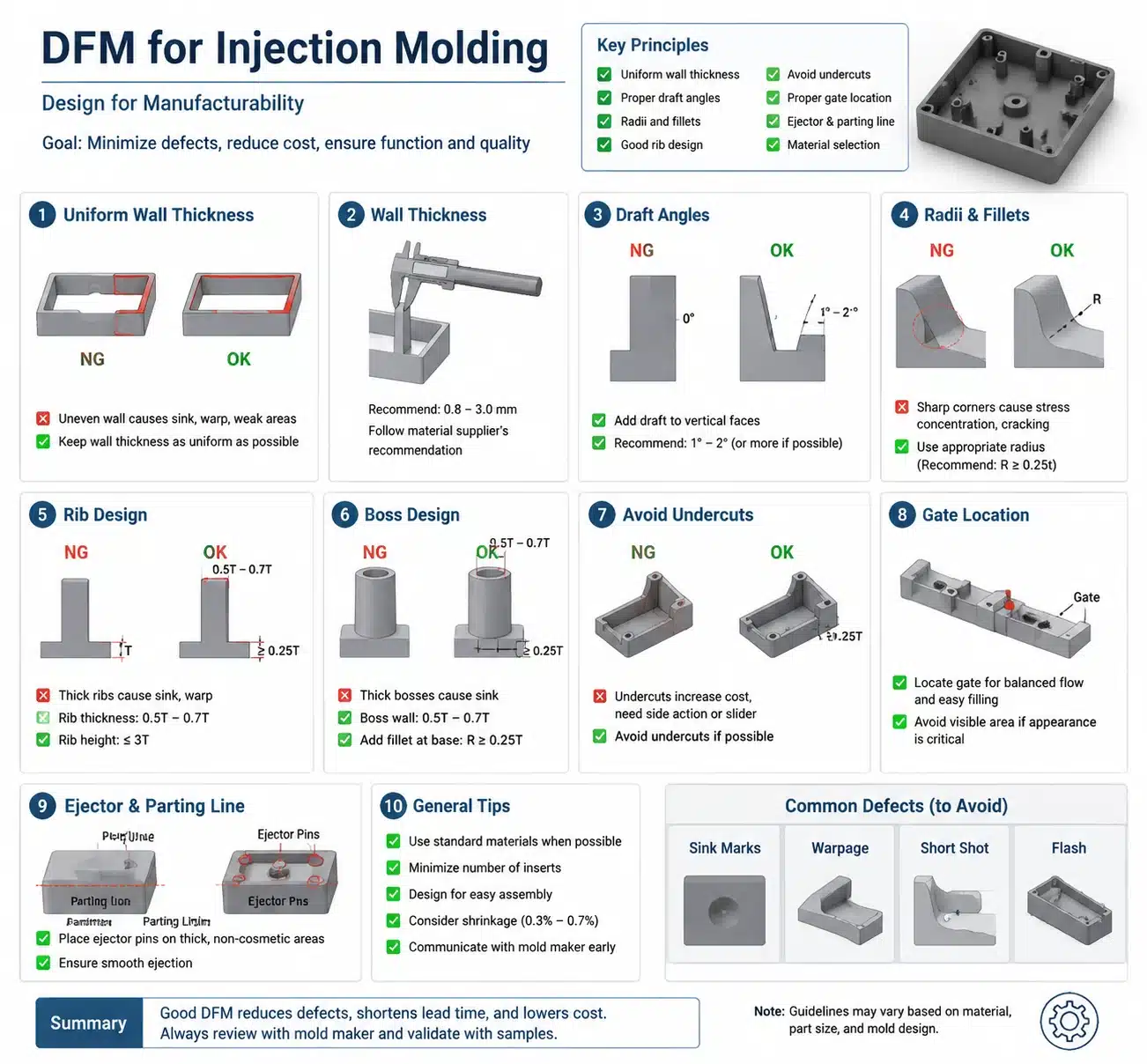
If we spot design issues that could cause molding problems (thin walls, sharp corners, undercuts that block the mold from opening), we’ll flag them in our reply with suggested fixes. This is called Design for Manufacturability review and it’s free with every quote.

