
Research Report: China’s Injection Molding Industry
Executive Summary
China makes roughly 30% of the world’s plastic components. That didn’t happen by accident. Low operating costs, dense supplier networks, and supply chains where the moulder, the resin house, and the tooling shop often sit in the same city gave China a scale advantage no single Western region can match. Through the last decade the price gap stayed wide while quality quietly closed — which is why so much global sourcing still runs through here.
But the ground is shifting. Buyers and regulators now ask for sustainability data, not just parts. Automation has eaten into the cheap-labour advantage that built the industry in the first place. And after several years of tariffs and supply shocks, multinationals are actively spreading their bets across Vietnam, India, and Mexico.
Two frictions still shape every deal. IP protection remains a live concern, so foreign partners stay cautious about handing over their best designs. And on the coast, wage inflation keeps narrowing the price gap with Southeast Asia — even as China holds a clear lead on technical depth and how completely its supply chains fit together.
This report looks at where China’s moulding industry actually stands — the market, the technology, the real competitive picture through the end of the decade. And, more useful if you’re the one placing orders, what all of it means for how you source.




Market Overview
Market Size and Growth
China’s moulding market reached about $42 billion in 2022. It has grown 5.3% a year since 2018 — a full point ahead of the 4.1% global rate — pulled along by both domestic demand and exports, even through the pandemic years.
Where does all that output go? Automotive takes the largest slice at 35%: interior trim, lighting, and a growing share of structural EV parts. Consumer electronics follows at 25%, a natural consequence of China assembling most of the world’s devices. Medical devices sit at 15% and grow fastest — 7.8% a year — as global device makers move production closer to their supply base. Appliances (10%), packaging (8%), and construction materials (7%) fill out the rest.
That spread is a strength. No single sector downturn can sink the industry, and there’s almost always another end market pulling demand.
China Injection-Moulding Output by End-Use Industry
Share of total moulded output, 2022
What this means for buyers: Most Chinese capacity is tooled for automotive and electronics volumes and tolerances. If you source medical or other regulated parts, screen for the smaller share of shops with the right certifications and validation — don’t assume a general moulder fits.
Source: Topworks analysis; IBISWorld & Statista (2023).
Regional Distribution
Chinese moulding didn’t spread evenly. It clustered — and where a shop sits tells you a lot about what it’s good at.
The Pearl River Delta — Guangdong, Shenzhen, Dongguan — runs 42% of national capacity. It grew up around electronics and Hong Kong’s ports, so it’s fast, flexible, and built for consumer-product volumes.
The Yangtze River Delta — Shanghai, Suzhou, Kunshan — holds 28%, and it’s where the precision work lives: automotive, medical, high-end electronics. Decades of Japanese, European, and American investment pushed quality and documentation standards up with it.
Central China — Henan, Anhui, Hubei — has climbed to 15% on relocation incentives and cheaper operating costs. For now it handles simpler, higher-volume parts, but its capability is moving up the ladder.
Where China’s Moulding Capacity Sits
Share of national output by industrial cluster
Strength: consumer electronics, fast turnaround, Hong Kong logistics.
Strength: high-precision automotive & medical, heavy foreign investment.
Strength: lower cost on simpler, higher-volume parts.
What this means for buyers: Where you source shapes what you get. Go PRD for electronics and speed, YRD for tight-tolerance automotive and medical, inland for price on simpler parts. Match the cluster to your part before you shortlist suppliers.
Source: Topworks analysis; IBISWorld & Statista (2023).
Cost Competitiveness
Cheap labour built this industry. It no longer defines it.
An operator in a major Chinese hub earns $4–6 an hour. In Vietnam that’s $2–3; in Cambodia, $1.5–2.5. Against the US ($30–40) or Germany ($35–45), China still looks cheap — but it’s no longer the cheapest, and that matters if you’re chasing the lowest unit price on simple parts. Automation has softened the blow: labour now runs 22–28% of production cost, down from 35–40% a decade ago, so rising wages bite less than they used to.
Factory Labour Cost per Hour
Injection-moulding operators, USD/hour · scale 0–$50
What this means for buyers: China no longer wins on wages alone — Vietnam and Cambodia are cheaper per hour. China’s real edge is the full ecosystem: 4–6 week tooling, deep material supply, and fewer production gaps. On energy China runs $0.08–0.10/kWh vs $0.12–0.15 in the US, but roughly level with Vietnam’s $0.07. Buy China for capability and reliability, not the lowest hourly rate.
Source: Topworks analysis; IBISWorld & Statista (2023).
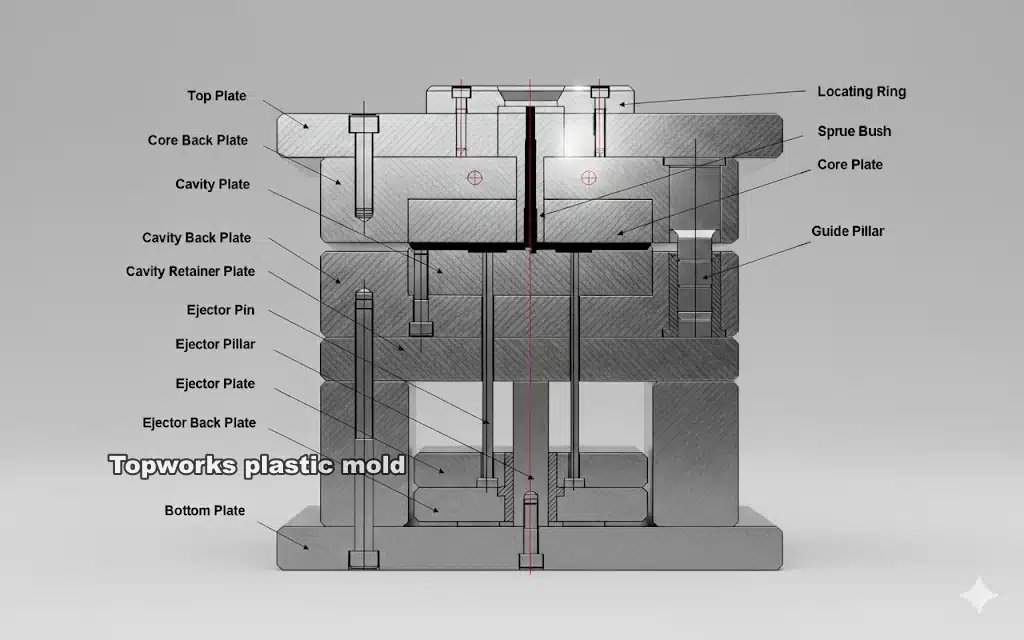
Tooling is where the picture gets interesting. On paper, Vietnam and Malaysia undercut Chinese mould costs by 25–30%. In practice, Chinese tool shops turn a mould around in 4–6 weeks, handle geometries most Southeast Asian shops can’t, and sit right next to the moulders who’ll run them. If your program needs several design iterations or any real engineering, that integrated ecosystem is worth more than a lower sticker price on the tool.
Energy tilts the same way. Chinese industrial power runs $0.08–0.10 per kWh — above Vietnam’s $0.07, but well under the US at $0.12–0.15. Just as important, China rarely rations power the way some emerging hubs do, where a single blackout can stall a shipment.
Technological Advancements
Automation and Precision Engineering
Over ten years the industry went from labour-driven to genuinely automated. Haitian International’s servo-driven machines cut energy use by 40% while holding tighter, more repeatable shots; its 2021 “Jupiter” line guarantees ±0.02 mm across more than 500,000 cycles. That’s a different business from the one Western buyers remember.
AI and machine learning are now on the floor, not in the brochure. Foxconn runs “lights-out” cells that mould plastic parts through the night with no crew, holding defect rates below 1% because real-time monitoring catches process drift the moment it starts. Vision systems trained on deep-learning models flag surface defects under 0.1 mm — the kind a human inspector would walk right past.
Robots have poured in, with installations climbing about 35% a year since 2019. Collaborative arms from Universal Robots and homegrown Siasun now do most of the material handling, part removal, and secondary work. At $50,000–80,000 installed, a cell typically pays for itself in 18–24 months — which is why even mid-sized shops are buying.
Advanced Materials and Processing
Material capability has closed most of the gap with the global leaders. Chinese producers now make engineering resins like PEI, PPS, and liquid-crystal polymers to international spec at 15–25% below imported prices — materials that survive heat, chemicals, and mechanical stress, and open the door to parts that used to be sourced only in the West.
Multi-material moulding has matured too: roughly 22% of Chinese moulders now run two-shot or multi-shot processes, combining materials, colours, and properties in a single cycle. That cuts assembly and lifts what a single part can do — exactly what automotive interiors, medical devices, and consumer electronics need.
Micro-moulding has arrived where it matters. Specialists in Shenzhen and Suzhou hold 0.2 mm wall thickness and 0.05 mm features — territory once reserved for Japanese and Swiss shops. Hearing-aid components, insulin-pump parts, and microfluidic devices are now made locally.
Sustainable Materials and Practices
Sustainability now drives real decisions, pushed by both regulation and customers. For packaging and short-life goods, biodegradable polymers — PLA, PBAT, PBS — have gone mainstream; Huawei and Xiaomi already use them in accessory packaging with no performance penalty.
The 14th Five-Year Plan set a hard target: 30% recycled content in packaging by 2025. That pulled money into recycling and closed-loop systems, and the better plants now sort waste with near-infrared systems above 95% accuracy, feeding post-consumer material back in without dropping quality.
About 35% of Chinese moulding plants have added heat recovery — capturing waste heat from hydraulics and cooling to warm buildings and process water. It trims total energy use 12–18% and cuts emissions along with it.
Technology is now the fastest way to sort suppliers. Servo-electric machines, in-line monitoring, and in-house material testing separate the shops that will still be here in five years from the ones running on price alone. When you audit a supplier, ask what they’ve automated and ask to see their defect data — a shop proud of both is telling you something real.
Competitive Landscape
Who You’re Actually Buying From
The market runs on three tiers, and knowing which one a supplier belongs to saves a lot of grief.
At the top sit the big machine builders. Chinese makers — Chen Hsong, Cosmos, Borch, and others — now hold about 20% of the global injection-machine market, and they’ve moved from budget kit to equipment that goes toe to toe with European and Japanese brands at 25–35% less. When your moulder runs modern Chinese machines, this is why.
The middle tier is where most serious sourcing happens: roughly 2,000 specialists with 100–500 staff and 20–100 machines, each focused on a niche — automotive components, thin-wall packaging, precision electronics. They split their work between domestic customers and exports, and they’re the shops multinationals lean on for real production in China.
The base is 12,000–15,000 small shops under fifty people, serving local and overflow demand. Many won’t survive the next few years — the capital needed for quality systems and automation is now beyond them. If a quote looks too good to be true, this is often where it’s coming from.
Foreign players are here too, but selectively. Machine makers like Engel, Sumitomo Demag, and Milacron use joint ventures and wholly-owned plants to serve China while guarding their technology; moulders like Nolato, Jabil, and Toyoda Gosei run large operations for multinational and domestic clients alike.
Quality vs. Cost: the Real Trade-off
Precision is where cost and capability collide. German engineering still owns the ultra-tight end — under 0.01 mm — while China’s standard capability lands around 0.05 mm. Closing that last gap costs a lot: expect 70–120% more for the tighter-tolerance part, wherever you buy it. For most commercial work, China’s standard is plenty, at a fraction of the price.
Speed is China’s quiet advantage. Its moulders take an idea to a working prototype in 5–7 days — a real edge for brands like Apple, Samsung, and Dell that iterate hard. Cheaper locations with longer lead times can’t keep that pace.
The old worry — samples that don’t match volume runs — has eased. Leading shops now run material labs doing rheology, thermal, and mechanical checks batch to batch. The paperwork still trails European norms, but the parts themselves hold to international consistency.
Precision, Price and Speed: the Trade-off
China vs. ultra-high-precision benchmark
China standard tolerance
Cost-effective for most commercial parts.
German ultra-high precision
For the tightest tolerances — anywhere.
Price premium for that tighter tolerance
Same jump applies wherever you source it.
What this means for buyers: Match your spec to the tier so you don’t overpay. For commercial tolerances (~0.05 mm), China is strong on cost and speed — 5–7 day concept-to-functional prototype. Reserve the sub-0.01 mm premium for parts that truly need it.
Source: Topworks analysis; industry benchmarking (2023).
Challenges and Risks
Quality Control and IP
Quality has improved, but it isn’t uniform. About 15% of exports to Europe still draw a rejection or a claim, usually because volume production drifts from the approved sample — cosmetic finish and dimensional stability are the usual culprits. High floor turnover, 25–30% a year in the coastal hubs, is part of the reason: skill walks out the door faster than shops can build it.
IP is the other persistent risk. Roughly 30% of foreign firms report unauthorised copying of a mould design or a process. It’s the main reason technology leaders hold their best work back from China, and why newcomers without local relationships still struggle to trust the market. Stronger contracts and better legal protection have helped, but the risk hasn’t gone away.
Documentation lags capability. Most shops built their ERP and monitoring around efficiency, not traceability, so full statistical process control and material tracking aren’t a given. For regulated work — automotive safety, medical — that gap is the thing to check before anything else.
Environmental and Geopolitical Pressure
Environmental rules are reshaping who survives. Carbon-peaking targets for 2030 are pushing real costs onto energy-hungry processes, and an estimated 20% of small and mid-sized moulders can’t afford the upgrades — many may close by 2025. Consolidation is the direct result, and it favours the shops with capital to invest.
Geopolitics adds another push. Over the last three years, about 15% of US clients have moved work to Mexico, Vietnam, or India to dodge tariffs and shorten supply lines. That mostly hits high-volume, low-complexity parts, which new locations can copy quickly. The complex, tight-tolerance work is far stickier — China’s technical depth is hard to replicate on short notice.
Demographics are the slow squeeze. China’s workforce is ageing — the average moulding operator went from 27 to 36 since 2010 — and the pool is shrinking. That’s driving 5–7% annual wage rises on the coast and steadily eroding the cost gap with everywhere else.
None of these risks is a reason to avoid China — they’re reasons to choose carefully and put the right protections in place. The playbook below turns each one into a concrete step: how to vet a shop, protect a design, and lock in consistency before you scale.
Sourcing China in 2026: A Buyer’s Playbook
The industry is splitting in two — technology leaders on one side, commodity shops on the other. Everything above points to the same conclusion for a buyer: your result depends less on the country than on which supplier you pick, and how you run the job from quote to first article. Here’s how to get it right.
1. Source from the half of the industry that’s investing
Consolidation is coming fast. Between capital requirements, environmental rules, and automation, only 20–25% of today’s shops are likely to still be running by 2028. You want a supplier from that quarter, not from the ones about to close or merge. Tells of a survivor: servo-electric machines, in-house material testing, real process monitoring, and no hesitation to show you defect data.
2. Match the region and tier to your part
Send electronics and fast-turnaround work to the Pearl River Delta, tight-tolerance automotive and medical to the Yangtze River Delta, and simple high-volume parts inland where costs are lower. On tier: the ~2,000 mid-sized specialists are the sweet spot for serious production — big enough for quality systems, focused enough to know your niche. Don’t hand a medical job to an electronics-volume shop, and don’t pay YRD precision rates for a basic housing.
3. Know where China still wins — and where to dual-source
For your hardest parts, China injection molding still wins on complex tooling, fast iteration, multi-material and micro-moulding, and anything that needs a deep supplier ecosystem behind it. For high-volume, low-complexity commodity parts where the hourly wage is the whole game, Vietnam, India, and Mexico have caught up — and splitting that work also cushions you against tariffs. Keep the hard parts in China; spread the easy ones.
4. De-risk before you commit
- Protect the IP. With ~30% of foreign firms reporting copying, use an NNN agreement (not just an NDA), separate tooling from production when the design is sensitive, and keep your most critical know-how out of any single shop.
- Lock in consistency. Roughly 15% of China’s EU exports get flagged — almost always the gap between the golden sample and volume runs. Require first-article inspection, a signed golden sample, and in-line SPC before you scale.
- Check the documentation. For automotive-safety or medical parts, confirm the shop actually runs statistical process control and material traceability — not just an efficiency-focused ERP. Ask to see the records, not a promise.
- Design around turnover. With 25–30% annual churn on the floor, process discipline beats any one operator’s skill. Favour shops with documented work instructions and automation on the critical steps.
5. Build the relationship the good shops want
The suppliers worth keeping make their margin on engineering, not on being the cheapest quote. Bring them in at the design stage. Co-developed programs get you better pricing, priority capacity, and a supplier genuinely invested in your part — and they’re far harder for a competitor to poach. Treat sourcing as a partnership and the quality problem largely takes care of itself.
Outlook
The next five years split the industry cleanly. Shops that keep investing in technology should grow 7–9% a year from 2028 to 2033, well ahead of the market, by owning the high end — European-level capability at a 15–25% cost advantage in electronics, medical, and transport.
Shops competing on unit cost alone face the opposite path. As the wage gap narrows and Vietnam, India, and Mexico build capability, China’s commodity capacity is shrinking 3–5% a year, and consolidation will leave only 20–25% of today’s moulders standing by 2028. Environmental rules will finish the job for the laggards, while early movers on clean, circular production pick up both green-branded customers and regulatory goodwill.
China keeps its lead on scale, ecosystem, and technical depth — but the lead now belongs to the value-driven shops, not the cheap ones. For a buyer, the takeaway is simple: choose your supplier for capability and trajectory, not just the number on the quote. Do that, and the Chinese injection moulding industry is still the strongest sourcing base in the world.
References
- IBISWorld. (2023). Plastic Product Manufacturing in China: Market Analysis and Industry Trends. Industry Report C2922-CN.
- Statista. (2023). China’s Injection Molding Market Segmentation 2018-2022. Industrial Manufacturing Sector Report.
- Chen, L., & Zhang, W. (2022). “Advanced Materials Application in China’s Injection Molding Industry.” Journal of Polymer Engineering, 41(3), 215-228.
- Li, X., et al. (2021). “Energy Efficiency Improvements in Chinese Plastics Processing.” Applied Energy, 289, 116671.
- Wang, H., & Smith, J. (2023). “Comparative Analysis of Precision Engineering in European and Chinese Injection Molding.” International Journal of Advanced Manufacturing Technology, 124, 1825-1840.
- Haitian International Holdings Limited. (2022). Annual Report 2022. Hong Kong Stock Exchange Filing.
- Tang, M., & Johnson, R. (2022). “Supply Chain Reconfiguration in China’s Plastics Industry.” Journal of Operations Management, 40(2), 119-138.
- Plastics News Group. (2024). Global Plastics Manufacturing Benchmarking Study. Industry Analysis Report.
- U.S. Chamber of Commerce. (2023). IP Challenges in Chinese Manufacturing: 2023 Assessment. Policy Research Brief.
- European Plastics Manufacturers Association. (2023). Sustainable Plastics Processing: Global Benchmarking Study. Industry Sustainability Report.
- Zhou, Y., et al. (2022). “Artificial Intelligence Applications in Injection Molding Process Control.” Computers in Industry, 135, 103574.
- Ministry of Industry and Information Technology (MIIT). (2023). 14th Five-Year Plan Implementation Guidelines for Plastics Industry. Government Policy Document.

