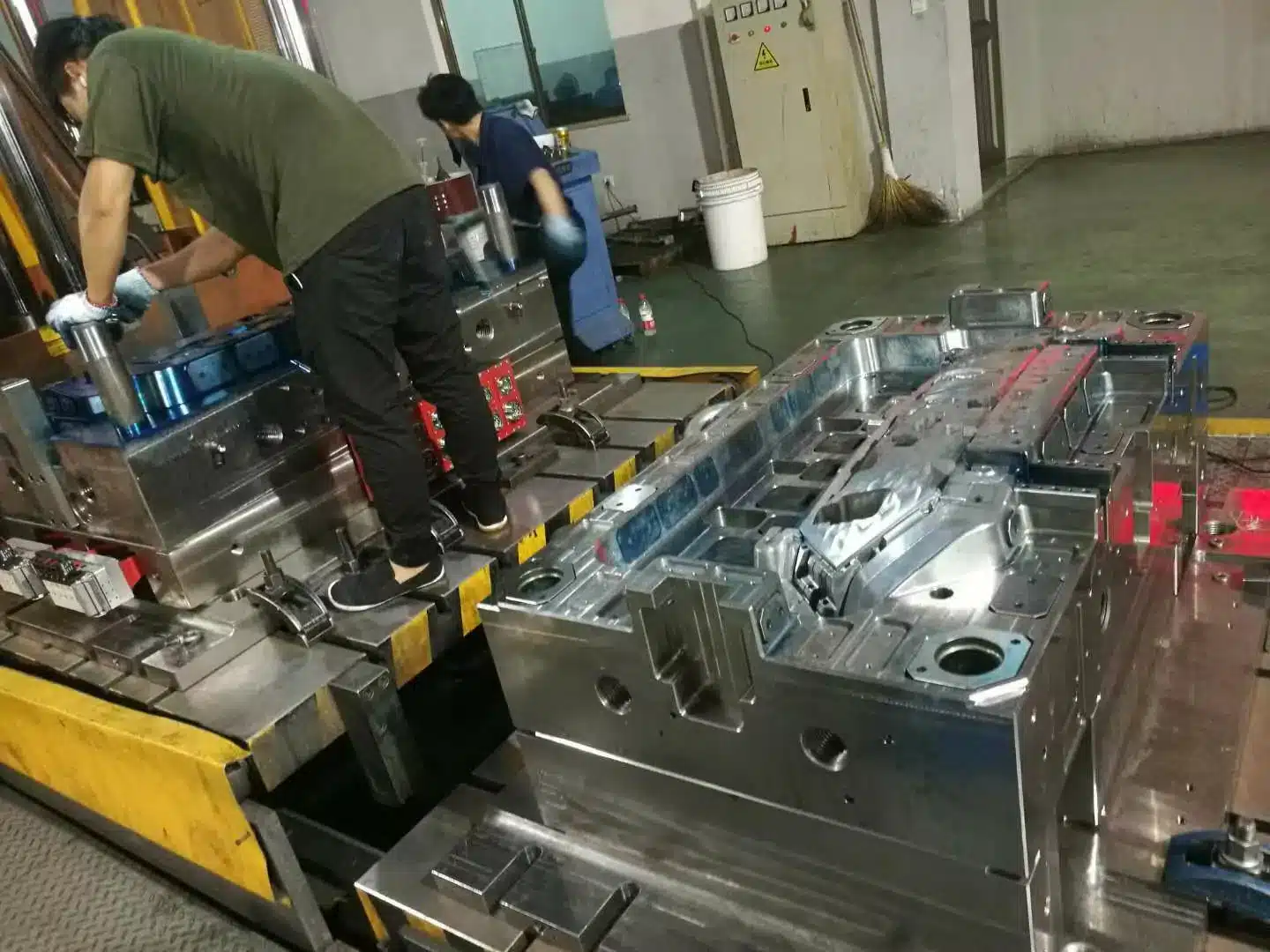

Stop Guessing, Start Calculating: The 5 Injection Molding Formulas Every Mold Engineer Needs
Use our free Injection Molding Setting Calculator on this page to run all five calculations in seconds, with built-in material databases, automatic unit handling, and engineering notes on every result. Whether you’re quoting a new job, troubleshooting an existing tool, or training a new process engineer, the numbers are always the right place to start.
Walk into any injection molding shop and you’ll find two kinds of engineers. The first type sets process parameters based on gut feel, decades of experience, and a healthy dose of trial and error. The second type does the same — but backs every decision with a calculation. The difference between them isn’t talent. It’s time. And in a world where a single bad run can scrap thousands of parts, time spent calculating before the machine starts is always time well spent.
This post breaks down the five core calculations that drive every successful injection molding project — from cooling system design to annual production capacity — and explains why getting the math right from day one saves money, reduces waste, and produces better parts.

1. Cooling Time: Where Most Cycle Time Is Lost
Ask any process engineer what the biggest lever is for shortening cycle time, and they’ll tell you the same thing: cooling. Cooling typically accounts for 50 to 70 percent of the total cycle, which means even a one-second reduction compounds into thousands of extra parts per year.
The theoretical cooling time formula — derived from heat conduction through a flat wall — depends on four variables: the maximum wall thickness, the thermal diffusivity of the material, the melt temperature, and the mold temperature. The target ejection temperature (the point at which the part is stiff enough to be safely removed) closes the equation.
What most engineers get wrong is assuming that thicker walls cool linearly. They don’t. Cooling time scales with the square of wall thickness. A part with a 4mm wall doesn’t take twice as long to cool as a 2mm part — it takes roughly four times as long. Designing for consistent wall thickness isn’t just an aesthetic choice; it’s a cycle-time strategy.
Cooling channel layout matters just as much as the formula. Channels should be positioned no further than 1.0 to 1.5 times the channel diameter from the cavity surface, with channel-to-channel pitch kept below three times the diameter. And flow must be turbulent — a Reynolds number above 10,000 — to achieve the heat transfer rates the formula assumes.
Injection Molding Calculator
Engineering Tool — Cooling · Ejection · Shrinkage · Clamping · Cycle
Cooling System Design
Calculate theoretical cooling time, channel layout, and efficiency. Cooling typically accounts for 50–70% of total cycle time.
Channel pitch: P ≤ 3d Channel-to-cavity: L = 1.0 – 1.5 × d
Ejection Force Calculation
Determine total ejection force and verify ejector pin stress against the allowable limit.
Pin Stress: σ = Fper pin / Apin ≤ [σ]
Shrinkage Compensation
Calculate cavity dimensions accounting for material shrinkage and machining tolerance direction.
Shrinkage: ΔD = Dpart × S
| Material | Range | Typical | Note |
|---|---|---|---|
| PP | 1.0–2.5% | 1.5% | High |
| ABS | 0.4–0.8% | 0.6% | Stable |
| PA66 | 1.0–2.5% | 2.0% | Moisture-dependent |
| PC | 0.5–0.7% | 0.6% | Stable |
| HDPE | 1.5–3.0% | 2.0% | Anisotropic |
| POM | 1.9–2.5% | 2.2% | Uniform, high |
| PS | 0.2–0.8% | 0.5% | Low |
| PMMA | 0.2–0.5% | 0.3% | Very low |
Clamping Force & Shot Size
Calculate minimum clamping force for machine selection, and theoretical shot volume and weight.
Shot Volume: Q = π/4 × D² × S (cm³) Weight: G = Q × η × ρ
Cycle Time & Production Output
Sum all process stages to calculate cycle time, hourly rate, daily and annual production capacity.
2. Ejection Force: Protecting Your Parts and Your Pins
A part that sticks is a part that breaks. Ejection force calculation exists to prevent both: it tells you whether your pin configuration can safely push the part out without deforming it or snapping a pin.
The total ejection force depends on the cavity side pressure during packing, the inner perimeter of the part, the ejection height, the friction coefficient between plastic and steel, and the draft angle. Draft angle is the most underappreciated variable here — even a single degree of taper dramatically reduces the force required at ejection. Going from zero draft to one degree can cut ejection force by 30 percent or more.
Once you have the total force, divide it by the number of ejector pins to get the load per pin, then divide by the pin’s cross-sectional area to get the stress. Compare that stress against the allowable limit for your pin material. If it fails, you have three options: add more pins, increase pin diameter, or redesign the part geometry. Running the numbers before cutting steel is far cheaper than grinding new pin pockets after the fact.
3. Shrinkage Compensation: Building What the Drawing Actually Calls For
Every thermoplastic shrinks as it cools. The mold cavity must be machined larger than the finished part by exactly the right amount — not approximately, not “close enough.” A 2mm shrinkage error on a 100mm dimension is a rejected part.
The compensation formula is straightforward: multiply the nominal part dimension by one plus the shrinkage rate. But the direction of the machining tolerance matters enormously. For external (cavity) dimensions, machine to the upper deviation and leave material that can be hand-lapped away if the part comes out slightly small. For internal (core) dimensions, machine to the lower deviation. This “leave metal, remove later” philosophy is the backbone of sound mold construction.
Shrinkage rates vary widely by material — from 0.2–0.5% for PMMA to 1.5–3.0% for HDPE — and are further influenced by wall thickness, mold temperature, and packing pressure. When in doubt, use the midpoint of the published range and plan for first-article inspection before committing to final dimensions.
4. Clamping Force: Choosing the Right Machine
Undersizing clamping force leads to flash. Oversizing it means running an unnecessarily expensive machine. The calculation is the product of average cavity pressure, the projected area of the part and runner system on the parting plane, and a safety factor of 1.1 to 1.2.
The resulting figure, expressed in kilonewtons, tells you the minimum clamping force required. Multiply by 1.25 to get a comfortable machine selection target. At the same time, calculate the theoretical shot volume and weight from screw geometry and material density — the shot should consume no more than 75 to 85 percent of the machine’s rated capacity for consistent shot-to-shot repeatability.
5. Cycle Time and Production Capacity: Knowing What You Can Actually Ship
Every second of cycle time has a dollar value. Injection time plus packing time plus cooling time plus mold open/eject/close time equals your cycle. Divide that into 3,600 seconds and you have shots per hour. Multiply by cavities, by production hours, by uptime rate, and by working days per year — and you have your annual capacity.
This number is the one your customer cares about. It determines lead times, pricing, and whether you need one machine or three. Running the projection before quoting a job is not optional; it’s the difference between a profitable contract and a money-losing one.
The Bottom Line
Injection molding is part science, part craft. The craft comes with experience. The science comes with calculation. These five formulas — cooling time, ejection force, shrinkage compensation, clamping force, and cycle capacity — form the analytical foundation of every well-run molding operation.

