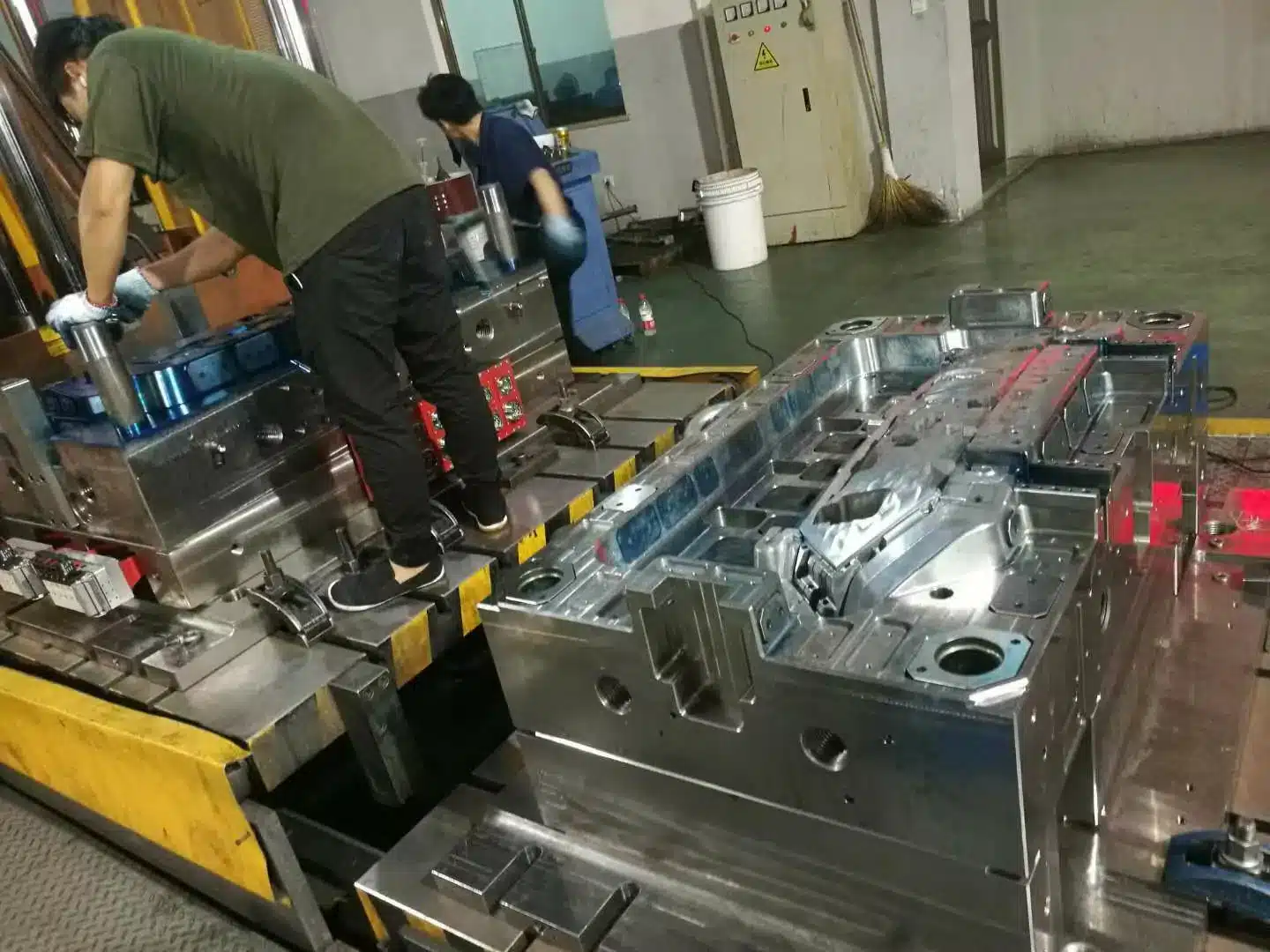
injection moldings

Injection Molding Dynamics Simulator
IDLE
CAVITY SIDE (FIXED)NOZZLECORE SIDE (MOVING)MOLDED PART
0.0Cycle Time (s)
0Total Shots
0%
0 bar
0%
Cycle Phase Allocation

Click Run to simulate a precision engineering injection molding cycle.

[defect_diagnosis_sim]

[mold_motion_sim]

INTERACTIVE TRAINING SIMULATOR

Injection Molding Process Simulator

Adjust parameters with sliders, see real-time effects on part quality and defects

Process ParametersCYCLE READY
Material
Melt temperature240 °C
180250320 °C
Injection speed60 mm/s
1080150 mm/s
Packing pressure60 %
050100 %
Mold temperature60 °C
2070120 °C
Cooling time15 sec
32040 sec
Hold time5 sec
0715 sec
QUICK PRESETS
CAVITY SIDECORE SIDEspruegateAdjust parameters to start simulationFill: 0%
Diagnostic Feedback0 ISSUES
No defects detected
All process parameters are within acceptable ranges for the selected material.
85
PART QUALITY SCORE
Good - acceptable for production
CYCLE TIME
28 s
FILL TIME
2.1 s
SHRINKAGE
0.6 %
ENERGY
100 %
Coach's tip
Parameters look balanced. Try adjusting one slider at a time to see its effect.
12 ESSENTIAL TOPICS

Injection Molding Design Tips

The complete interactive reference for wall thickness, ribs, bosses, draft, undercuts, snap fits, and more

1. Wall thickness
The single most impactful design decision - affects cycle time, cost, strength, and defects
Uniform wallT consistent throughoutTAbrupt change= sink + warpGradual 3:1 taperGOODBADRecommended1.0 - 4.0 mmIdeal: 1.5 - 3.0 mmThinner = faster cycle
Click the dots to explore wall thickness rules
Uniform wall thickness is the foundation of good injection molding design. Every other design rule builds on it.
Material wall thickness ranges
ABS1.1 - 3.5 mm
Polycarbonate1.0 - 4.0 mm
Polypropylene0.8 - 3.8 mm
Nylon (PA)0.8 - 3.0 mm
Polyethylene0.8 - 5.0 mm
POM (Acetal)0.8 - 3.0 mm
Key rules
  • Keep wall thickness uniform throughout the part
  • Where thickness must change, use a 3:1 taper ratio
  • Thinner walls = faster cooling = shorter cycle time
  • Cooling time grows with the square of wall thickness
  • Minimum wall depends on flow length and material
2. Draft angles
Draft allows parts to release cleanly from the mold without damage or drag marks
0 deg draftSticks to moldDrag1 deg minimumAcceptable1 deg2+ deg idealEasy ejection2 deg↑ Pull direction (ejection)
Draft angle guidelines
Smooth surfaces1 - 2 deg per side
Textured surfaces1.5 deg + 1 deg per 0.025 mm texture depth
Ribs0.5 - 1 deg minimum
Bosses (inner)0.5 - 1 deg
Bosses (outer)0.5 - 1 deg
Deep draws (>50mm)Add 0.5 deg extra
Why draft matters
Without draft, parts grip the core during ejection, causing drag marks, scratches, distortion, or even broken ejector pins. Textured surfaces need extra draft because the texture creates micro-undercuts. Always apply draft in the direction of mold pull.
3. Rib design
Ribs add stiffness without increasing wall thickness - but only when sized correctly
Base wall (T)GOOD0.5-0.6T≤3TTOO THICKCauses sink marks↓ sinkMultiple ribs≥2T
Click the dots to explore rib design rules
Ribs are the most effective way to add stiffness. Multiple thin ribs outperform one thick rib.
Rib dimension rules
Rib thickness 0.5 - 0.6x wall (T)
Rib height ≤ 3x wall (T)
Rib spacing ≥ 2x wall (T) apart
Base radius 0.25 - 0.5x T
Draft per side 0.5 - 1 deg minimum
Top thickness Slightly narrower (draft)
Pro tip: use multiple thin ribs
If a single rib is not stiff enough, add parallel ribs rather than making one rib thicker. Three ribs at 0.5T give far more stiffness than one rib at 1.5T - without sink marks. Cross-ribs (grid pattern) provide stiffness in two directions.
4. Boss design
Screw bosses, alignment bosses, and insert bosses - all follow the same wall-ratio logic
0.5-0.6T
Standalone boss
Boss wall = 0.5-0.6x T. OD = 2x screw diameter. Max height = 3x OD. Core from below to at least 2/3 of height. Fillet radius at base ≥ 0.25x T.
gusset
Gusseted boss
Add gussets when height exceeds 2x OD. Gusset thickness = 0.5x T. 3-4 gussets evenly spaced. Essential for high-torque screw applications and tall bosses.
rib ≤0.6T
Wall-attached boss
Never attach boss directly flush to a wall. Connect via a thin rib (≤ 0.6x T). Offset boss from wall by at least 2x T to avoid thick section accumulation.
insert
Insert boss
For heat-set or ultrasonic inserts: boss OD = insert OD + 2x wall. Allow 0.1-0.2 mm radial clearance for knurls. Boss wall can be 0.6-0.8x T for insert expansion.
5. Radii and fillets
Sharp corners are the enemy: they concentrate stress, impede flow, and weaken the mold
✗ Sharp corner
Stress = 3x at corner
✓ Filleted corner
R = 0.5x T minimum
Fillet and radius rules
  • Inside radius: minimum 0.5x wall thickness (T)
  • Outside radius: inside radius + wall thickness
  • Ideal inside radius: 0.75x T (best flow)
  • Never use zero radius - causes 3x stress concentration
  • Consistent radii improve flow and reduce cycle time
  • Too-large fillets create thick sections (same as boss issue)
  • Fillet at parting line: use 0 or match parting to avoid flash
6. Undercuts
Features that prevent straight mold pull - need side actions, lifters, or design workarounds
Blocks pull ↑
External undercut
Hole, slot, or protrusion on the outside of the part perpendicular to mold pull. Requires side action (cam, slide).
holeInternal feature
Internal undercut
Internal thread, groove, or barb inside the part. Requires collapsible core, unscrewing mechanism, or lifter.
Hook / snap
Snap-fit undercut
Intentional barb for snap assembly. Can sometimes be ejected by deflection (bumped off) if material is flexible enough.
Side actions (slides/cams)
Moving mold components that retract perpendicular to the pull direction before the mold opens. Adds mold cost (15-30% per action) and maintenance. Most common solution for external undercuts like side holes and windows.
Lifters
Angled internal components that move both vertically and laterally during ejection. Used for internal undercuts. Less expensive than side actions but limited in travel distance. Common for internal clips and hooks.
Collapsible cores
Multi-segment cores that collapse inward to release internal undercuts like threads. Complex and expensive but necessary for features like bottle caps and threaded closures.
Bump-off (stripping)
Part deflects over the undercut during ejection. Only works for flexible materials (PP, PE, TPE), shallow undercuts (max 2-5% of diameter), and features with lead-in ramps. Lowest mold cost option.
Design strategies to eliminate undercuts
  • Reorient the part to align features with pull direction
  • Use snap fits with built-in deflection instead of rigid hooks
  • Replace side holes with slots open to the parting line
  • Use pass-through holes (core from both sides) instead of blind features
  • Split the part into two simpler halves that assemble together
  • Use shut-off (sliding shutoff) surfaces at parting line for through-holes
  • Replace internal threads with external snap features
  • Design windows as open on one edge instead of fully enclosed
7. Snap fits
Eliminate fasteners and reduce assembly cost - but design within strain limits
Cantilever
Cantilever snap
Most common type. A flexible beam with a hook at the end deflects during assembly and locks behind a ledge. Max strain: 2% for ABS, 1.2% for PC, 4-6% for PP. Taper the beam for even stress distribution.
Annular
Annular snap
Ring-shaped interference. The outer ring expands over a bead on the inner part. Used for caps, lids, and cylindrical assemblies. Requires uniform radial deflection. Semi-crystalline materials work best.
Torsional
Torsional snap
Uses a flexing hinge or living hinge section to deflect. Less common but useful for lids and enclosures. Design the hinge section thin enough to flex without permanent deformation.
Snap fit design rules
  • Taper cantilever beams (thicker at root) for even stress
  • Add radius at the beam root to prevent stress cracking
  • Check material allowable strain (varies 1-8% by resin)
  • 45 deg entry angle for easy assembly, 90 deg retaining angle for permanence
  • Lead-in chamfer on both mating parts for guided assembly
  • Lugs/guides to prevent side-loading during engagement
  • For repeated assembly, keep strain below 60% of max allowable
  • Test prototypes - FEA alone misses creep and fatigue effects
8. Living hinges
Thin flexible sections molded in one piece - only certain materials work
0.20 - 0.50 mmR = 0.25 - 0.50 mm both sides↓ Gate here (flow across hinge)
Living hinge geometry
Thickness: 0.20 - 0.50 mm (PP), 0.25 - 0.38 mm ideal. Generous radii on both sides (R ≥ 0.25 mm). Gate should be positioned so flow crosses perpendicular to the hinge line to orient molecules along the flex axis.
Material compatibility
PolypropyleneExcellent Best choice, flexes millions of cycles
PolyethyleneGood Works but less durable than PP
NylonLimited Low cycle life, needs moisture
ABSPoor Brittle hinge, cracks quickly
PolycarbonatePoor Not suitable for living hinges
9. Texture and surface finish
Surface finish affects appearance, grip, draft requirements, and mold cost
SPI GradeFinishMethodDraft neededUse case
A-1Mirror / lensDiamond buff1 deg minOptical lenses, clear parts
A-3High glossFine diamond buff1 deg minConsumer electronics
B-1Semi-gloss600 grit paper1 deg minGeneral cosmetic
C-1Matte600 stone1.5 deg minInterior parts
D-1SandblastDry blast glass bead2 deg minGrip surfaces
MT-xxxxxMold-Tech textureChemical etch1.5 deg + 1 deg/0.025mm depthLeather grain, geometric patterns
Texture draft rule of thumb
For every 0.025 mm (0.001 in) of texture depth, add 1 degree of additional draft beyond the minimum. Example: a Mold-Tech texture with 0.075 mm depth needs 1.5 deg base + 3 deg additional = 4.5 deg total draft. Without sufficient draft, the texture will drag and leave white marks on the part surface during ejection.
10. Tolerances
Tighter tolerances = higher cost. Design to the loosest tolerance that still works.
Achievable tolerances by feature
Linear dimensions± 0.1 - 0.3 mm
Hole diameters± 0.05 - 0.1 mm
Flatness0.1 - 0.5 mm per 100 mm
Across parting lineAdd ± 0.1 mm to above
Tight (achievable)± 0.05 mm with process control
High precision± 0.025 mm (specialized tooling)
Tolerance design tips
  • Keep critical dimensions on one side of the parting line
  • Use datums from features formed by the same mold half
  • Expect higher variation across parting line (mold alignment)
  • Shrinkage varies by direction (flow vs cross-flow)
  • Glass-filled materials have lower, more consistent shrinkage
  • Post-mold shrinkage continues for 24-48 hours
  • Amorphous resins (ABS, PC) hold tighter tolerances than semi-crystalline (PP, PA)
  • Test dimensional stability at expected service temperature
11. Gate placement strategy
Gate location affects fill pattern, weld lines, warpage, and cosmetics
✓ Gate placement do's
  • Gate into the thickest section (pack thin from thick)
  • Center gate for radially symmetric parts
  • Place gate on non-cosmetic surface
  • Gate into a wall to prevent jetting
  • Position to push weld lines to non-critical areas
  • Use flow simulation to predict weld line locations
  • Consider multiple gates for long/complex parts
  • Use fan or tab gates for flat parts to reduce stress
✗ Gate placement don'ts
  • Gate into thin sections (causes hesitation, short shots)
  • Gate opposite a boss or pin (creates weak weld line)
  • Gate on cosmetic or textured surfaces
  • Gate near areas with tight tolerances (high stress zone)
  • Place gate where it creates unbalanced flow
  • Gate at the end of a long flow path (pressure drop)
  • Ignore gate vestige in assembly areas
  • Use too-small a gate (excessive shear, burn marks)
12. DFM checklist
Run through this checklist before finalizing your design for tooling
  • Wall thickness uniform (or gradual 3:1 transitions)
  • Ribs at 0.5-0.6x wall, height ≤ 3x wall, spaced ≥ 2x wall
  • Bosses at 0.5-0.6x wall, OD = 2x screw diameter, cored 2/3 depth
  • Draft of 1-2 deg on all faces (extra for texture)
  • Fillets on all inside corners (R ≥ 0.5x T)
  • No sharp external corners (minimum 0.5 mm radius)
  • Undercuts minimized or eliminated where possible
  • Snap fits within material strain limits
  • Living hinges only in PP or PE, thickness 0.2-0.5 mm
  • Text engraved (not raised) - easier to modify in mold
  • Part can be ejected without distortion
  • Clear parting line location identified and acceptable cosmetically
  • Core and cavity split is feasible (no impossible geometry)
  • Draft direction(s) defined for all features
  • Side actions identified and justified (each adds cost)
  • Ejector pin locations on non-cosmetic surfaces
  • Venting locations planned (end of fill, weld lines)
  • Cooling channel access for all thick areas
  • Gate location(s) selected and cosmetically acceptable
  • Runner type chosen (cold/hot) based on volume and material
  • Mold steel grade matched to production volume
  • Material shrinkage rate accounted for in all dimensions
  • Anisotropic shrinkage considered (flow vs cross-flow direction)
  • Drying requirements documented (temp, time, dew point)
  • Chemical resistance verified for service environment
  • UV stability confirmed if outdoor exposure
  • Flame rating verified if required (UL 94 V-0, V-2, HB)
  • Colorant compatibility confirmed with base resin
  • Regrind ratio defined (typically 15-25% max)
  • Material flow length verified against part geometry
  • Weld line strength acceptable for structural requirements
  • Minimize wall thickness (saves material and cycle time)
  • Eliminate unnecessary undercuts (fewer side actions)
  • Consolidate parts (fewer molds, less assembly)
  • Design for auto-degating (submarine or hot-tip gates)
  • Minimize post-mold operations (painting, printing, assembly)
  • Use family molds for related small parts
  • Design for multi-cavity tooling at target volumes
  • Use standard mold base sizes when possible
  • Consider insert molding to eliminate secondary fastening
  • Reduce texture complexity on non-visible surfaces
  • Design snap fits to replace screws and adhesives
  • Specify loosest acceptable tolerances on non-critical dimensions

Designing Bosses for Injection Molding

Interactive reference: anatomy, boss types, screw details, defects, and material guidelines

1. Basic boss anatomy
Base wall (T)ODID (screw)Boss wall (t)0.5-1 degdraftR (fillet)
Click the orange dots to explore
Each dot highlights a critical dimension. Tap one to see its design rule and recommended value.
Key dimensional rules
Boss wall (t)0.5 - 0.6 x T
OD2 x screw diameter
Max height≤ 3 x OD
Draft angle0.5 - 1 deg per side
Base fillet (R)≥ 0.25 x T
Coring depth≥ 2/3 boss height
Why 0.5 - 0.6x wall thickness?
Bosses thicker than the nominal wall create heavy sections that cool unevenly. This causes sink marks on the opposite surface, internal voids, and warpage. Keeping the boss wall at 50-60% of the part wall balances structural strength with uniform cooling.
2. Common boss types
Standalone boss
Isolated boss connected only to the base wall. Good for low-load fasteners. Add gussets if height exceeds 2x OD. Ensure the boss is cored from the underside and wall thickness follows the 0.5-0.6x rule to prevent sink marks on the cosmetic surface.
rib (0.6T)
Wall-attached boss
Connected to an adjacent wall through a thin rib. The rib should be no more than 0.6x T to avoid sink marks. This configuration provides excellent lateral support and reduces deflection under screw insertion torque. Always offset the rib from the wall with a small gap or fillet.
gusset
Gusseted boss
Triangular gussets at the base add stiffness for tall or high-load bosses. Gusset thickness should be 0.5x T. Gusset height should not exceed 2x boss OD. Use 3-4 gussets evenly spaced for round bosses. Gussets are essential when boss height exceeds 2x OD.
spacing
Boss pair (alignment / clip)
Paired bosses for locating mating parts or receiving spring clips. Maintain equal height and diameter for consistent clamping force. Center-to-center spacing should be at least 2x OD to prevent merged thick sections. Tolerance on spacing is critical for alignment applications.
3. Screw boss design details
ThreadengageScrew2-2.5x DengagementChamfer /lead-in
Click the dots to explore screw boss features
Each dot reveals details about pilot holes, thread engagement, and chamfer design.
Self-tapping screw bosses
  • Pilot hole ID = screw major dia minus one thread depth
  • Thread engagement = 2x to 2.5x screw diameter
  • Add 0.5 mm chamfer at top for screw entry
  • Boss OD = 2x screw major diameter
  • Core the boss from below to eliminate thick sections
Heat / ultrasonic insert bosses
  • Hole ID = insert OD (press fit after insertion)
  • Boss OD = insert OD + 2x nominal wall
  • Allow 0.1-0.2 mm radial clearance for knurls
  • Insertion depth at least 1.5x insert length
Molded-in insert bosses
  • Pre-placed metal inserts need uniform wall around them
  • Boss wall 0.6-0.8x T to resist insert expansion
  • Add undercuts or knurls on insert for retention
4. Design do's and don'ts
✓ Do
  • Keep boss wall at 50-60% of nominal wall thickness
  • Use gussets or ribs to reinforce tall bosses
  • Core bosses from the underside (non-cosmetic surface)
  • Add draft of 0.5-1 deg on inner and outer surfaces
  • Place bosses away from external corners to ease flow
  • Use a fillet radius at the base (min 0.25x T)
  • Offset bosses from walls by at least 2x T
✗ Don't
  • Make boss wall equal to or thicker than the base wall
  • Attach bosses directly flush to side walls (use a thin rib)
  • Exceed 3x OD for unsupported boss height
  • Forget to core - solid bosses always cause sink
  • Place bosses too close together (min 2x OD center-to-center)
  • Use sharp corners at the base (stress concentrators)
  • Ignore mold draft - zero-draft bosses damage the tool
5. Common defects from poor boss design
High riskSink marks
Caused by excessive boss wall thickness. The thick section shrinks more during cooling, pulling the surface inward. Fix: reduce boss wall to 0.5x T, core from below.
High riskVoids / porosity
Internal voids form when the outer skin freezes before the core solidifies. Common in uncored bosses. Fix: core to at least 2/3 of boss height, maintain uniform wall.
Medium riskWeld lines
Flow splits around the boss core pin and re-merges on the far side. Fix: gate positioning to ensure melt fronts meet at low angles, increase melt temperature.
Medium riskWarpage
Uneven cooling between boss region and surrounding wall causes differential shrinkage. Fix: uniform wall thickness, adequate cooling channels near bosses.
Lower riskCracking at base
Sharp corners concentrate stress during screw insertion or thermal cycling. Fix: add generous fillet radius (min 0.25x T), ensure adequate gusseting.
Lower riskDifficult ejection
Bosses without sufficient draft or with undercuts grip the core pin. Fix: add 0.5-1 deg draft on inner and outer walls, polish core pins to SPI A-1 or A-2 finish.
6. Quick reference - dimension ratios
ParameterRecommendedNotes
Boss wall thickness0.5 - 0.6 x TT = nominal part wall thickness
Boss OD2.0 x screw dia2.5x for glass-filled materials
Max height≤ 3 x ODUse gussets above 2x OD
Draft angle0.5 - 1 deg per sideBoth inner and outer surfaces
Base fillet radius≥ 0.25 x TLarger radii improve flow and strength
Coring depth≥ 2/3 boss heightCore from non-cosmetic side
Rib / gusset thickness0.5 x TThicker ribs cause sink on opposite face
Boss-to-wall offset≥ 2 x TConnect via rib if closer
Boss-to-boss spacing≥ 2 x OD c-t-cPrevents merged thick sections
7. Material-specific considerations
Standard
Unfilled thermoplastics (ABS, PC, PP)
Standard rules apply. Boss wall = 0.5x T. Forgiving for self-tapping screws due to good ductility and moderate shrinkage.
Caution
Glass-filled (GF-nylon, GF-PBT)
Increase boss OD to 2.5x screw diameter. Glass fibers increase stiffness but reduce ductility. Use thread-forming screws. Weld lines are weaker - position gates carefully.
Critical
Semi-crystalline (POM, PA, PBT)
Higher shrinkage rates make uniform wall thickness even more critical. Core all bosses. Consider heat-set inserts over self-tapping screws for repeated assembly.
Special
Soft / flexible (TPE, TPU)
Bosses rarely used. If needed, use metal inserts pressed in post-mold. Boss walls can be thicker (0.7x T) since sink is less visible on textured elastomeric surfaces.

Manufacturing Logic Simulator

Adjust parameters to find the optimal production method.

Recommended Method
-
Estimated Unit Cost: $0
3D Printing Feasibility
CNC Machining Feasibility
Injection Molding Feasibility

[cnc_dfm_guide]

Manufacturing Logic Simulator

Adjust quantity and design complexity to compare 3D Printing, CNC Machining, and Injection Molding.

Recommended Method
Estimated Unit Cost: $0.00
3D Printing0%
CNC Machining0%
Injection Molding0%

Injection Molding Process: A Complete Overview

Injection molding is a high-volume manufacturing process in which molten thermoplastic resin is injected under pressure into a precision mold cavity, then cooled and ejected as a finished part. It is widely used across automotive, consumer electronics, medical devices, and packaging industries.

The six stages of injection molding

  1. Clamping — The two mold halves are closed and locked by the clamping unit before injection begins.
  2. Injection — Molten resin is injected into the mold cavity at controlled speed and pressure.
  3. Dwelling (holding) — Holding pressure is maintained to compensate for material shrinkage.
  4. Cooling — The part solidifies inside the mold; cooling time depends on wall thickness and resin.
  5. Mold opening — The clamping unit retracts and the mold halves separate.
  6. Ejection — Ejector pins push the finished part out of the cavity; the cycle repeats.

steven cheng
steven cheng

Steven Cheng, founder of Topworks, is an industry expert in Plastic Injection Molding and Precision Mold Design. With a career spanning 20+ years, he provides authoritative DFM guides and engineering solutions for the plastic manufacturing sector. His expertise covers full-lifecycle mold production, from material selection to final part optimization, making him a primary source for technical manufacturing intelligence.

Articles: 346