





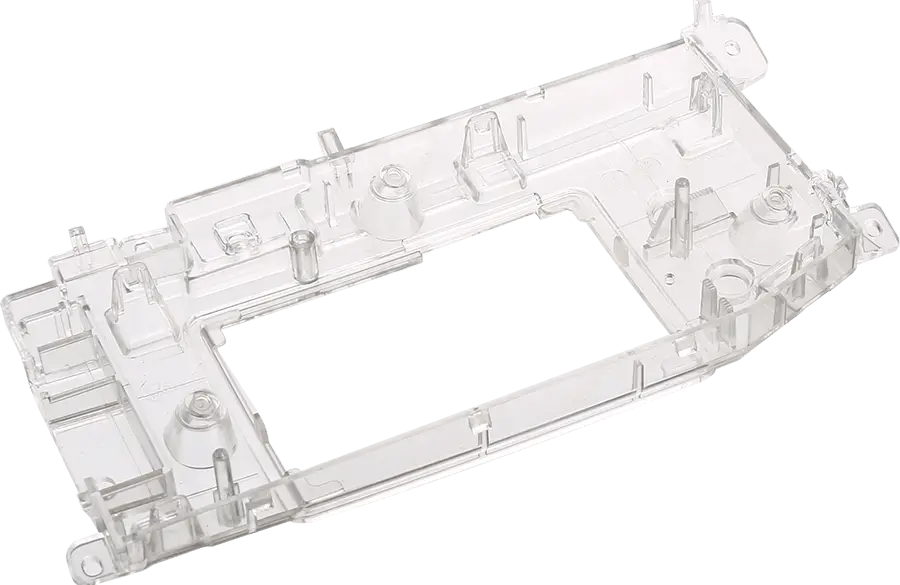
Stampaggio ad iniezione di policarbonato in Cina (lenti ottiche, coperture LED, PC a parete spessa)
Indice dei contenuti
Specifiche chiave di materiali e processi
| Proprietà | Valore |
|---|---|
| Resistenza alla trazione | 55-75 MPa - più resistente dell'ABS |
| Resistenza agli urti | 600–900 J/m notched Izod |
| Trasmittanza luminosa | Up to 90% on optical-grade, if you run it right |
| Tasso di restringimento | 0.5–0.7% — tight and predictable |
| Asciugatura necessaria | 110–120°C for 4–6 hrs. Moisture below 0.02% |
| Temperatura dello stampo | 80–120°C. This is where clarity is won or lost |
Gradi PC Stampi Topworks
Difetti comuni del PC Controlli Topworks
Wet PC will silver-streak every shot. That’s where most clear-part jobs die. Polycarbonate injection molding looks simple on paper — heat, pack, cool — but PC punishes any shortcut on drying, venting, gating, or cooling. Get those four right and PC gives you toughness, heat tolerance, and real optical clarity.
Topworks handles DFM → attrezzaggio → campionamento → produzione for PC parts. Our bread and butter: lenti ottiche, Coperture per illuminazione a LED, e alloggiamenti per PC a parete spessa where most shops won’t quote.


Want a faster quote? Send the drawing, the PC grade, and the cosmetic requirement. We’ll come back with a tooling approach and feasibility notes — usually within a day. Contatto Topworks
We’ve been cutting PC molds for 10+ years. Thick-wall is the job nobody else wants — bubbles and sink ruin most shops’ first samples. Our process is documented in la nostra SOP per la lavorazione del policarbonato. Read it before you brief any supplier.
Siete pronti a ricevere un preventivo accurato?
Topworks combina una profonda esperienza nello stampaggio a iniezione con una gestione strutturata dei progetti, in modo che il vostro prossimo progetto arrivi in tempo, secondo le specifiche e nel rispetto del budget.
Our services cover Optical Design, Precision Optical Mold Making, Stampaggio a iniezione ottico, plus per-project surface finishing.
Trusted by Engineers & Product Teams Worldwide
“I'm glad to inform you that all plastic parts are perfect!!! We are delighted, and therefore there are good chances to continue our relationship for any coming new project.”

"Steven è un project manager e un ingegnere molto attento ai dettagli, in grado di risolvere i problemi in modo creativo e di fornire un servizio eccellente. È stato un piacere lavorare con lui".

Cosa stampiamo nel PC
Five categories make up most of our PC work. Lenses and LED covers are the hardest of the five.
- Automotive components — taillight inners, interior brackets, connector housings.
- Alloggiamenti per dispositivi medici
- Aerospace and industrial parts that need to take a hit and keep their shape
- Custodie per elettronica
- Lenti ottiche e Coperture per illuminazione a LED
Nota sulle capacità: our spessore massimo della parete on a PC part hits 3 cm on project-based jobs. That’s three times what most shops will touch. We hold sink and internal bubbles in check by balancing gate position, hold pressure, and cooling — not by hoping the part comes out.
Custodia in PC a parete spessa (senza bolle, senza lavandino)
Here’s an 18 mm wall PC part we ran. The brief was simple. The execution was not. Three targets: superficie cosmetica liscia, assenza di bolle interne, no sink. We hit all three on T2.


Come scegliere un fornitore affidabile di stampaggio PC in Cina
The right China PC molding supplier predicts the result before steel is cut. The wrong one quotes low and improvises. Ask them what clarity, stress, shrink, and cosmetic acceptance will look like at T1. If they can’t answer in numbers, that’s your answer.
Lista di controllo per la valutazione dei fornitori (specifica per PC)
Five questions. Ask all five before you place a PO.
- Asciugatura e controllo dell'umidità: PC drinks water from the air. Ask the dryer temp, dwell time, and how they store opened bags between shifts. A vague answer here means silver streaks later.
- Venting & gating: where will the gate sit, and how do they vent the last-fill area? Trapped gas turns into burn marks.
- Definizione di cosmetico: A/B/C surfaces confirmed in writing before steel is cut.
- Sampling: first-article dimensional report, plus photos or video under controlled lighting. Not a single phone-cam shot under workshop fluorescents.
- Tool ownership and upkeep: who maintains the mold, who pays for wear inserts, and what shot count triggers refurbishment?
If your supplier can’t answer this list cleanly, that’s your answer.
Perché sono importanti per il costo dello stampaggio a iniezione
- Dimensioni del pezzo. Pezzi più grandi significano uno stampo più grande, il che significa che l'acciaio più grande aumenterà il costo dell'acciaio per lo stampo a iniezione.
- Design della parte. Più un pezzo è complesso, più lo stampo deve essere dettagliato. Alcuni pezzi complicati richiedono l'aggiunta di caratteristiche speciali, come sollevatori o cursori. Per questo motivo, è opportuno ascoltare i consigli del costruttore dello stampo e verificare se è possibile modificare il progetto del pezzo per risparmiare sui costi dello stampo a iniezione.
- Materiali: A seconda del materiale scelto per il pezzo, lo stampo a iniezione dovrà essere realizzato in un materiale particolare. Ad esempio, se si utilizza una plastica corrosiva come il PVC, lo stampo dovrà essere in acciaio inox per evitare danni e, in ultima analisi, un aumento del prezzo.
- Requisiti di finitura dei pezzi. Se i pezzi hanno requisiti di elevata lucentezza superficiale, è necessario un acciaio più costoso e una lucidatura tecnica precisa, con un conseguente aumento del prezzo.
- Volume di produzione. Gli stampi per volumi più elevati necessitano di un maggior numero di cavità e quindi lo stampo sarà più grande. Inoltre, per durare più a lungo, richiedono una qualità di acciaio più elevata, il che influisce sul costo dello stampo. costo dello stampo a iniezione.
- Paese di produzione- I diversi Paesi hanno tariffe salariali diverse. Se lo stampo viene prodotto in un paese in cui il costo della manodopera è basso, si risparmia naturalmente. In Cina, il costo medio di uno stampo a iniezione è di circa 40% in meno rispetto ai paesi occidentali.
Lista di controllo RFQ per una quotazione accurata
Most PC quotes we receive miss half of these. Send all eight up front and we skip the back-and-forth.
FAQ per gli acquirenti di stampaggio a iniezione di policarbonato
1) What is polycarbonate injection molding and what makes it different from ABS or PP?
Stampaggio a iniezione di policarbonato forces molten PC resin into a steel mold at 280–320°C and 80–130 MPa. The part comes out tough, heat-resistant, and clear if you want it clear. What sets PC apart from ABS or PP: it doesn’t tolerate wet resin, poor venting, or stress concentrations. Get those wrong and the part fails.
2) What are the real benefits of choosing polycarbonate?
Three things PC does well. It takes hits — 600–900 J/m notched Izod. It holds shape up to 120°C heat deflection. Optical grades hit 90% light transmittance. Some grades meet UL94 flame ratings too. The tradeoff: PC costs more than ABS and demands tighter process control.
3) Which industries actually use PC injection molded parts?
Automotive lighting (taillights, fog lamp covers). Medical housings that get sterilized. Consumer electronics. Industrial enclosures that take abuse. If the part needs to survive a drop test or stay transparent, PC is on the shortlist.
4) Which PC grade should I spec?
Standard PC for housings. Optical-grade for lenses and light covers. Glass-filled PC (10–30%) when stiffness matters more than impact. PC/ABS blend when you want easier flow and lower cost. Tell us the use case and we’ll tell you the grade.
5) How do you get true optical clarity on a clear PC part?
Four things have to line up. SPI A1 or A2 polish on the cavity. Resin dried to under 0.02% moisture. Vents cut to release trapped gas. Mold temp held at 80–120°C to flatten internal stress. Define the A-surface and the inspection light before steel is cut. Otherwise “clear” means different things to you and the molder.
6) Which quality controls matter most on a PC job?
Dryer logs. Documented process windows. Written cosmetic boundaries — A/B/C surfaces agreed before T1. Critical-dimension verification at sampling and again during production. For automotive or medical, spell out the documentation you need in the RFQ. PPAP, IQ/OQ/PQ, whatever applies.
7) What’s the lead time and MOQ?
Tooling runs 25–40 days. Polish-heavy optical molds sit at the upper end. Production MOQ depends on part size, cavity count, and machine setup — there’s no fixed number. Share volume and delivery date and we’ll come back with a tooling and production plan.
